


The Atherogenic Role of Circulating Modified Lipids in Atherosclerosis
- PMID: 31330845
- PMCID: PMC6678182
- DOI: 10.3390/ijms20143561
The Atherogenic Role of Circulating Modified Lipids in Atherosclerosis
Abstract
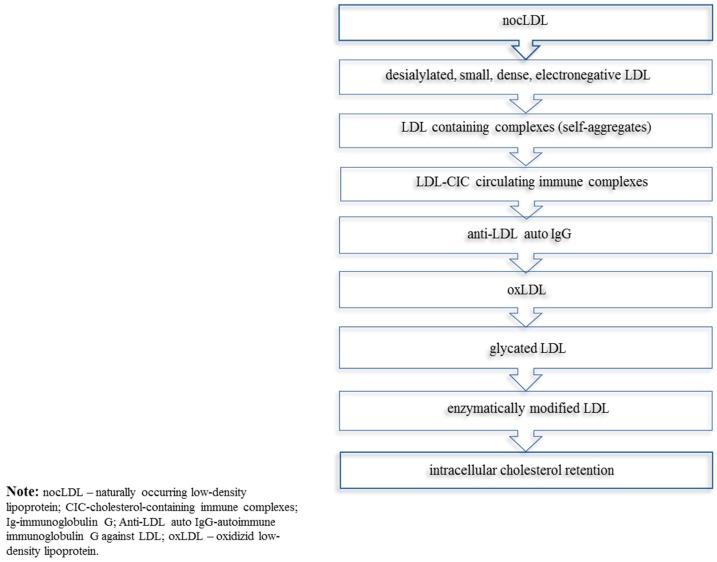
Lipid accumulation in the arterial wall is a crucial event in the development of atherosclerotic lesions. Circulating low-density lipoprotein (LDL) is the major source of lipids that accumulate in the atherosclerotic plaques. It was discovered that not all LDL is atherogenic. In the blood plasma of atherosclerotic patients, LDL particles are the subject of multiple enzymatic and non-enzymatic modifications that determine their atherogenicity. Desialylation is the primary and the most important atherogenic LDL modification followed by a cascade of other modifications that also increase blood atherogenicity. The enzyme trans-sialidase is responsible for the desialylation of LDL, therefore, its activity plays an important role in atherosclerosis development. Moreover, circulating modified LDL is associated with immune complexes that also have a strong atherogenic potential. Moreover, it was shown that antibodies to modified LDL are also atherogenic. The properties of modified LDL were described, and the strong evidence indicating that it is capable of inducing intracellular accumulation of lipids was presented. The accumulated evidence indicated that the molecular properties of modified LDL, including LDL-containing immune complexes can serve as the prognostic/diagnostic biomarkers and molecular targets for the development of anti-atherosclerotic drugs.
Keywords: LDL-CIC; atherosclerosis; desialylation; modified low-density lipoprotein; trans-sialidase.
Conflict of interest statement
The authors declare no conflict of interest.
Figures
References
-
- World Health Organization . World Heart Day 2017. WHO; Geneva, Switzerland: 2017.
-
- Bloom D.E., Cafiero E.T., Jané-Llopis E., Abrahams-Gessel S., Bloom L.R., Fathima S., Feigl A.B., Gaziano T., Mowafi M., Pandya A., et al. The Global Economic Burden of Noncommunicable Disease. World Economic Forum; Geneva, Switzerland: 2011.
-
- Board J.B.S. Joint British Societies’ consensus recommendations for the prevention of cardiovascular disease (JBS3) Heart. 2014;100:ii1–ii67. - PubMed
-
- Kaplan H., Thompson R.C., Trumble B.C., Wann L.S., Allam A.H., Beheim B., Frohlich B., Sutherland M.L., Sutherland J.D., Stieglitz J., et al. Coronary atherosclerosis in indigenous South American Tsimane: A cross-sectional cohort study. Lancet. 2017;389:1730–1739. doi: 10.1016/S0140-6736(17)30752-3. - DOI - PMC - PubMed
Publication types
MeSH terms
Substances
Grants and funding
LinkOut - more resources
Full Text Sources
Medical
Miscellaneous
