Review
. 2019 Jul 19;24(14):2631.
doi: 10.3390/molecules24142631.

Terpene Derivatives as a Potential Agent against Antimicrobial Resistance (AMR) Pathogens

Affiliations
Review

Terpene Derivatives as a Potential Agent against Antimicrobial Resistance (AMR) Pathogens

Nik Amirah Mahizan et al. Molecules. .

Abstract

The evolution of antimicrobial resistance (AMR) in pathogens has prompted extensive research to find alternative therapeutics. Plants rich with natural secondary metabolites are one of the go-to reservoirs for discovery of potential resources to alleviate this problem. Terpenes and their derivatives comprising of hydrocarbons, are usually found in essential oils (EOs). They have been reported to have potent antimicrobial activity, exhibiting bacteriostatic and bactericidal effects against tested pathogens. This brief review discusses the activity of terpenes and derivatives against pathogenic bacteria, describing the potential of the activity against AMR followed by the possible mechanism exerted by each terpene class. Finally, ongoing research and possible improvisation to the usage of terpenes and terpenoids in therapeutic practice against AMR are discussed.

Keywords: antimicrobial resistance; synergy; terpenes; terpenoids.


Conflict of interest statement

All authors declare no conflicts of interest.

Figures
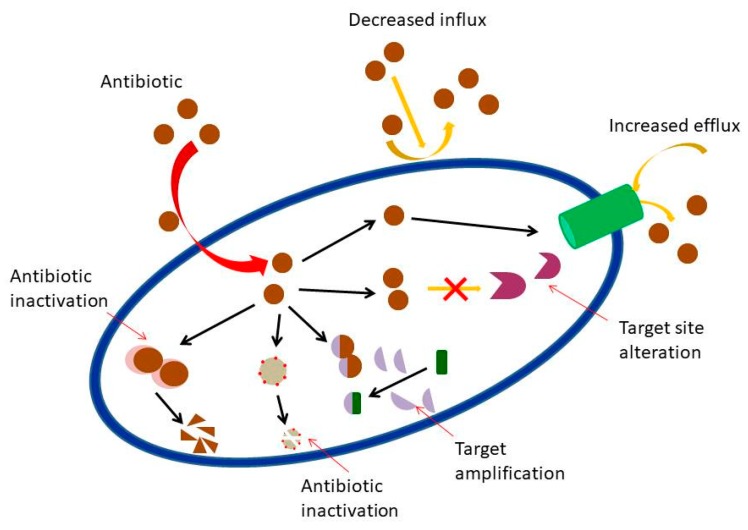
Figure 1
Figure 1
Overall mechanisms of antibiotic resistance in bacteria. Picture adapted from [17].
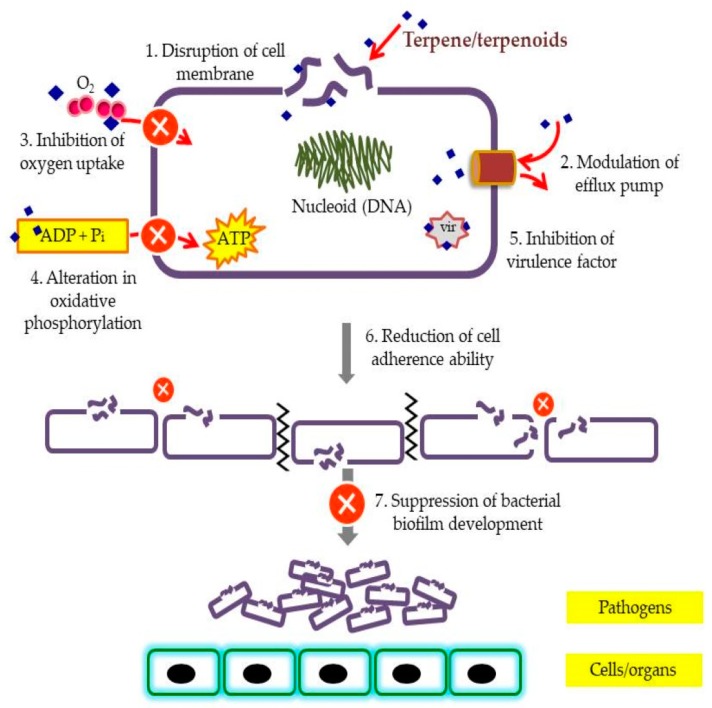
Figure 2
Figure 2
Postulated mode of action of terpene/terpenoids on antibiotic resistance pathogens and as combination therapies.

References

    1. Mandal S.M., Roy A., Ghosh A.K., Hazra T.K., Basak A., Franco O.L. Challenges and future prospects of antibiotic therapy: From peptides to phages utilization. Front. Pharmacol. 2014;5:105. doi: 10.3389/fphar.2014.00105. - DOI - PMC - PubMed
    1. Barbieri R., Coppo E., Marchese A., Daglia M., Sobarzo-Sánchez E., Nabavi S.F. Phytochemicals for human disease: An update on plant-derived compounds antibacterial activity. Microbiol. Res. 2017;196:44–68. doi: 10.1016/j.micres.2016.12.003. - DOI - PubMed
    1. Blair J.M., Webber M.A., Baylay A.J., Ogbolu D.O., Piddock L.J. Molecular mechanisms of antibiotic resistance. Nat. Rev. Microbiol. 2015;1:42. doi: 10.1038/nrmicro3380. - DOI - PubMed
    1. Zacchino S.A., Butassi E., Cordisco E., Svetaz L.A. Hybrid combinations containing natural products and antimicrobial drugs that interfere with bacterial and fungal biofilms. Phytomedicine. 2017;37:14–26. doi: 10.1016/j.phymed.2017.10.021. - DOI - PubMed
    1. Rajagopal M., Martin M.J., Santiago M., Lee W., Kos V.N., Meredith T., Gilmore M.S., Walker S. Multidrug intrinsic resistance factors in Staphylococcus aureus identified by profiling fitness within high-diversity transposon libraries. MBio. 2016;7:4. doi: 10.1128/mBio.00950-16. - DOI - PMC - PubMed

MeSH terms