


Clinical burden of illness in patients with phenylketonuria (PKU) and associated comorbidities - a retrospective study of German health insurance claims data
- PMID: 31331350
- PMCID: PMC6647060
- DOI: 10.1186/s13023-019-1153-y
Clinical burden of illness in patients with phenylketonuria (PKU) and associated comorbidities - a retrospective study of German health insurance claims data
Abstract
Background: Phenylketonuria (PKU) is an inherited deficiency in the enzyme phenylalanine hydroxylase (PAH), which, when poorly-managed, is associated with clinical features including deficient growth, microcephaly, seizures, and intellectual impairment. The management of PKU should start as soon as possible after diagnosis to prevent irreversible damage and be maintained throughout life. The aim of this study was to assess the burden of illness in PKU patients in general and in PKU patients born before and after the introduction of newborn screening in Germany.
Methods: This retrospective matched cohort analysis used the Institut für angewandte Gesundheitsforschung Berlin (InGef) research database containing anonymized healthcare claims of approximately 4 million covered lives. PKU patients were compared with matched controls from the general population within the same database (1:10 ratio via direct, exact matching on age and gender without replacement). PKU patients were included if they were aged ≥18 years on 01/01/15 and were continuously enrolled from 01/01/10 to 31/12/15. The 50 most commonly reported comorbidities and 50 most commonly prescribed medications in the PKU population were analyzed. Differences between groups were tested using 95% confidence interval (CI) of prevalence ratio (PR) values.
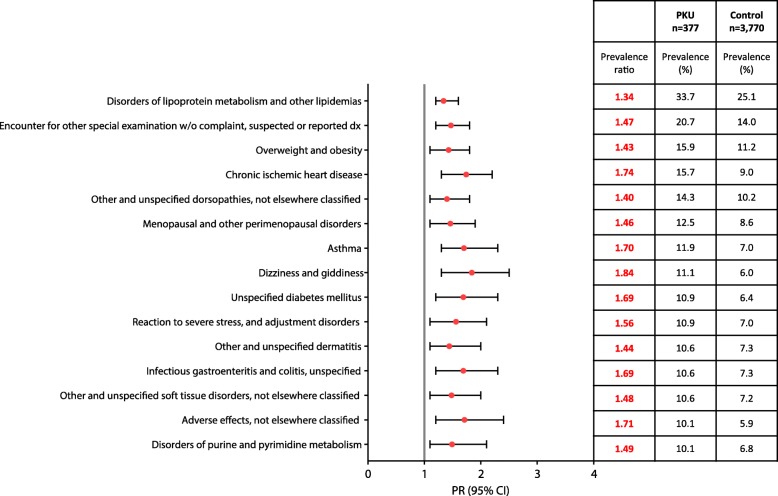
Results: The analysis included 377 adult PKU patients (< 5 of which were receiving sapropterin dihydrochloride) and 3,770 matched controls. Of the 50 most common comorbidities in the PKU population, those with a statistically significant PR > 1.5 vs controls included major depressive disorders (PR = 2.3), chronic ischemic heart disease (PR = 1.7), asthma (PR = 1.7), dizziness and giddiness (PR = 1.8), unspecified diabetes mellitus (PR = 1.7), infectious gastroenteritis and colitis (PR = 1.7), and reaction to severe stress and adjustment disorders (PR = 1.6). The most commonly prescribed Anatomical Therapeutic Chemical (ATC) subcodes among PKU patients (vs the control population) are for systemic antibacterials (34.7% vs 32.8%), anti-inflammatory and antirheumatic (29.4% vs 27.5%), renin-angiotensin agents (30.0% vs 27.0%), acid-related disorders (29.4% vs 20.2%), and beta-blockers (24.9% vs 19.9%).
Conclusion: The overall clinical burden on patients with PKU is exacerbated by a significantly higher risk of numerous comorbidities and hence, prescribing of the requisite medication, both for recognized (e.g. major depressive disorders) and more unexpected comorbidities (e.g. ischemic heart disease).
Keywords: Burden of disease; Burden of illness; Claims data; Hyperphenylalaninemia; Phenylketonuria; Statutory health insurance.
Conflict of interest statement
IA, MJ, AJ, PL, and CS are full-time employees and stockholders of BioMarin Europe Ltd. KK, JA, CJ, and SB are full-time employees of Xcenda, acting as contractors of BioMarin Europe Ltd. for the execution of this study. FT received honoraria for presentations from BioMarin. AM has been a member of scientific advisory boards supported by BioMarin Europe Ltd. and has received honoraria as a speaker for BioMarin Europe Ltd. FR has received speaker and consulting honoraria from BioMarin Europe Ltd.
Figures
References
-
- Phenylalanine hydroxylase gene locus-specific database [Internet]. Accessed June 12, 2018. Available from: http://www.biopku.org/home/pah.asp.
Publication types
MeSH terms
LinkOut - more resources
Full Text Sources
Medical
Research Materials
