


Officer characteristics and racial disparities in fatal officer-involved shootings
- PMID: 31332014
- PMCID: PMC6689929
- DOI: 10.1073/pnas.1903856116
Officer characteristics and racial disparities in fatal officer-involved shootings
Erratum in
-
Correction for Johnson et al., Officer characteristics and racial disparities in fatal officer-involved shootings.Proc Natl Acad Sci U S A. 2020 Apr 21;117(16):9127. doi: 10.1073/pnas.2004734117. Epub 2020 Apr 13. Proc Natl Acad Sci U S A. 2020. PMID: 32284413 Free PMC article. No abstract available.
Retraction in
-
Retraction for Johnson et al., Officer characteristics and racial disparities in fatal officer-involved shootings.Proc Natl Acad Sci U S A. 2020 Jul 28;117(30):18130. doi: 10.1073/pnas.2014148117. Epub 2020 Jul 10. Proc Natl Acad Sci U S A. 2020. PMID: 32651282 Free PMC article. No abstract available.
Abstract
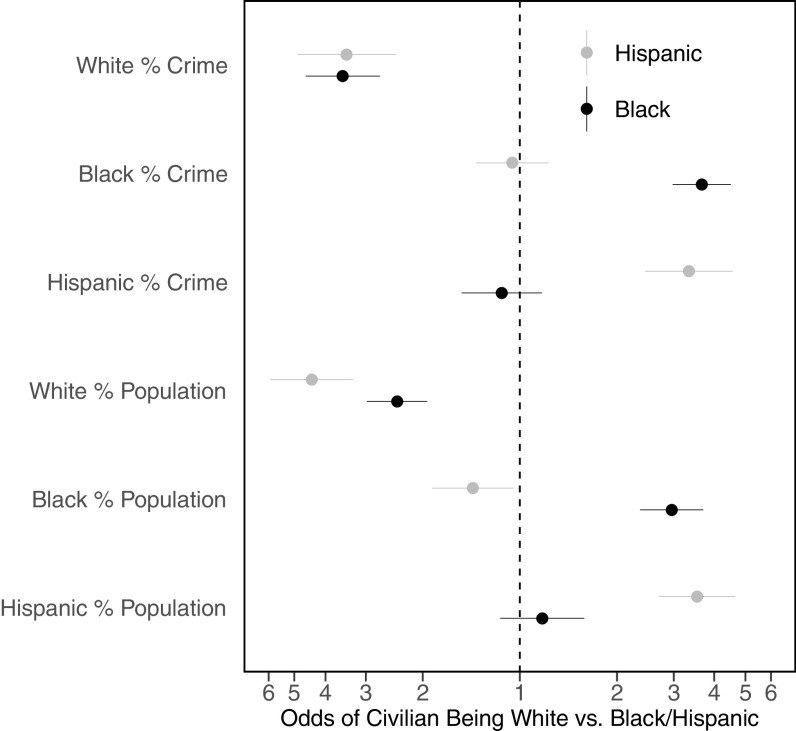
Despite extensive attention to racial disparities in police shootings, two problems have hindered progress on this issue. First, databases of fatal officer-involved shootings (FOIS) lack details about officers, making it difficult to test whether racial disparities vary by officer characteristics. Second, there are conflicting views on which benchmark should be used to determine racial disparities when the outcome is the rate at which members from racial groups are fatally shot. We address these issues by creating a database of FOIS that includes detailed officer information. We test racial disparities using an approach that sidesteps the benchmark debate by directly predicting the race of civilians fatally shot rather than comparing the rate at which racial groups are shot to some benchmark. We report three main findings: 1) As the proportion of Black or Hispanic officers in a FOIS increases, a person shot is more likely to be Black or Hispanic than White, a disparity explained by county demographics; 2) race-specific county-level violent crime strongly predicts the race of the civilian shot; and 3) although we find no overall evidence of anti-Black or anti-Hispanic disparities in fatal shootings, when focusing on different subtypes of shootings (e.g., unarmed shootings or "suicide by cop"), data are too uncertain to draw firm conclusions. We highlight the need to enforce federal policies that record both officer and civilian information in FOIS.
Keywords: benchmarks; officer-involved shootings; police use of force; racial bias; racial disparity.
Conflict of interest statement
The authors declare no conflict of interest.
Figures
Comment in
-
Making inferences about racial disparities in police violence.Proc Natl Acad Sci U S A. 2020 Jan 21;117(3):1261-1262. doi: 10.1073/pnas.1919418117. Proc Natl Acad Sci U S A. 2020. PMID: 31964781 Free PMC article. No abstract available.
-
Young unarmed nonsuicidal male victims of fatal use of force are 13 times more likely to be Black than White.Proc Natl Acad Sci U S A. 2020 Jan 21;117(3):1263. doi: 10.1073/pnas.1917915117. Proc Natl Acad Sci U S A. 2020. PMID: 31964782 Free PMC article. No abstract available.
-
Reply to Knox and Mummolo and Schimmack and Carlsson: Controlling for crime and population rates.Proc Natl Acad Sci U S A. 2020 Jan 21;117(3):1264-1265. doi: 10.1073/pnas.1920184117. Proc Natl Acad Sci U S A. 2020. PMID: 31964783 Free PMC article. No abstract available.
-
Scientific versus public debates: A PNAS case study.Proc Natl Acad Sci U S A. 2020 Aug 4;117(31):18135-18136. doi: 10.1073/pnas.2012328117. Epub 2020 Jul 15. Proc Natl Acad Sci U S A. 2020. PMID: 32669443 Free PMC article. No abstract available.
References
-
- President’s Task Force on 21st Century Policing , Final Report of the President’s Task Force on 21st Century Policing (Office of Community Oriented Policing Services, Washington, DC, 2015).
-
- Davis A. C., Lowery W., FBI director calls lack of data on police shootings “ridiculous,” “embarrassing.“ The Washington Post, 7 October 2015. https://www.washingtonpost.com/national/fbi-director-calls-lack-of-data-....
-
- Data from “Shot dead by police.” The Washington Post. https://www.washingtonpost.com/graphics/national/police-shootings/. Accessed 1 January 2016.
-
- Vice News , Shot by cops and forgotten. Vice News, 11 December 2017. https://news.vice.com/en_ca/article/xwvv3a/shot-by-cops.
-
- Donner C. M., Popovich N., Hitting (or missing) the mark: An examination of police shooting accuracy in officer-involved shooting incidents. Policing Int. J. 42, 474–489 (2018).
Publication types
MeSH terms
LinkOut - more resources
Full Text Sources
Research Materials
