. 2019 Jul 22;10(1):3255.
doi: 10.1038/s41467-019-11216-7.

Genomic epidemiology of syphilis reveals independent emergence of macrolide resistance across multiple circulating lineages

Affiliations

Genomic epidemiology of syphilis reveals independent emergence of macrolide resistance across multiple circulating lineages

Mathew A Beale et al. Nat Commun. .

Abstract

Syphilis is a sexually transmitted infection caused by Treponema pallidum subspecies pallidum and may lead to severe complications. Recent years have seen striking increases in syphilis in many countries. Previous analyses have suggested one lineage of syphilis, SS14, may have expanded recently, indicating emergence of a single pandemic azithromycin-resistant cluster. Here we use direct sequencing of T. pallidum combined with phylogenomic analyses to show that both SS14- and Nichols-lineages are simultaneously circulating in clinically relevant populations in multiple countries. We correlate the appearance of genotypic macrolide resistance with multiple independently evolved SS14 sub-lineages and show that genotypically resistant and sensitive sub-lineages are spreading contemporaneously. These findings inform our understanding of the current syphilis epidemic by demonstrating how macrolide resistance evolves in Treponema subspecies and provide a warning on broader issues of antimicrobial resistance.


Conflict of interest statement

The authors declare no competing interests.

Figures
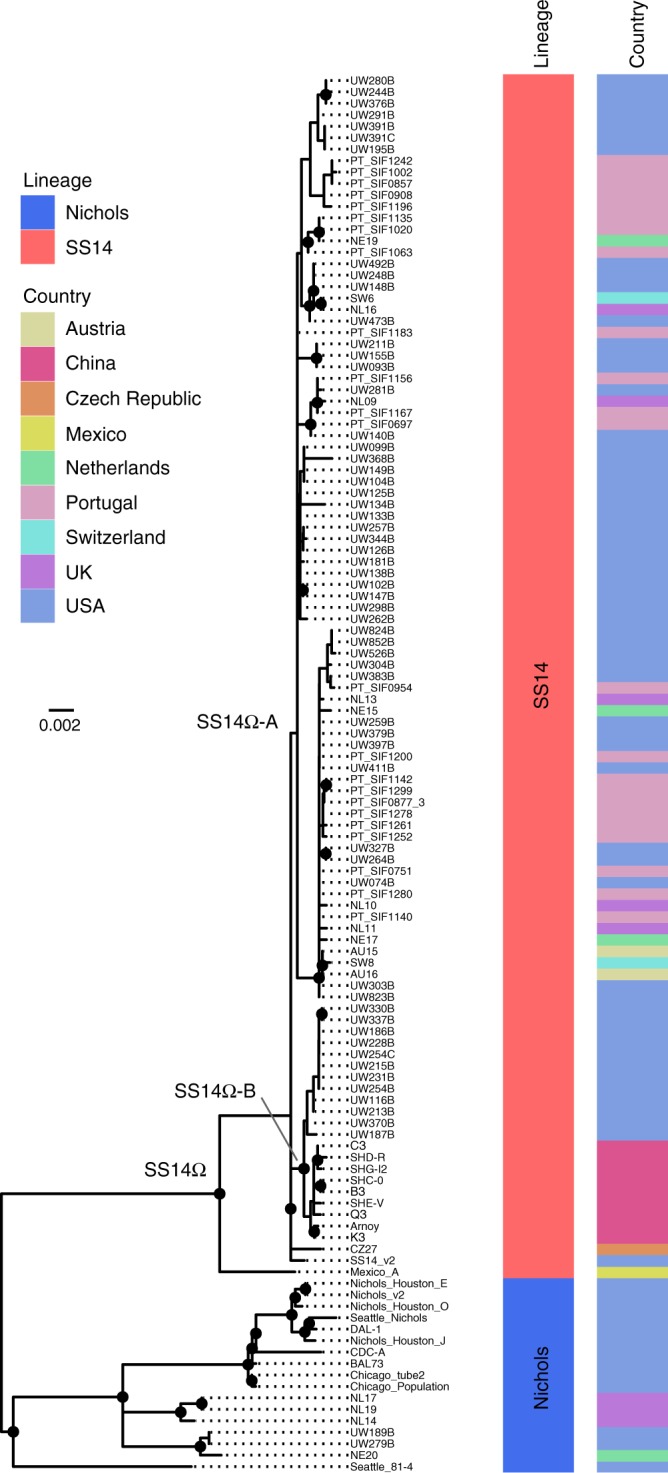
Fig. 1
Fig. 1
Maximum likelihood phylogeny of 122 high-quality T. pallidum subspecies pallidum genomes, showing lineage and country of origin. Tree includes sequences from recently clinically derived samples and those with more extensive laboratory passage. Ultra-Fast bootstrap values > = 95% are labelled with black nodes points. Branches are scaled by mean nucleotide substitutions/site
Fig. 2
Fig. 2
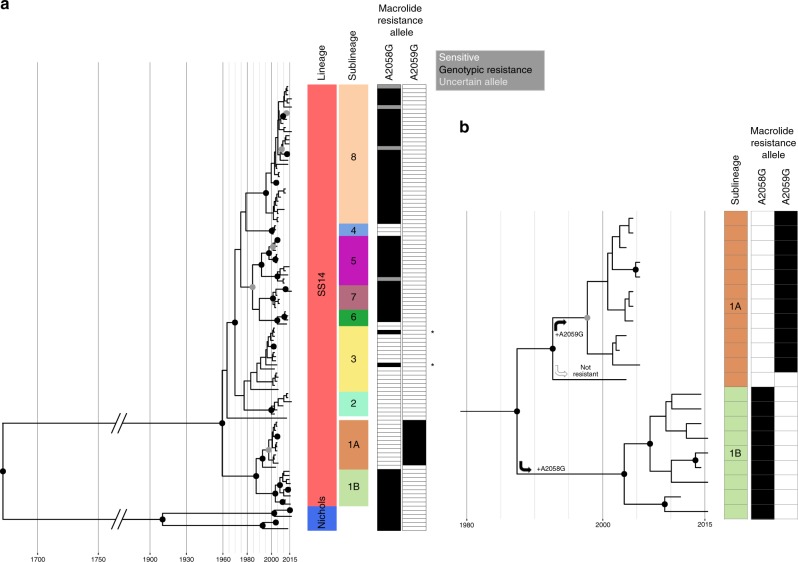
Bayesian maximum credibility phylogeny shows expansion of discrete sub-lineages within SS14-lineage, with independent evolution of macrolide resistance. a Time-scaled phylogeny of all recently clinically derived genomes. Coloured tracks indicate lineage, sub-lineage, and presence of macrolide resistance conferring 23S rRNA SNPs (black = present, white = absent, grey = uncertain—alleles in some samples could not be definitively classified either because they appeared mixed or because of low numbers of reads at each site). Node points are shaded according to posterior support (black ≥ 96%, dark grey > 91%, light grey > 80%). *Sporadic (non-lineage associated) gain of resistance is highlighted in sub-lineage 3 (samples UW133B and UW262B). b Expanded view of sub-lineages, showing independent acquisition and fixation of macrolide resistance alleles
Fig. 3
Fig. 3
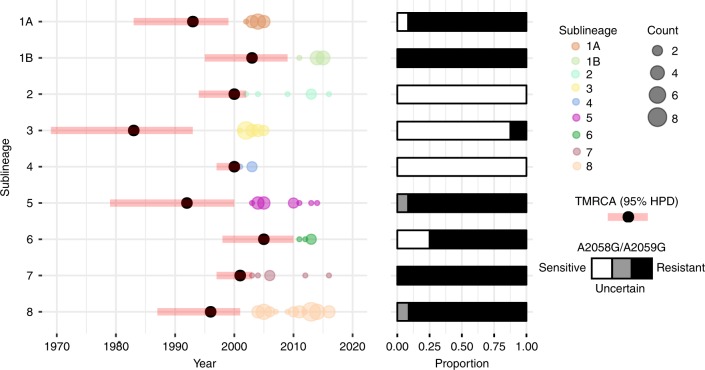
Macrolide resistant and sensitive SS14 sub-lineages evolved independently prior to 2006 and expanded equally regardless of resistance genotype. This figure shows sample collection dates grouped by sub-lineage, with size of coloured circle proportional to number of sequences, and showing predicted time to most recent common ancestor (TMRCA; black circle) with 95% highest posterior density (HPD; red bars), and proportion of genotypically macrolide resistant (black), sensitive (white) and uncertain (grey) samples

References

    1. Tampa M, Sarbu I, Matei C, Benea V, Georgescu S. Brief history of syphilis. J. Med. Life. 2014;7:4–10. - PMC - PubMed
    1. Chesson HW, Dee TS, Aral SO. AIDS mortality may have contributed to the decline in syphilis rates in the United States in the 1990s. Sex. Transm. Dis. 2003;30:419–424. doi: 10.1097/00007435-200305000-00008. - DOI - PubMed
    1. Fenton KA, et al. Infectious syphilis in high-income settings in the 21st century. Lancet Infect. Dis. 2008;8:244–253. doi: 10.1016/S1473-3099(08)70065-3. - DOI - PubMed
    1. Centers for Disease Control. Syphilis—2016 STD Surveillance Report. https://www.cdc.gov/std/stats16/Syphilis.htm (2017).
    1. Zhou Y, et al. Prevalence of HIV and syphilis infection among men who have sex with men in China: a meta-analysis. BioMed. Res. Int. 2014;2014:620431. - PMC - PubMed

Publication types

MeSH terms