. 2019 Jul 22;9(1):10583.
doi: 10.1038/s41598-019-46870-w.

Multiple genotypes of Echovirus 11 circulated in mainland China between 1994 and 2017

Affiliations

Multiple genotypes of Echovirus 11 circulated in mainland China between 1994 and 2017

Jie Li et al. Sci Rep. .

Abstract

Echovirus 11 (E-11) is one of the most frequently isolated enteroviruses causing meningitis and other diseases such as hand, foot, and mouth disease (HFMD) and acute flaccid paralysis (AFP). Fifty-nine newly determined E-11 VP1 sequences from the China AFP and HFMD surveillance network and 500 E-11 VP1 sequences obtained from the GenBank database, which were associated with 12 categories of diseases, were screened for phylogenetic analysis. Based on the standard method of genotype classification, E-11 strains circulated worldwide were reclassified into six genotypes as A, B, C, D, E, and F, in which genotype F is newly divided, and genotypes A and C are further divided into A1-5 and C1-4 by this research, whereas genotype D was still divided into D1-5 as in a previous study of Oberste et al. Sub-genotype A1 was the predominant sub-genotype in mainland China between 2008-2017, whereas sub-genotype D5 was the predominant sub-genotype circulated outside China from 1998-2014. However, genotype and sub-genotype spectra showed statistical significance among AFP and HFMD cases (χ2 = 60.86, P < 0.001), suggesting that different genotypes might have a tendency to cause different diseases. Strengthening the surveillance of E-11 might provide further information about pathogenic evolution or specific nucleotide mutation associated with different clinical diseases.


Conflict of interest statement

The authors declare no competing interests.

Figures
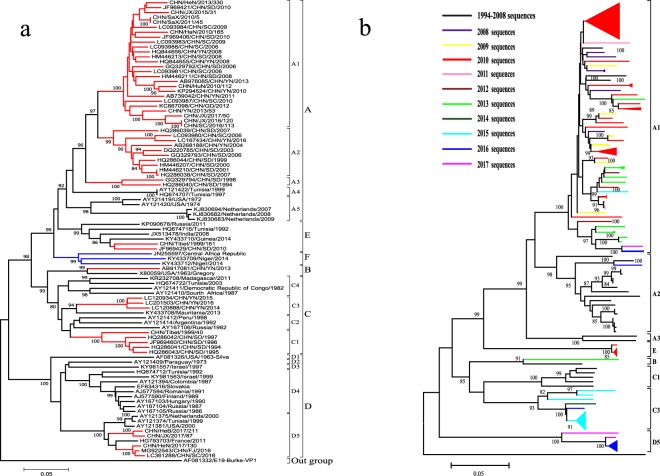
Figure 1
Figure 1
(a) Phylogenetic analysis. Phylogenetic dendrogram generated by the neighbour-joining method using the maximum composite likelihood model based on complete E-11 VP1 nucleotide sequences of 94 representative strains from both domestic and overseas sources between 1953 (the prototype strain Gregory) and 2017, with E-19 strain Burke as the outgroup. A difference of at least 8% and 15% in the entire VP1 region of E-11 strains was used to distinguish sub-genotypes and genotypes. The numbers at nodes represent the percentage of 1000 bootstrap replicates that supported the distal cluster. The name formatting of E-11 strains followed “GenBank number/country of origin/year of isolation”. Genotypes and sub-genotypes were marked on the right side of the tree. The relative phylogenetic distance was measured by the scale at the bottom, which means Nucleotide substitution rate, the 0.05 indicates that there are 5 differences per 100 nucleotides when the length of the branch is equal to the scale at the bottom. Representative strains isolated in China are marked in red, and the newly added genotype F is marked in blue. (b) Phylogenetic tree based on the complete VP1 nucleotide sequences of 200 E-11 strains in mainland China. The branches of sequences are highlighted in different colours according to the year (2008 to 2017).
Figure 2
Figure 2
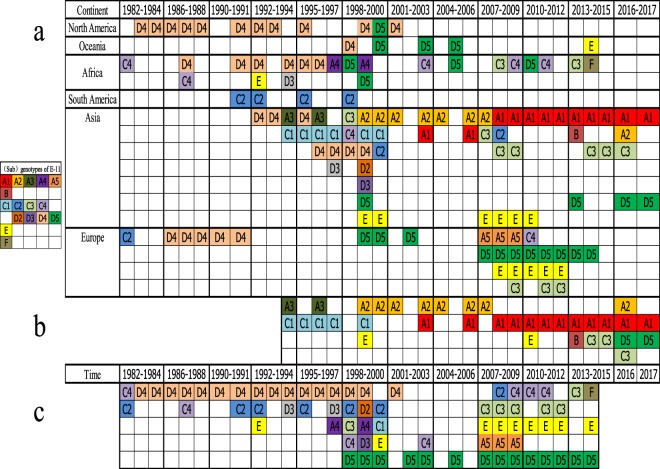
Time distribution of different (sub-)genotypes from 1982–2017. Note: (a) shows the (sub-)genotype distribution of different continents based on 559 E-11 sequences. (b) Shows the time distribution of different (sub-)genotypes of E-11 based on 200 sequences isolated in mainland China. (c) Shows the time distribution of different E-11 (sub-)genotypes based on 359 sequences isolated outside mainland China.

References

    1. Chen, L. Analysis of genotypes 7 and 11 of echo virus in Tibet autonomous region, Master thesis, Union medical university of China, http://graduate.pumc.edu.cn/ (2007).
    1. Oberste MS, Maher K, Kilpatrick DR, Pallansch MA. Molecular evolution of the human enteroviruses: correlation of serotype with VP1 sequence and application to picornavirus classification. J Virol. 1999;73:1941. - PMC - PubMed
    1. Hyypiä T, Hovi T, Knowles NJ, Stanway G. Classification of enteroviruses based on molecular and biological properties. J Gen Virol. 1997;78(Pt 1):1–11. doi: 10.1099/0022-1317-78-1-1. - DOI - PubMed
    1. Norder H, et al. Sequencing of ‘untypable’ enteroviruses reveals two new types, EV-77 and EV-78, within human enterovirus type B and substitutions in the BC loop of the VP1 protein for known types. J Gen Virol. 2003;84:827. doi: 10.1099/vir.0.18647-0. - DOI - PubMed
    1. Huang K, et al. Antigenic characteristics and genomic analysis of novel EV-A90 enteroviruses isolated in Xinjiang, China. Sci Rep. 2018;8:10247. doi: 10.1038/s41598-018-28469-9. - DOI - PMC - PubMed

Publication types