. 2019 Jul 22;9(1):10573.
doi: 10.1038/s41598-019-45866-w.

Modulation of defence and iron homeostasis genes in rice roots by the diazotrophic endophyte Herbaspirillum seropedicae

Affiliations

Modulation of defence and iron homeostasis genes in rice roots by the diazotrophic endophyte Herbaspirillum seropedicae

Liziane Cristina Campos Brusamarello-Santos et al. Sci Rep. .

Abstract

Rice is staple food of nearly half the world's population. Rice yields must therefore increase to feed ever larger populations. By colonising rice and other plants, Herbaspirillum spp. stimulate plant growth and productivity. However the molecular factors involved are largely unknown. To further explore this interaction, the transcription profiles of Nipponbare rice roots inoculated with Herbaspirillum seropedicae were determined by RNA-seq. Mapping the 104 million reads against the Oryza sativa cv. Nipponbare genome produced 65 million unique mapped reads that represented 13,840 transcripts each with at least two-times coverage. About 7.4% (1,014) genes were differentially regulated and of these 255 changed expression levels more than two times. Several of the repressed genes encoded proteins related to plant defence (e.g. a putative probenazole inducible protein), plant disease resistance as well as enzymes involved in flavonoid and isoprenoid synthesis. Genes related to the synthesis and efflux of phytosiderophores (PS) and transport of PS-iron complexes were induced by the bacteria. These data suggest that the bacterium represses the rice defence system while concomitantly activating iron uptake. Transcripts of H. seropedicae were also detected amongst which transcripts of genes involved in nitrogen fixation, cell motility and cell wall synthesis were the most expressed.


Conflict of interest statement

The authors declare no competing interests.

Figures
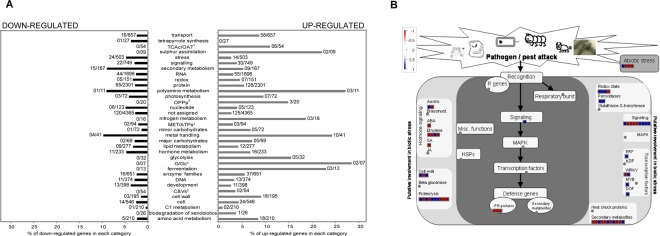
Figure 1
Figure 1
Transcripts differentially expressed in rice roots colonised by H. seropedicae were grouped according to metabolic categories according to MapMan. Overview metabolism is shown in Panel A and biotic and abiotic stress in Panel B. (A) Up-regulated genes are shown in the right-hand column (in gray) and down-regulated genes in the left column (in black). Numbers of regulated genes and total numbers of expressed genes are shown for each category. 1TCA cycle/organic acids: 2oxidative pentose phosphate pathway; 3mitochondrial electron transport/ATP synthesis; 4gluconeogenesis/glyoxylate cycle; 5cofactor and vitamin synthesis. (B) The scheme was constructed using only genes with fold change ≥2; ≤2. Small squares represent up-regulated (blue) or down-regulated (red) genes.
Figure 2
Figure 2
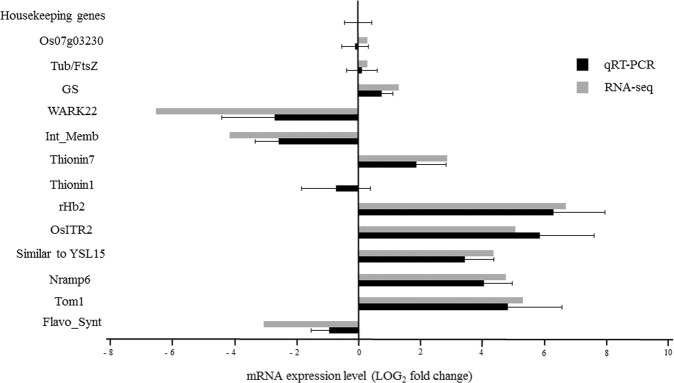
Confirmation of differential expression of rice genes by qRT-PCR and RNA-Seq. The results are average of three independent samples and error bars represent, the standard deviation. The reference genes used for the analysis were actin 1, tubulin beta-2 chain and conserved hypothetical protein.
Figure 3
Figure 3
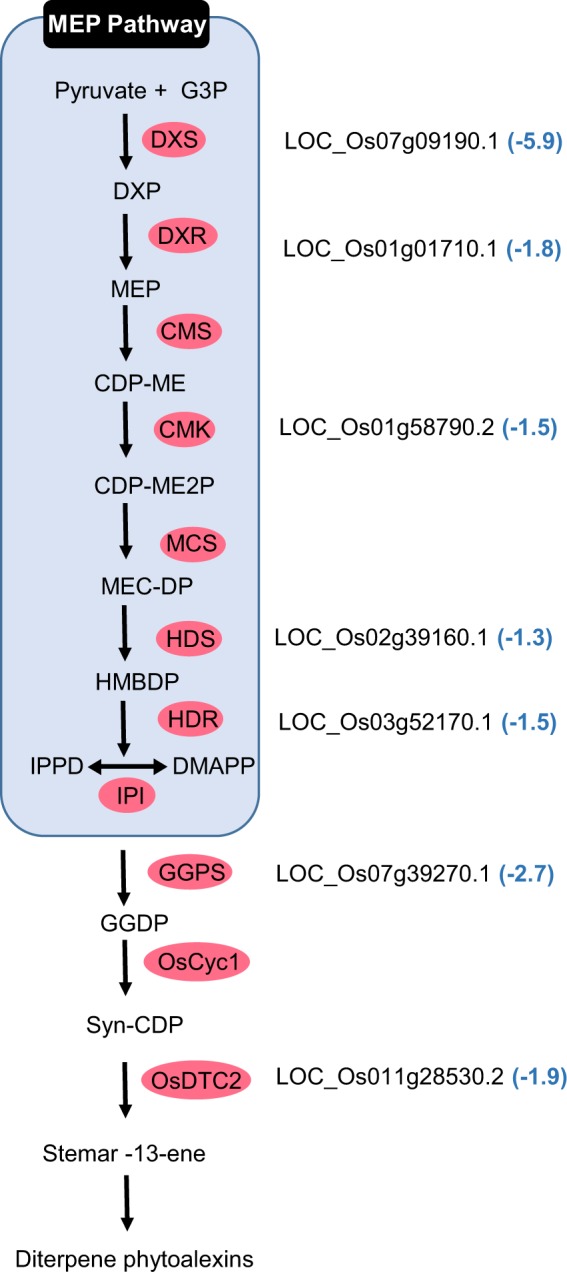
Isoprenoid synthesis genes down-regulated in rice roots colonised by H. seropedicae. The names of the genes differentially expressed are shown and the numbers in parentheses represent the fold change. The components of the MEP pathway leading to geranylgeranyl diphosphate synthesis and the diterpenoid- phytoalexin pathway are: G3P, glyceraldehyde-3-phosphate; DXP, 1-deoxy-D-xylulose 5-phosphate; MEP, 2-C-methyl-D-erythritol 4-phosphate; CDP-ME, 4-(cytidine 5-diphospho)-2-C-methyl-D-erythritol; CDP-ME2P, 2-phospho-4-(cytidine 5′-diphospho)-2-C-methyl-D-erythritol; MEC-DP, 2-C-methyl-D-erythritol 2,4-cyclodiphosphate; HMBDP, 1-hydroxy-2-methyl-2-butenyl 4-diphosphate; IPP, isopentenyl diphosphate; DMAPP, dimethylallyl diphosphate; GGDP, geranylgeranyl diphosphate; and CDP, copalyl diphosphate. Enzymes are indicated in rose coloured circles: DXS, 1-deoxy-D-xylulose 5-phosphate synthase; DXR, DXP reductoisomerase; CMS, CDP-ME synthase; CMK, CDP-ME kinase; MCS, MECDP synthase; HDS, HMBDP synthase; HDR, HMBDP reductase; IPI, IPP isomerase; GGPS, GGDP synthase; OsCyc1, syn-CDP synthase; OsCyc2, ent-CDP synthase; OsDTC2, stemar-13-ene synthase.
Figure 4
Figure 4
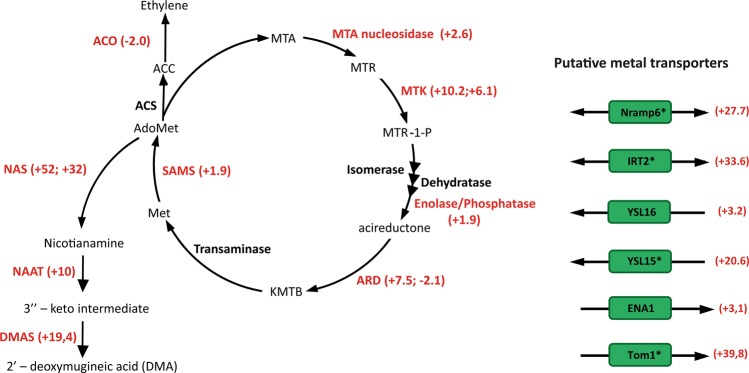
Differentially expressed genes in rice roots following colonisation by H. seropedicae. Genes involved in siderophore synthesis and transport, the methionine salvage pathway and ethylene synthesis are shown. Numbers in parentheses represent the fold change. H. seropedicae SmR1 induces methionine recycling and mugineic acid (MA) synthesis as well as the expression of transporters involved in iron metabolism. The expression of those genes marked with an asterisk was confirmed by RT-qPCR Abbreviations: AdoMet, S-adenosylmethionine; ACC, 1-aminocyclopropane-1-carboxylate; ACS, 1-aminocyclopropane-1-carboxylate synthase; ACO, 1-aminocyclopropane-1-carboxylate oxidase; MTA, 5′-methylthioadenosine; MTR, 5′-methylthioribose; MTK, methylthioribose kinase; MTR-1-P, 5′-methylthioribose-1-phosphate; KMTB, 2-keto-4-methylthiobutyrate; ARD, acireductone dioxygenase; SAMS, S-adenosylmethionine synthetase; NAS, nicotianamine synthase; NAAT nicotianamine aminotransferase; DMAS, deoxymugineic acid synthase; Tom1, transporter of mugineic acid 1; ENA1 (efflux transporters of nicotianamine 1); Nramp6, Natural Resistance-Associated Macrophage Protein; IRT2(iron-regulated transporter 2); YSL16 (yellow strip-like gene 16); YSL15 (yellow strip-like gene 15).

References

    1. Ladha JK, Reddy PM. Nitrogen fixation in rice systems: state of knowledge and future prospects. Plant and Soil. 2003;252:151–167. doi: 10.1023/A:1024175307238. - DOI
    1. Monteiro RA, et al. Herbaspirillum-plant interactions: microscopical, histological and molecular aspects. Plant and Soil. 2012;356:175–196. doi: 10.1007/s11104-012-1125-7. - DOI
    1. Chubatsu LS, et al. Nitrogen fixation control in Herbaspirillum seropedicae. Plant Soil. 2012;356:197–207. doi: 10.1007/s11104-011-0819-6. - DOI
    1. Gyaneshwar P, James EK, Reddy PM, Ladha JK. Blackwell Science Ltd Herbaspirillum colonization increases growth and nitrogen accumulation in aluminium-tolerant rice varieties. New Phytologist. 2002;154:131–145. doi: 10.1046/j.1469-8137.2002.00371.x. - DOI
    1. James EK. Nitrogen fixation in endophytic and associative symbiosis. Field Crops Research. 2000;65:197–209. doi: 10.1016/S0378-4290(99)00087-8. - DOI

Publication types

Supplementary concepts