. 2019 Jul 22;9(1):10551.
doi: 10.1038/s41598-019-47152-1.

High-fat diet intake induces depressive-like behavior in ovariectomized rats

Affiliations

High-fat diet intake induces depressive-like behavior in ovariectomized rats

Valter T Boldarine et al. Sci Rep. .

Abstract

This study tested the effects of ovariectomy, allied or not to high-fat feeding and estradiol replacement, on hormonal, metabolic and behavioral parameters, to explore the connection of obesity and depression after menopause. Wistar rats were either ovariectomized or sham-operated and fed with either standard chow or lard-enriched diet for twelve weeks. Sub-groups of ovariectomized rats received estradiol replacement. Depressive-like behaviors were assessed by the forced swim test and locomotor activity was assessed by the elevated plus maze test. Ovariectomy alone increased body weight gain and feed efficiency and induced hyperleptinemia and glucose intolerance while it increased caloric intake and body adiposity only marginally. High-fat intake alone induced obesity and, in combination with ovariectomy, accentuated the ovariectomy-induced alterations. Estradiol replacement attenuated the hormonal alterations only in chow-fed rats. Ovariectomy combined with high-fat intake induced depressive-like behaviors, which were marginally attenuated by estradiol. Depressive-like behaviors were associated with metabolic and body composition parameters and with estrogen status. The data indicate that the vulnerability to develop depression after menopause is influenced by high-fat intake. It is suggested that weight management is a crucial issue in postmenopausal women, probably having a beneficial role in preventing the appearance of mental health problems.


Conflict of interest statement

The authors declare no competing interests.

Figures
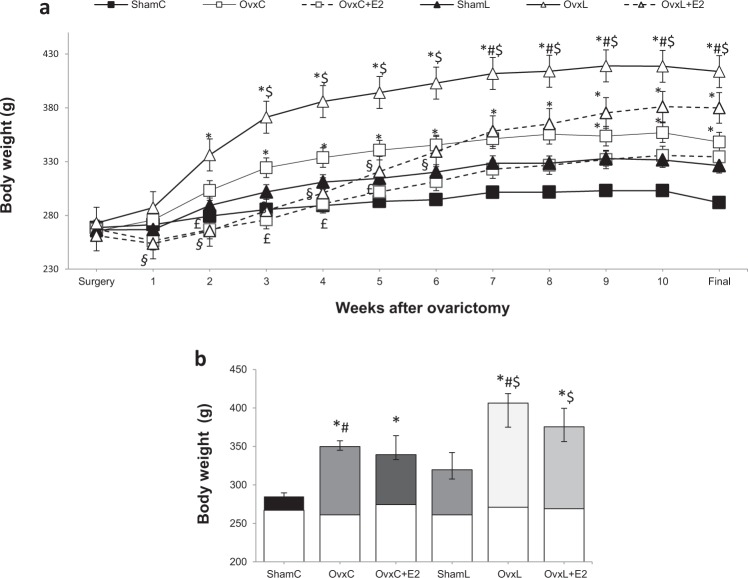
Figure 1
Figure 1
Weekly evolution of body weight (a) and 12-weeks cumulative body weight gain (b). The blank bars in Figure b represent the initial body weight. Groups were fed with either control diet - ShamC (n = 18), OvxC (n = 18), OvxC + E2 (n = 18) or high-lard diet - ShamL (n = 17), OvxL (n = 18), OvxL + E2 (n = 17), for twelve weeks. Data are expressed as medians and interquartile range (Q1–Q3) for both figures. *p < 0.05 vs. ShamC; #p < 0.05 OvxC vs. OvxL; $p < 0.05 vs. ShamL; £p < 0.05 vs. OvxC + E2; §p < 0.05 vs. OvxL + E2.
Figure 2
Figure 2
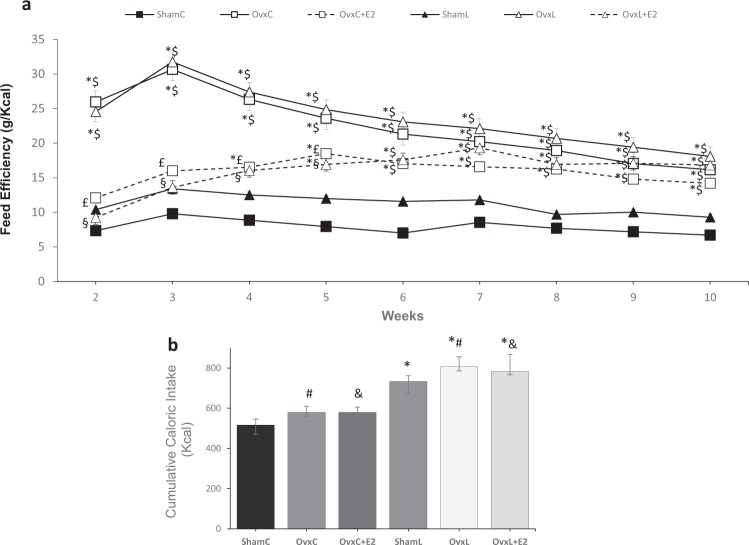
Feed efficiency (a) and cumulative caloric intake (b). Groups were fed with either control diet - ShamC (n = 18), OvxC (n = 18), OvxC + E2 (n = 18) or high-lard diet - ShamL (n = 17), OvxL (n = 18), OvxL + E2 (n = 17), for twelve weeks. Data are expressed as medians and interquartile range (Q1-Q3) for both figures. *p < 0.05 vs. ShamC; #p < 0.05 OvxC vs. OvxL; $p < 0.05 vs. ShamL; &p < 0.05 OvxC + E2 vs. OvxL + E2; £p < 0.05 vs. OvxC + E2; §p < 0.05 vs. OvxL + E2.
Figure 3
Figure 3
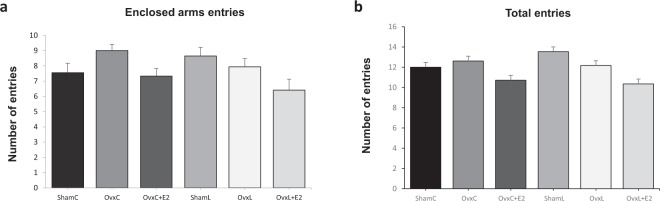
Elevated plus-maze test: Number of enclosed arms entries (a) and number of total entries (enclosed and opened arms). (b) Groups were fed with control diet-ShamC (n = 18), OvxC (n = 18), OvxC + E2 (n = 18), and groups fed with high-lard diet-ShamL (n = 17), OvxL (n = 18),OvxL + E2 (n = 17). Data are expressed as means ± SEM.
Figure 4
Figure 4
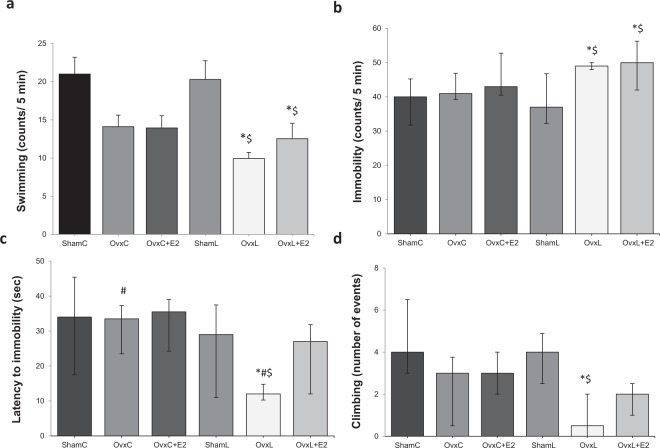
Modified forced swim test: Swimming frequency (a), Immobility frequency (b), latency to immobility (c) and climbing events (d) in groups fed with control diet-ShamC (n = 18), OvxC (n = 18), OvxC + E2 (n = 18), and groups fed with high-lard diet-ShamL (n = 17), OvxL (n = 18),OvxL + E2 (n = 17). Data are expressed as means ± SEM for swimming frequency and as medians and interquartile range (Q1-Q3) for the other parameters. *p < 0.05 vs. ShamC; #p < 0.05 OvxC vs. OvxL; $p < 0.05 vs. ShamL.

References

    1. Donato GB, et al. Association between menopause status and central adiposity measured at different cut-offs of waist circumference and waist-to-hip ratio. Menopause. 2006;13:280–285. doi: 10.1097/01.gme.0000177907.32634.ae. - DOI - PubMed
    1. Georgakis M, et al. Association of age at menopause and duration of reproductive period with depression after menopause: A systemic review and meta-analysis. JAMA psychiatry. 2016;73(2):139–149. doi: 10.1001/jamapsychiatry.2015.2653. - DOI - PubMed
    1. Kozakowski J, et al. Obesity in menopause - our negligence or an unfortunate inevitability? Menopause Rev. 2017;16(2):61. doi: 10.5114/pm.2017.68594. - DOI - PMC - PubMed
    1. Anderson SE, et al. Adolescent obesity and risk for subsequent major depressive disorder and anxiety disorder: prospect evidence. Psychosom. Med. 2007;69:740–747. doi: 10.1097/PSY.0b013e31815580b4. - DOI - PubMed
    1. Jantaratnotai N, et al. The interface of depression and obesity. Obes Ras. Clin Pract. 2017;11(1):1–10. - PubMed

Publication types