. 2019 Jul 22;9(1):10572.
doi: 10.1038/s41598-019-46819-z.

A set of molecular markers predicts chemosensitivity to Mitomycin-C following cytoreductive surgery and hyperthermic intraperitoneal chemotherapy for colorectal peritoneal metastasis

Affiliations

A set of molecular markers predicts chemosensitivity to Mitomycin-C following cytoreductive surgery and hyperthermic intraperitoneal chemotherapy for colorectal peritoneal metastasis

Nicholas Brian Shannon et al. Sci Rep. .

Abstract

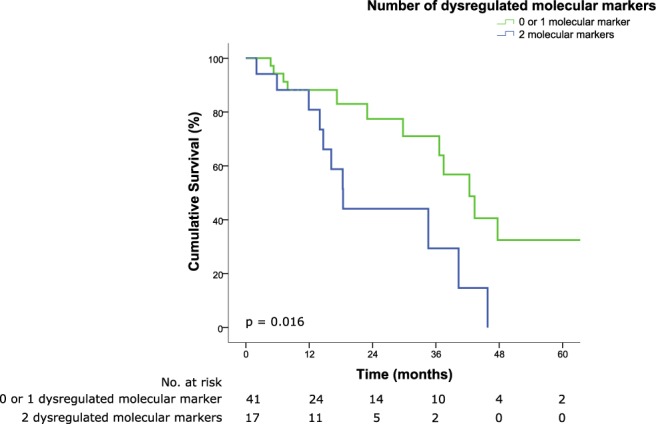
Cytoreductive surgery (CRS) and hyperthermic intraperitoneal chemotherapy (HIPEC) is associated with significant perioperative morbidity and mortality. We aim to generate and validate a biomarker set predicting sensitivity to Mitomycin-C to refine selection of patients with colorectal peritoneal metastasis (CPM) for this treatment. A signature predicting Mitomycin-C sensitivity was generated using data from Genomics of Drug Sensitivity in Cancer and The Cancer Genome Atlas. Validation was performed on CPM patients who underwent CRS-HIPEC (n = 62) using immunohistochemistry (IHC). We determined predictive significance of our set using overall survival as a surrogate endpoint via a logistic regression model. Three potential biomarkers were identified and optimized for IHC. Patients exhibiting lower expression of PAXIP1 and SSBP2 had poorer survival than those with higher expression (p = 0.045 and 0.140, respectively). No difference was observed in patients with differing DTYMK expression (p = 0.715). Combining PAXIP1 and SSBP2 in a set, patients with two dysregulated protein markers had significantly poorer survival than one or no dysregulated marker (p = 0.016). This set independently predicted survival in a Cox regression model (HR 5.097; 95% CI 1.731-15.007; p = 0.003). We generated and validated an IHC prognostic set which could potentially identify patients who are likely to benefit from HIPEC using Mitomycin-C.


Conflict of interest statement

The authors declare no competing interests.

Figures
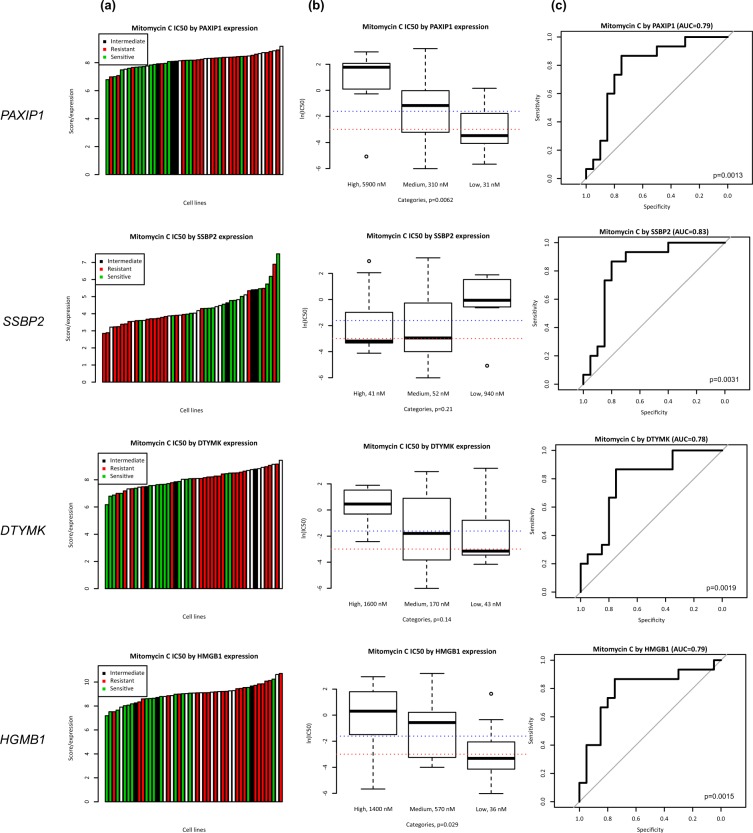
Figure 1
Figure 1
Correlation between gene expression and Mitomycin-C IC50 in identified molecular markers. (a) Waterfall plot representing distribution of Mitomycin-C sensitivity (resistant IC50 > 200 nM, intermediate IC50 > 50 nM, and sensitive IC50 < 50 nM) across colorectal cancer cell lines ordered by the expression of the respective genes (PAXIP1, SSBP2, DTYMK, HGMB1). (b) Box plot representing IC50 values in cell lines grouped by expression quartiles (high = top quartile, low = bottom quartile, medium = within interquartile range). Dotted lines represent sensitive and resistant cutoffs for IC50 values. (c) Receiver operating characteristic (ROC) curve representing ability of gene expression to correctly classify sensitive or resistant cell lines (PAXIP1 AUC = 0.79, p = 0.0013, SSBP2 AUC = 0.83, p = 0.0031, DTYMK AUC = 0.78, p = 0.0019, and HMGB1 AUC = 0.79, p = 0.0015).
Figure 2
Figure 2
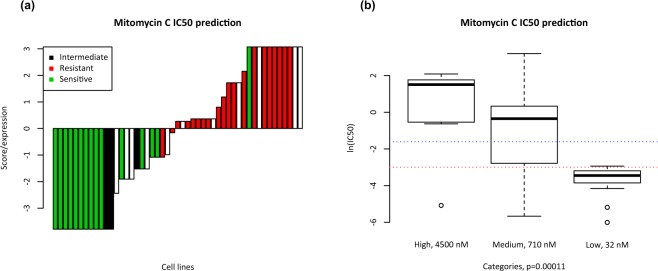
Combined 4-gene predictive model. (a) Waterfall plot representing distribution of Mitomycin-C sensitivity (resistant IC50 > 200 nM, intermediate IC50 > 50 nM, and sensitive IC50 < 50 nM) across colorectal cancer cell lines ordered by prediction scores from the combined model. (b) Box plot representing IC50 values in cell lines grouped by prediction from the 4-gene prediction model (predictions low = sensitive, high = resistant, medium = intermediate score). Dotted lines represent sensitive and resistant cutoffs for IC50 values.
Figure 3
Figure 3
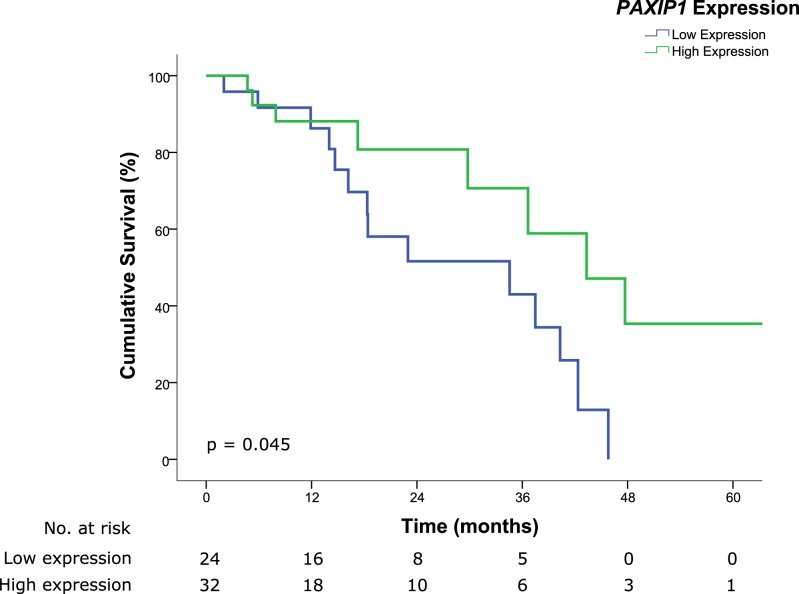
Kaplan-Meier survival curve illustrating poor prognosis in patients with lower expression of PAXIP1 (median OS, 34.6 months vs. 43.3 months for low and high expressions respectively, HR 2.595, 95% CI 1.022–6.589, p = 0.045). Low and high immunoreactivity scores were 0–3 and 4–9, respectively.
Figure 4
Figure 4
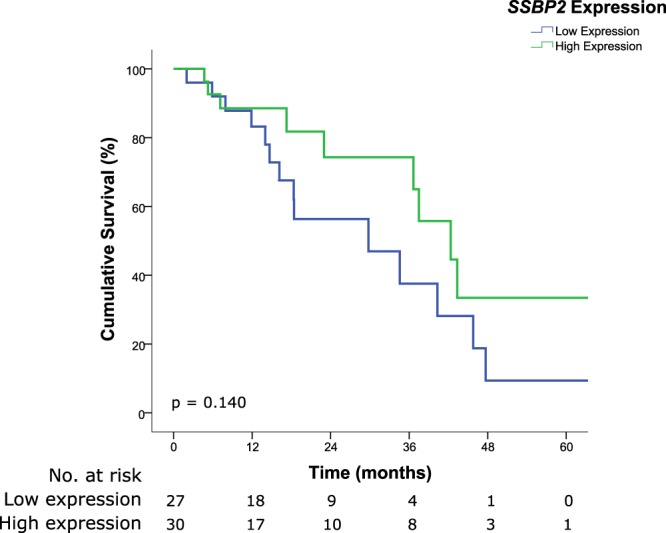
Kaplan-Meier survival curve illustrating poor prognosis in patients with lower expression of SSBP2 although it did not reach statistical significance (median OS, 29.8 months vs. 42.3 months for low and high expressions respectively, HR 1.886, 95% CI 0.812–4.378, p = 0.140). Low and high immunoreactivity scores were 0–3 and 4–9, respectively.
Figure 5
Figure 5
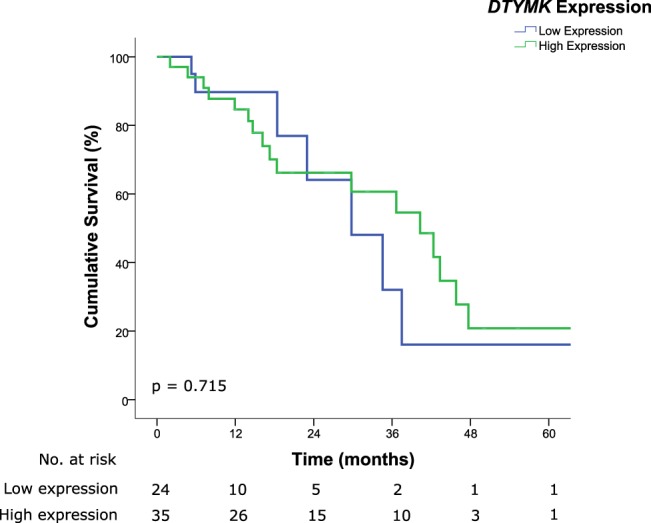
Kaplan-Meier survival curve illustrating no difference in survival in patients with differing expression of DTYMK (median OS, 29.8 months vs. 40.3 months for low and high expressions respectively, HR 0.846, 95% CI 0.345–2.077, p = 0.715). Low and high immunoreactivity scores were 0–3 and 4–9, respectively.
Figure 6
Figure 6
Kaplan-Meier survival curve illustrating poor prognosis in patients with 2 dysregulated molecular markers (median OS, 42.3 months vs. 18.4 months for one or no dysregulated marker and two dysregulated markers respectively, HR 2.844, 95% CI 1.212–6.674, p = 0.016).

References

    1. GLOBOCAN. GLOBOCAN 2012: Estimated Cancer Incidence, Mortality and Prevalence Worldwide in 2012, http://globocan.iarc.fr/Pages/fact_sheets_cancer.aspx (2012).
    1. Goldberg RM, et al. A randomized controlled trial of fluorouracil plus leucovorin, irinotecan, and oxaliplatin combinations in patients with previously untreated metastatic colorectal cancer. J Clin Oncol. 2004;22:23–30. doi: 10.1200/JCO.2004.09.046. - DOI - PubMed
    1. Kim GP, et al. Phase III noninferiority trial comparing irinotecan with oxaliplatin, fluorouracil, and leucovorin in patients with advanced colorectal carcinoma previously treated with fluorouracil: N9841. J Clin Oncol. 2009;27:2848–2854. doi: 10.1200/JCO.2008.20.4552. - DOI - PMC - PubMed
    1. Franko J, et al. Prognosis of patients with peritoneal metastatic colorectal cancer given systemic therapy: an analysis of individual patient data from prospective randomised trials from the Analysis and Research in Cancers of the Digestive System (ARCAD) database. Lancet Oncol. 2016;17:1709–1719. doi: 10.1016/S1470-2045(16)30500-9. - DOI - PubMed
    1. Yan TD, Black D, Savady R, Sugarbaker PH. Systematic review on the efficacy of cytoreductive surgery combined with perioperative intraperitoneal chemotherapy for peritoneal carcinomatosis from colorectal carcinoma. J Clin Oncol. 2006;24:4011–4019. doi: 10.1200/JCO.2006.07.1142. - DOI - PubMed

Publication types

MeSH terms