


Comorbid Personality Disorders in Individuals With an At-Risk Mental State for Psychosis: A Meta-Analytic Review
- PMID: 31333509
- PMCID: PMC6625011
- DOI: 10.3389/fpsyt.2019.00429
Comorbid Personality Disorders in Individuals With an At-Risk Mental State for Psychosis: A Meta-Analytic Review
Erratum in
-
Corrigendum: Comorbid Personality Disorders in Individuals With an At-Risk Mental State for Psychosis: A Meta-Analytic Review.Front Psychiatry. 2020 May 12;11:235. doi: 10.3389/fpsyt.2020.00235. eCollection 2020. Front Psychiatry. 2020. PMID: 32477168 Free PMC article.
Abstract
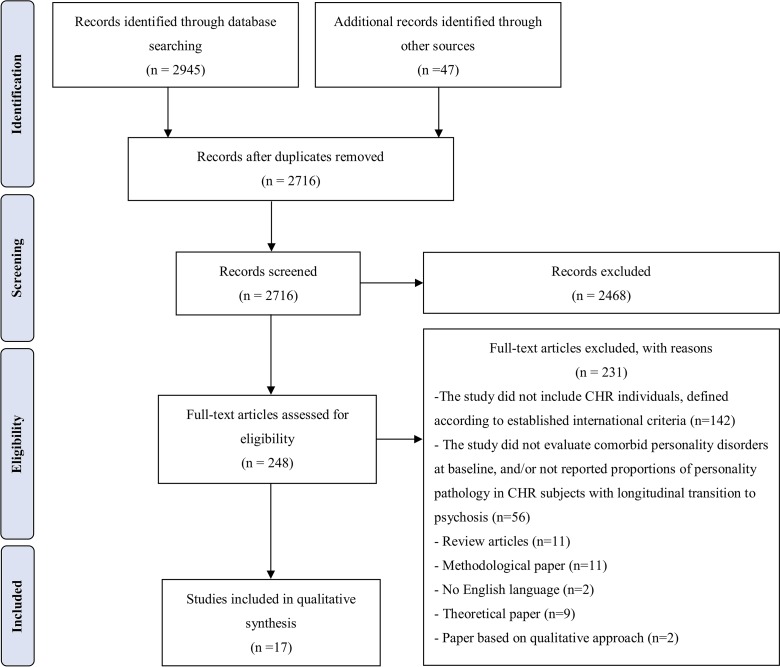
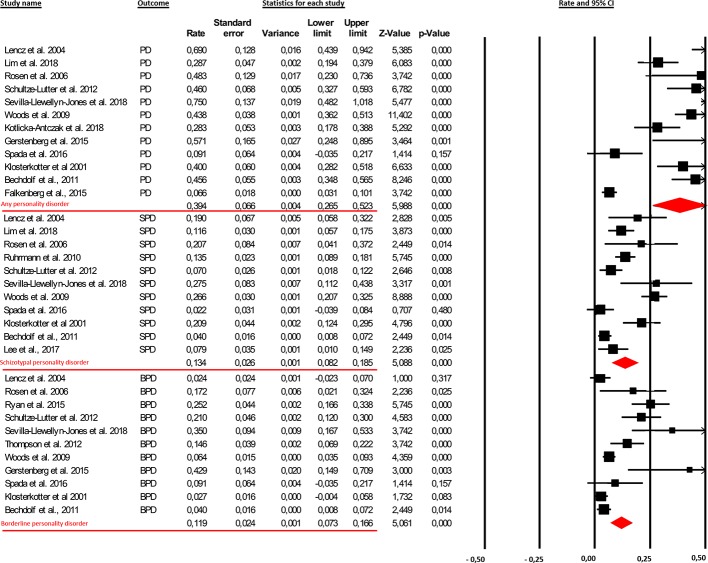
Increasing evidence shows that personality pathology is common among patients at clinical high risk (CHR) for psychosis. Despite the important impact that this comorbidity might have on presenting high-risk psychopathology, psychological functioning, and transition to full psychotic disorders, the relationship between personality syndromes and CHR state has received relatively little empirical attention. The present meta-analytic review aimed at 1) estimating the prevalence rates of personality disorders (PDs) in CHR individuals and 2) examining the potential role of PDs in predicting transition from CHR state to a full-blown psychotic disorder. The systematic search of the empirical literature identified 17 relevant studies, including a total of 1,868 CHR individuals. Three distinct meta-analyses were performed to provide prevalence estimates of PDs in the CHR population. The first and more comprehensive meta-analysis focused on any comorbid PD (at least one diagnosis), the second one focused on schizotypal personality disorder (SPD), and the last one focused on borderline personality disorder (BPD). Moreover, a narrative review was presented to define the predictive role of personality disorders in promoting more severe outcomes in CHR patients. The findings showed that the prevalence rate of personality disorders in CHR patients was 39.4% (95% CI [26.5%-52.3%]). More specifically, 13.4% (95% CI [8.2%-18.5%]) and 11.9% (95% CI [0.73%-16.6%]) of this clinical population presented with SPD and BPD, respectively. Finally, the studies examining the effects of baseline personality diagnoses on conversion to psychotic disorders showed contradictory and insufficient results concerning the potential significant impact of SPD. Conversely, no effect of BPD was found. This meta-analytic review indicated that the CHR population includes a large subgroup with serious personality pathology, that may present with attenuated psychotic symptoms conjointly with distinct and very heterogeneous personality features. These findings support the need for improved understanding of both core psychological characteristics of CHR patients and differentiating aspects of personality that could have relevant clinical implications in promoting individualized preventive interventions and enhancing treatment effectiveness.
Keywords: clinical high risk (CHR); early detection and prevention; high risk (HR); personality disorders; ultra high risk (UHR).
Figures
References
Publication types
LinkOut - more resources
Full Text Sources
Miscellaneous
