. 2019 Jul 3:10:724.
doi: 10.3389/fneur.2019.00724. eCollection 2019.

Dysregulation of Respiratory Center Drive (P0.1) and Muscle Strength in Patients With Early Stage Idiopathic Parkinson's Disease

Affiliations

Dysregulation of Respiratory Center Drive (P0.1) and Muscle Strength in Patients With Early Stage Idiopathic Parkinson's Disease

Wei Zhang et al. Front Neurol. .

Abstract

Objective: The goal of this study is to evaluate pulmonary function and respiratory center drive in patients with early-stage idiopathic Parkinson's disease (IPD) to facilitate early diagnosis of Parkinson's Disease (PD). Methods: 43 IPD patients (Hoehn and Yahr scale of 1) and 41 matched healthy individuals (e.g., age, sex, height, weight, BMI) were enrolled in this study. Motor status was evaluated using the Movement Disorders Society-Unified PD Rating Scale (MDS-UPDRS). Pulmonary function and respiratory center drive were measured using pulmonary function tests (PFT). All IPD patients were also subjected to a series of neuropsychological tests, including Non-Motor Symptoms Questionnaire (NMSQ), REM Sleep Behavior Disorder Screening Questionnaire (RBDSQ), Beck Depression Inventory (BDI) and Mini Mental State Examination (MMSE). Results: IPD patients and healthy individuals have similar forced vital capacity (FVC), forced expiratory volume in 1s (FEV1), forced expiratory volume in 1s/forced vital capacity (FEV1/FVC), peak expiratory flow (PEF), and carbon monoxide diffusion capacity (DLCOcSB). Reduced respiratory muscle strength, maximal inspiratory pressure (PImax) and maximal expiratory pressure (PEmax) was seen in IPD patients (p = 0.000 and p = 0.002, respectively). Importantly, the airway occlusion pressure after 0.1 s (P0.1) and respiratory center output were notably higher in IPD patients (p = 0.000) with a remarkable separation of measured values compared to healthy controls. Conclusion: Our findings suggest that abnormal pulmonary function is present in early stage IPD patients as evidenced by significant changes in PImax, PEmax, and P0.1. Most importantly, P0.1 may have the potential to assist with the identification of IPD in the early stage.

Keywords: P0.1; Parkinson's disease; biomarker; respiratory center drive; respiratory muscle strength.


Figures
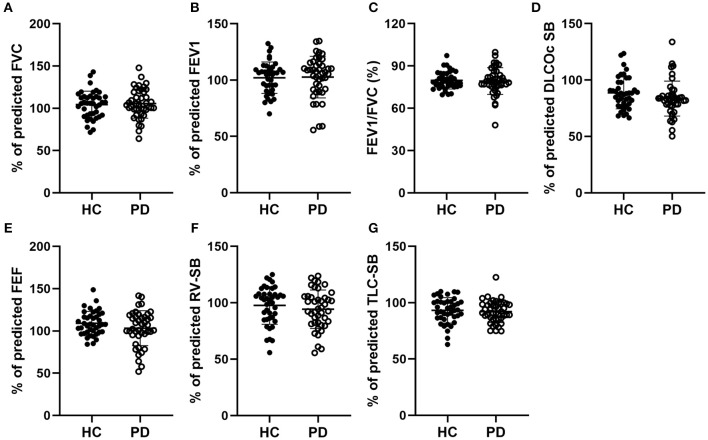
Figure 1
Figure 1
Comparisons of the pulmonary ventilation function between early-stage PD patients and age-matched healthy controls. (A–G) Percentage of predicted values of FVC (A), FEV1 (B), FEV1/FVC (C), DLCOc SB (D), FEF (E), RV-SB (F), and TLC-SB (G) showed no significant difference between early-stage PD patients (open circles, n = 43) and age-matched healthy controls (filled circles, n = 41, p > 0.05). Each symbol represents a single subject. Data are presented as mean ± SD.
Figure 2
Figure 2
Comparisons of the respiratory muscle strength between early-stage PD patients and age-matched healthy controls. (A–C) Percentage of predicted values of maximal inspiratory pressure [PImax, (A)] was significantly lower in early-stage PD patients (open circles, n = 43) and age-matched healthy controls (filled circles, n = 41, **p < 0.001). Note that both female [(B), n = 24] and male [(C), n = 19] early-stage PD patients (open circles) showed significantly lower values of PImax compared to the corresponding healthy controls (filled circles; female n = 20, male n = 21, *p < 0.05, **p < 0.01). (D–F) Percentage of predicted values of maximal expiratory pressure [PEmax, (D)] was significantly lower in early-stage PD patients (open circles, n = 43) and age-matched healthy controls (filled circles, n = 41, **p < 0.001). Note that both female [(E), n = 24) and male [(F), n = 19] early-stage PD patients (open circles) showed significantly lower values of PEmax compared to the corresponding healthy controls (filled circles; female n = 20, male n = 21, *p < 0.05, **p < 0.01). Each symbol represents a single subject. Data are presented as mean ± SD.
Figure 3
Figure 3
Comparisons of the respiratory drive between early-stage PD patients and age-matched healthy controls. (A) Percentage of predicted values of respiratory center drive (P0.1), was significantly higher in early-stage PD patients (open circles, n = 43) and age-matched healthy controls (filled circles, n = 41, **p < 0.001). (B–C) Both female [(B), n = 24] and male [(C), n = 19] early-stage PD patients (open circles) showed significantly larger values of PImax compared to the corresponding female [(B), n = 20] and male [(C), n = 21] healthy controls (filled circles, **p < 0.01). Each symbol represents a single subject. Data are presented as mean ± SD.

References

    1. de Lau LM, Breteler MM. Epidemiology of Parkinson's disease. Lancet Neurol. (2006) 5:525–35. 10.1016/S1474-4422(06)70471-9 - DOI - PubMed
    1. Johnson ME, Stecher B, Labrie V, Brundin L, Brundin P. Triggers, facilitators, and aggravators: redefining Parkinson's disease pathogenesis. Trends Neurosci. (2019) 42:4–13. 10.1016/j.tins.2018.09.007 - DOI - PMC - PubMed
    1. Kalia LV, Lang AE. Parkinson's disease. Lancet. (2015) 386:896–912. 10.1016/S0140-6736(14)61393-3 - DOI - PubMed
    1. Lilker ES, Woolf CR. Pulmonary function in Parkinson's syndrome: the effect of thalamotomy. Can Med Assoc J. (1968) 99:752–7. - PMC - PubMed
    1. Sabate M, Rodriguez M, Mendez E, Enriquez E, Gonzalez I. Obstructive and restrictive pulmonary dysfunction increases disability in Parkinson disease. Arch Phys Med Rehabil. (1996) 77:29–34. 10.1016/S0003-9993(96)90216-6 - DOI - PubMed
