


Bacterial Dynamics in Supraglacial Habitats of the Greenland Ice Sheet
- PMID: 31333595
- PMCID: PMC6616251
- DOI: 10.3389/fmicb.2019.01366
Bacterial Dynamics in Supraglacial Habitats of the Greenland Ice Sheet
Abstract
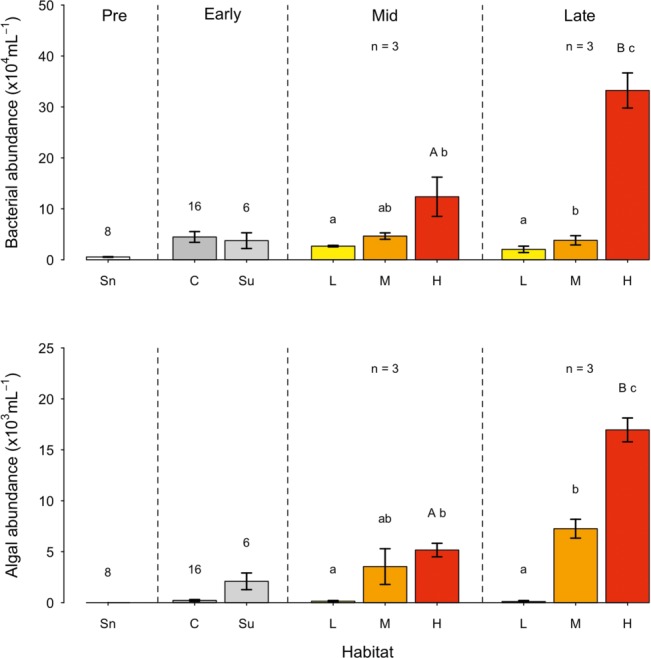
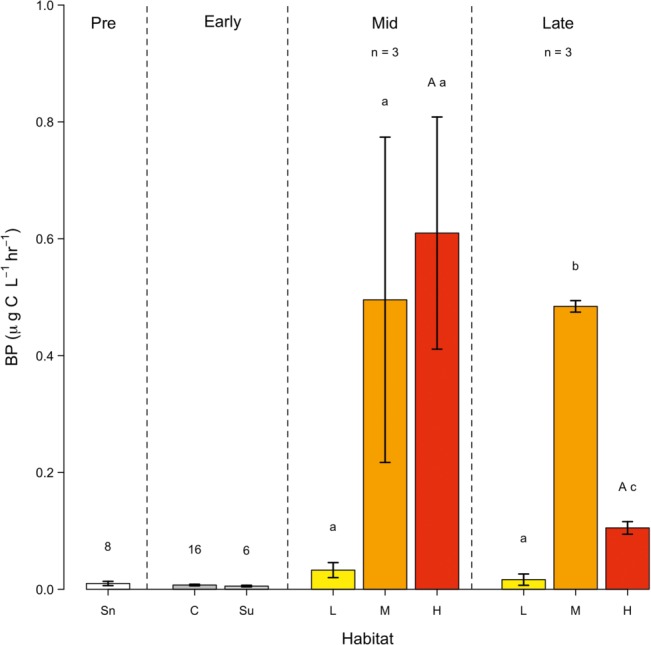
Current research into bacterial dynamics on the Greenland Ice Sheet (GrIS) is biased toward cryoconite holes, despite this habitat covering less than 8% of the ablation (melt) zone surface. In contrast, the expansive surface ice, which supports wide-spread Streptophyte micro-algal blooms thought to enhance surface melt, has been relatively neglected. This study aims to understand variability in bacterial abundance and production across an ablation season on the GrIS, in relation to micro-algal bloom dynamics. Bacterial abundance reached 3.3 ± 0.3 × 10⁵ cells ml-1 in surface ice and was significantly linearly related to algal abundances during the middle and late ablation periods (R 2 = 0.62, p < 0.05; R 2 = 0.78, p < 0.001). Bacterial production (BP) of 0.03-0.6 μg C L-1 h-1 was observed in surface ice and increased in concert with glacier algal abundances, indicating that heterotrophic bacteria consume algal-derived dissolved organic carbon. However, BP remained at least 28 times lower than net primary production, indicating inefficient carbon cycling by heterotrophic bacteria and net accumulation of carbon in surface ice throughout the ablation season. Across the supraglacial environment, cryoconite sediment BP was at least four times greater than surface ice, confirming that cryoconite holes are the true "hot spots" of heterotrophic bacterial activity.
Keywords: Greenland; bacterial abundance; bacterial production; glacier algae; ice sheet.
Figures
References
-
- Anesio A. M., Hodson A. J., Fritz A., Psenner R., Sattler B. (2009). High microbial activity on glaciers: importance to the global carbon cycle. Glob. Chang. Biol. 15, 955–960. 10.1111/j.1365-2486.2008.01758.x - DOI
-
- Anesio A. M., Sattler B., Foreman C., Telling J., Hodson A., Tranter M., et al. (2010). Carbon fluxes through bacterial communities on glacier surfaces. Ann. Glaciol. 51, 32–40. 10.3189/172756411795932092 - DOI
-
- Antony R., Willoughby A. S., Grannas A. M., Catanzano V., Sleighter R. L., Thamban M., et al. (2018). Photo-biochemical transformation of dissolved organic matter on the surface of the coastal East Antarctic ice sheet. Biogeochemistry 141, 229–247. 10.1007/s10533-018-0516-0 - DOI
LinkOut - more resources
Full Text Sources
