


Moving fast, thinking fast: The relations of physical activity levels and bouts to neuroelectric indices of inhibitory control in preadolescents
- PMID: 31333883
- PMCID: PMC6620425
- DOI: 10.1016/j.jshs.2019.02.003
Moving fast, thinking fast: The relations of physical activity levels and bouts to neuroelectric indices of inhibitory control in preadolescents
Abstract
Background: Structured vigorous physical activity (VPA) can improve cognitive control in children, but studies relating daily physical activity (PA) to cognitive control have yielded conflicting findings. While objectively measured daily PA summarizes all occurrences of PA within a registered period, a minimum duration of continuous PA is required for registration of a PA bout. Because brief bouts of high-intensity PA can account for a large proportion of children's daily activity-related energy expenditure, this study assessed whether daily and bouted VPA were selectively related to cognitive control in preadolescents relative to other PA intensities.
Methods: A total of 75 children between the ages of 8 and 10 years (49% girls) wore an ActiGraph wGT3X+ on the hip for 7 days. The acceleration signal from the vertical axis was summarized over 1 s, 5 s, and 15 s epochs. Daily and bouted moderate PA, moderate-to-vigorous PA, and VPA were measured. PA bouts were expressed as the frequency and time spent in 2 different continuous PA bouts, one lasting ≥10 s and the other lasting ≥30 s at a given intensity. Inhibitory control was assessed using behavioral responses to a modified flanker task (mean reaction time (RTmean) and accuracy). Attentional resource allocation and cognitive processing speed were measured using the amplitude and latency of the P3 component of event-related brain potentials, respectively. Associations between PA, behavioral indices of inhibitory control, P3 amplitude, and latency were assessed using hierarchical regression models.
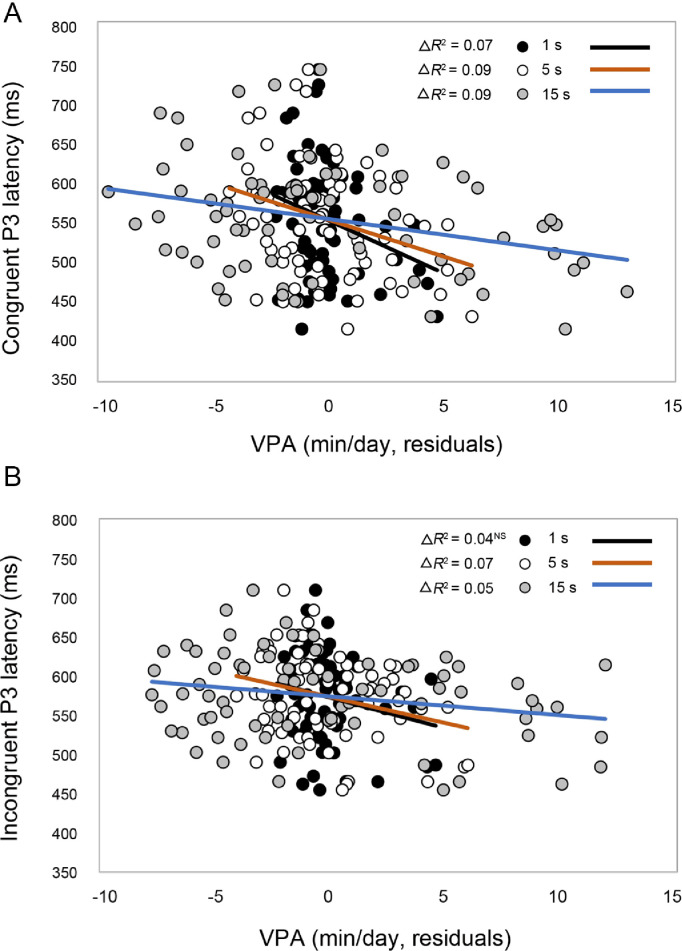
Results: Daily VPA was not related to RTmean or accuracy on either congruent or incongruent trials. In contrast, more time spent in VPA bouts lasting ≥30 s predicted shorter P3 latency across epochs and flanker congruencies (all β ≤ -0.24, all p ≤ 0.04). The associations between shorter P3 latency and the time spent in moderate-to-vigorous PA bouts lasting ≥30 s were less consistent and largely limited to congruent trials (congruent: β (-0.31, -0.34)). No significant associations were observed upon correction for false discovery rate.
Conclusion: The pattern of uncorrected associations aligns with the dose-response literature and suggests that brief VPA bouts may yield the greatest benefits to cognitive processing speed in preadolescents. Future studies using measures of brain structure and function are needed to understand the mechanisms linking bouted VPA to neurocognitive function during childhood.
Keywords: Accelerometry; Bouts; Children; ERPs; Inhibitory control; P3; Physical activity.
Figures

References
-
- Esteban-Cornejo I., Cadenas-Sanchez C., Contreras-Rodriguez O., Verdejo-Roman J., Mora-Gonzalez J., Migueles J.H. A whole brain volumetric approach in overweight/obese children: examining the association with different physical fitness components and academic performance. The ActiveBrains project. Neuroimage. 2017;159:346–354. - PubMed
Grants and funding
LinkOut - more resources
Full Text Sources
