Review
. 2019 Jul 5:6:101.
doi: 10.3389/fnut.2019.00101. eCollection 2019.

What Is Gluten-Why Is It Special?

Affiliations
Review

What Is Gluten-Why Is It Special?

Peter Shewry. Front Nutr. .

Abstract

Wheat gluten has an immense impact on human nutrition as it largely determines the processing properties of wheat flour, and in particular the ability to make leavened breads, other baked products, pasta and noodles. However, there has been increasing interest in wheat gluten over the past two decades because of its well-established role in triggering coeliac disease, and its perceived role in other adverse reactions to wheat. The literature on wheat gluten is vast and extends back over two centuries, with most studies focusing on the structures of gluten proteins and their role in determining the functional properties of wheat flour and dough. This article provides a concise account of wheat gluten, focusing on properties, and features which are relevant to its role in triggering coeliac disease and, to a lesser extent, other gluten-related disorders. It includes descriptions of the biological role of the gluten proteins, the structures and relationships of gluten protein families, and the presence of related types of protein which may also contribute to functional properties and impacts on health. It therefore provides an understanding of the gluten protein system at the level required by those focusing on its impact on human health.

Keywords: ATI; coeliac disease; gliadin; gluten; prolamin; protein; wheat.


Figures
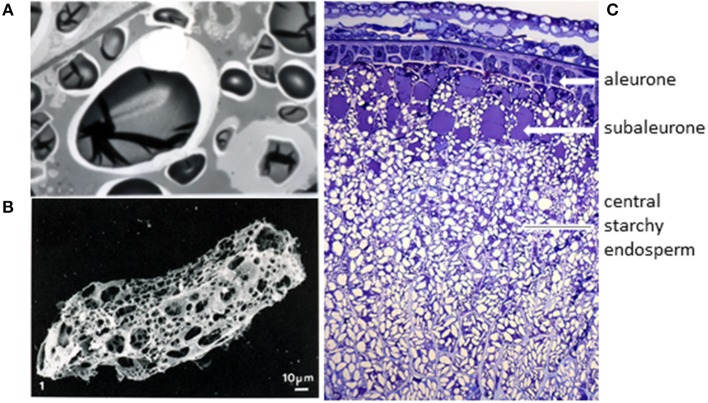
Figure 1
Figure 1
The origin of wheat gluten. (A) Transmission electron microscopy of starchy endosperm cells at a late stage of grain development (46 days after anthesis) shows that the individual protein bodies have fused to form a continuous proteinaceous matrix. Taken from Shewry et al. (9) with permission, provided by Dr. M. Parker (IFR, Norwich, UK). (B) Digestion of a flour particle to remove starch reveals a continuous proteinaceous network. Taken from Amend and Beauvais (10) with permission. (C) Transverse section of the lobe region of a developing wheat grain stained with Toluidine Blue to show the tissue structure and deposited protein (in blue). Figure kindly provided by Cristina Sanchis Gritsch and Paola Tosi (Rothamsted Research).
Figure 2
Figure 2
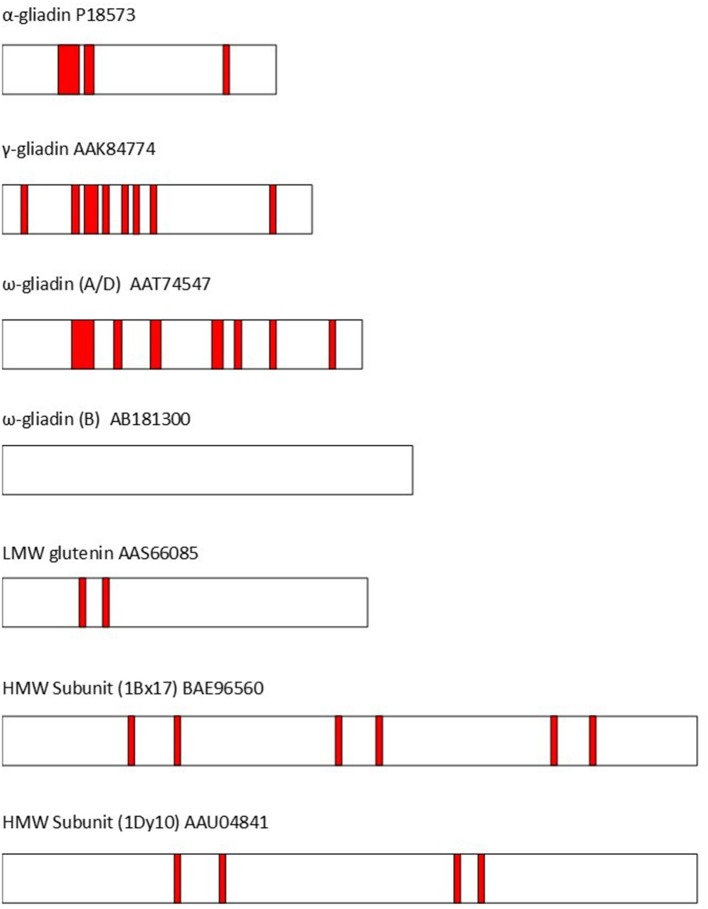
The distribution of T-cell epitopes (shown as red bars) in representative wheat gluten proteins (identified by GenBank accession codes). The epitopes are based on Sollid et al. (36). α-gliadin P18573: DQ2.5-glia-α1a, DQ2.5-glia-α1b, DQ2.5-glia-α2, & DQ8-glia-α1. γ-gliadin AAK84774: DQ2.5-glia-ω1/hor-1/sec-1, DQ8-glia-γ1a, DQ8-glia-γ2, DQ8-glia-γ4c, & DQ8-glia-γ5. ω-gliadin (A/D) AAT74547: DQ2.5-glia-γ5, DQ8-glia-γ1a, DQ2.5-glia-ω1/hor-1/sec-1, DQ8-glia- γ1b, & DQ2.5-glia- γ3. ω-gliadin (B) AB181300 no coeliac toxic epitopes present. LMW subunit AAS66085:DQ2.5-glut-L1. HMW Subunit (1Bx17) BAE96560: DQ8.5-glut-H1. HMW Subunit (1Dy10) AAU04841: DQ8.5-glut-H1. Modified from Shewry and Tatham (37).

References

    1. Beccari JB. De Frumento. Bononia: De Bononiensi Scientifiarurm et Atrium atque Academia Commentarii Tomi Secundi; (1745).
    1. Bailey CH. A translation of Beccari's “Concerning grain” 1728. Cereal Chem. (1941) 18:555–61.
    1. Dicke W. K. (1950). Coeliakie. (MD Thesis). Utrecht: University of Utrecht.
    1. Catassi C, Alaedini A, Bojarski C, Bonaz B, Bouma G, Carroccio A, et al. The overlapping area of non-celiac gluten sensitivity (NCGS) and wheat-sensitive irritable bowel syndrome (IBS): an update. Nutrients. (2017) 9:1268. 10.3390/nu9111268 - DOI - PMC - PubMed
    1. Juhász A, Belova T, Florides C, Maulis C, Fischer I, Gell G, et al. Genome mapping of seed-borne allergens and immunoresponsive proteins in wheat. Sci Adv. (2018) 4:eaar8602. 10.1126/sciadv.aar8602 - DOI - PMC - PubMed