


HOPE-Trial: Hemiarthroplasty Compared with Total Hip Arthroplasty for Displaced Femoral Neck Fractures in Octogenarians: A Randomized Controlled Trial
- PMID: 31334466
- PMCID: PMC6613852
- DOI: 10.2106/JBJS.OA.18.00059
HOPE-Trial: Hemiarthroplasty Compared with Total Hip Arthroplasty for Displaced Femoral Neck Fractures in Octogenarians: A Randomized Controlled Trial
Abstract
Background: The choice of primary hemiarthroplasty or total hip arthroplasty in patients ≥80 years of age with a displaced femoral neck fracture has not been adequately studied. As the number of healthy, elderly patients ≥80 years of age is continually increasing, optimizing treatments for improving outcomes and reducing the need for secondary surgery is an important consideration. The aim of the present study was to compare the results of hemiarthroplasty with those of total hip arthroplasty in patients ≥80 years of age.
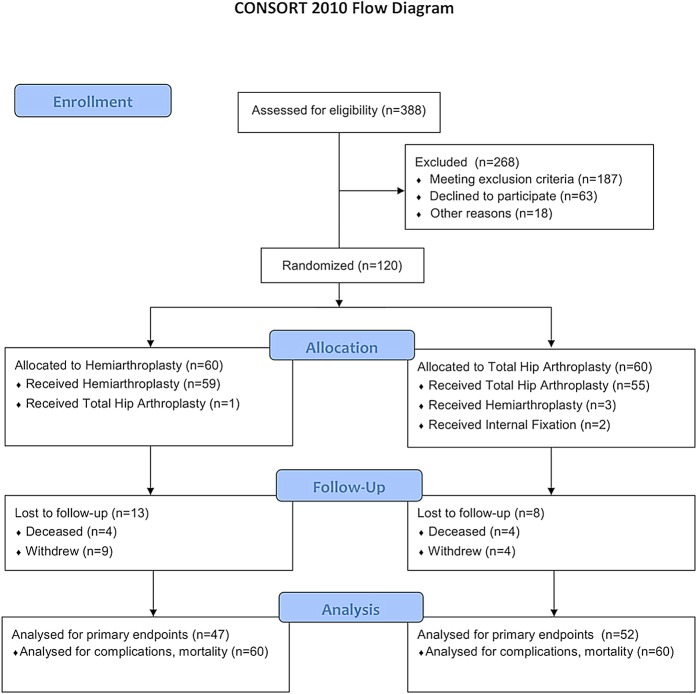
Methods: This prospective, randomized, single-blinded trial included 120 patients with a mean age of 86 years (range, 80 to 94 years) who had sustained an acute displaced femoral neck fracture <36 hours previously. The patients were randomized to treatment with hemiarthroplasty (n = 60) or total hip arthroplasty (n = 60). The primary end points were hip function and health-related quality of life at 2 years. Secondary end points included hip-related complications and reoperations, mortality, pain in the involved hip, activities of daily living, surgical time, blood loss, and general complications. The patients were reviewed at 3 months and 1 and 2 years.
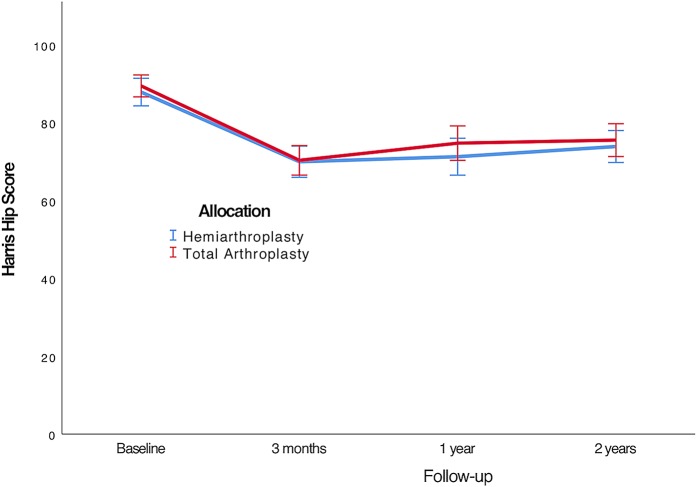
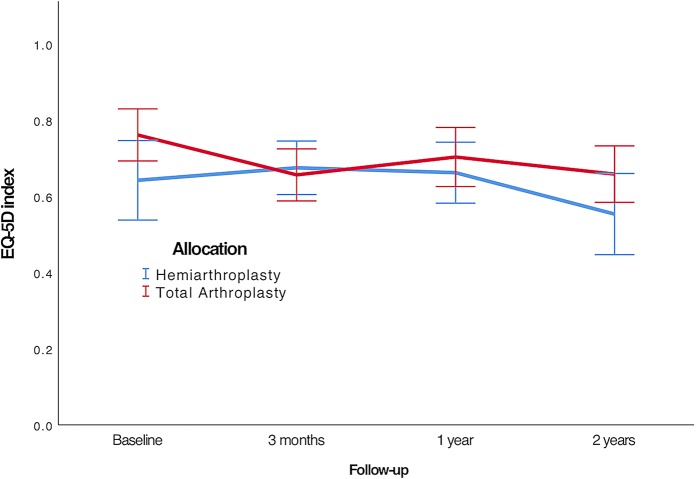
Results: We found no differences between the groups in terms of hip function, health-related quality of life, hip-related complications and reoperations, activities of daily living, or pain in the involved hip. Hip function, activities of daily living, and pain in the involved hip deteriorated in both groups compared with pre-fracture values. The ability to regain previous walking function was similar in both groups.
Conclusions: We found no difference in outcomes after treatment with either hemiarthroplasty or total hip arthroplasty in active octogenarians and nonagenarians with a displaced femoral neck fracture up to 2 years after surgery. Hemiarthroplasty is a suitable procedure in the short term for this group of patients.
Level of evidence: Therapeutic Level I. See Instructions for Authors for a complete description of levels of evidence.
Figures
References
-
- Parker MJ, Pryor G, Gurusamy K. Hemiarthroplasty versus internal fixation for displaced intracapsular hip fractures: a long-term follow-up of a randomised trial. Injury. 2010. April;41(4):370-3. Epub 2009 Oct 30. - PubMed
-
- Ravikumar KJ, Marsh G. Internal fixation versus hemiarthroplasty versus total hip arthroplasty for displaced subcapital fractures of femur—13 year results of a prospective randomised study. Injury. 2000. December;31(10):793-7. - PubMed
-
- Leonardsson O, Sernbo I, Carlsson A, Akesson K, Rogmark C. Long-term follow-up of replacement compared with internal fixation for displaced femoral neck fractures: results at ten years in a randomised study of 450 patients. J Bone Joint Surg Br. 2010. March;92(3):406-12. - PubMed
-
- Heetveld MJ, Rogmark C, Frihagen F, Keating J. Internal fixation versus arthroplasty for displaced femoral neck fractures: what is the evidence? J Orthop Trauma. 2009. July;23(6):395-402. - PubMed
-
- Keating JF, Grant A, Masson M, Scott NW, Forbes JF. Displaced intracapsular hip fractures in fit, older people: a randomised comparison of reduction and fixation, bipolar hemiarthroplasty and total hip arthroplasty. Health Technol Assess. 2005. October;9(41):iii-iv, ix-x, 1-65. - PubMed
LinkOut - more resources
Full Text Sources
Research Materials