


Adverse drug event and medication extraction in electronic health records via a cascading architecture with different sequence labeling models and word embeddings
- PMID: 31334805
- PMCID: PMC7489070
- DOI: 10.1093/jamia/ocz120
Adverse drug event and medication extraction in electronic health records via a cascading architecture with different sequence labeling models and word embeddings
Abstract
Objective: An adverse drug event (ADE) refers to an injury resulting from medical intervention related to a drug including harm caused by drugs or from the usage of drugs. Extracting ADEs from clinical records can help physicians associate adverse events to targeted drugs.
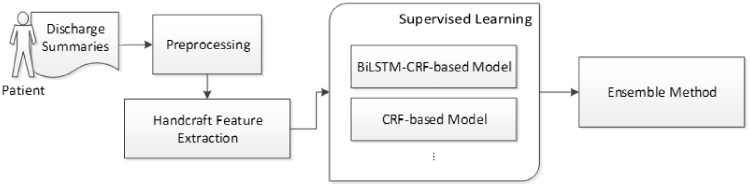
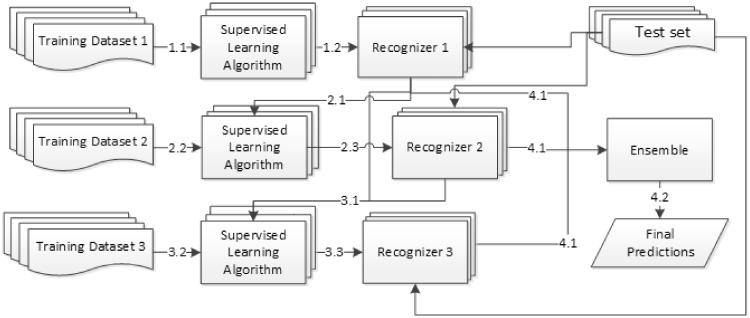
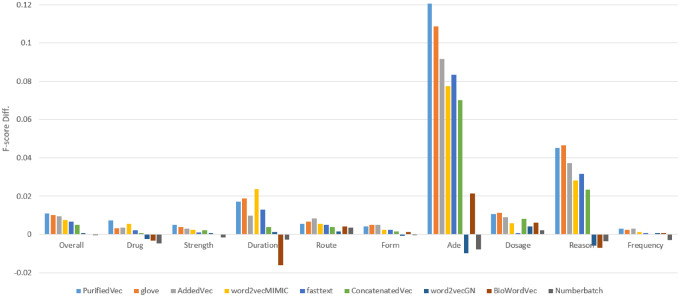
Materials and methods: We proposed a cascading architecture to recognize medical concepts including ADEs, drug names, and entities related to drugs. The architecture includes a preprocessing method and an ensemble of conditional random fields (CRFs) and neural network-based models to respectively address the challenges of surrogate string and overlapping annotation boundaries observed in the employed ADEs and medication extraction (ADME) corpus. The effectiveness of applying different pretrained and postprocessed word embeddings for the ADME task was also studied.
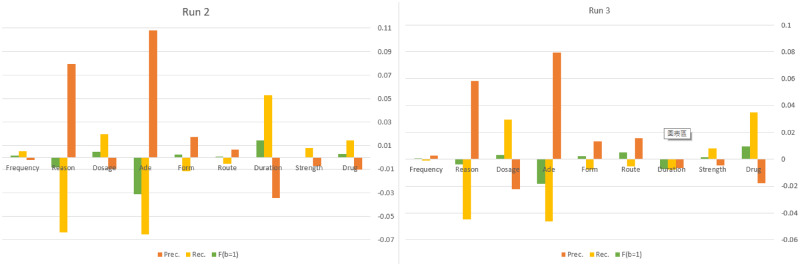
Results: The empirical results showed that both CRFs and neural network-based models provide promising solution for the ADME task. The neural network-based models particularly outperformed CRFs in concept types involving narrative descriptions. Our best run achieved an overall micro F-score of 0.919 on the employed corpus. Our results also suggested that the Global Vectors for word representation embedding in general domain provides a very strong baseline, which can be further improved by applying the principal component analysis to generate more isotropic vectors.
Conclusions: We have demonstrated that the proposed cascading architecture can handle the problem of overlapped annotations and further improve the overall recall and F-scores because the architecture enables the developed models to exploit more context information and forms an ensemble for creating a stronger recognizer.
Keywords: adverse drug event; electronic health record; information extraction; named entity recognition; word embedding.
© The Author(s) 2019. Published by Oxford University Press on behalf of the American Medical Informatics Association. All rights reserved. For permissions, please email: journals.permissions@oup.com.
Figures

References
-
- Nebeker JR, Barach P, Samore MH.. Clarifying adverse drug events: a clinician's guide to terminology, documentation, and reporting. Ann Intern Med 2004; 140 (10): 795–801. - PubMed
-
- Bates DW, Cullen DJ, Laird N, et al. Incidence of adverse drug events and potential adverse drug events: implications for prevention. JAMA 1995; 274 (1): 29–34. - PubMed
-
- Classen DC, Pestotnik SL, Evans RS, Lloyd JF, Burke JP.. Adverse drug events in hospitalized patients: excess length of stay, extra costs, and attributable mortality. JAMA 1997; 277 (4): 301–6. - PubMed
-
- Leape LL, Bates DW, Cullen DJ, et al. Systems analysis of adverse drug events. JAMA 1995; 274 (1): 35–43. - PubMed
Publication types
MeSH terms
Grants and funding
LinkOut - more resources
Full Text Sources
Medical
