Review
. 2019 Jul 12;24(14):2546.
doi: 10.3390/molecules24142546.

The Nervous System Relevance of the Calcium Sensing Receptor in Health and Disease

Affiliations
Review

The Nervous System Relevance of the Calcium Sensing Receptor in Health and Disease

Maria Lo Giudice et al. Molecules. .

Abstract

The calcium sensing receptor (CaSR) was first identified in parathyroid glands, and its primary role in controlling systemic calcium homeostasis by the regulation of parathyroid hormone (PTH) secretion has been extensively described in literature. Additionally, the receptor has also been investigated in cells and tissues not directly involved in calcium homeostasis, e.g., the nervous system (NS), where it plays crucial roles in early neural development for the differentiation of neurons and glial cells, as well as in the adult nervous system for synaptic transmission and plasticity. Advances in the knowledge of the CaSR's function in such physiological processes have encouraged researchers to further broaden the receptor's investigation in the neuro-pathological conditions of the NS. Interestingly, pre-clinical data suggest that receptor inhibition by calcilytics might be effective in counteracting the pathomechanism underlying Alzheimer's disease and ischemia, while a CaSR positive modulation with calcimimetics has been proposed as a potential approach for treating neuroblastoma. Importantly, such promising findings led to the repurposing of CaSR modulators as novel pharmacological alternatives for these disorders. Therefore, the aim of this review article is to critically appraise evidence which, so far, has been yielded from the investigation of the role of the CaSR in physiology of the nervous system and to focus on the most recent emerging concepts which have reported the receptor as a therapeutic target for neurodegeneration and neuroblastic tumors.

Keywords: Alzheimer’s disease; calcilytic; calcimimetic; calcium-sensing receptor; ischemia; nervous system; neuroblastoma.


Conflict of interest statement

The authors declare no conflict of interest.

Figures
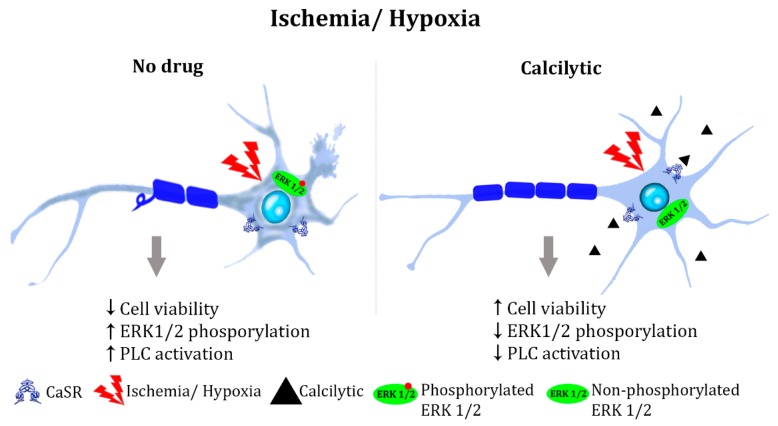
Figure 1
Figure 1
Hypothesized action of a calcilytic in ischemia and hypoxia: Neurons subjected to ischemic or hypoxic stress present reduced cell viability (due to the upregulation of cell death-related proteins such as caspase-3, Bax, and cytochrome C), increased ERK1/2 phosphorylation and phospholipase C (PLC)-activated-Ca2+ intracellular mobilization. Such events are likely mediated by the CaSR and concur with cell death (here represented by axonal demyelination and changes in cell morphology). Calcilytic treatment efficiently attenuates mitogen-activated protein kinase (MAPK) and PLC-activated pathways and restores cell viability.
Figure 2
Figure 2
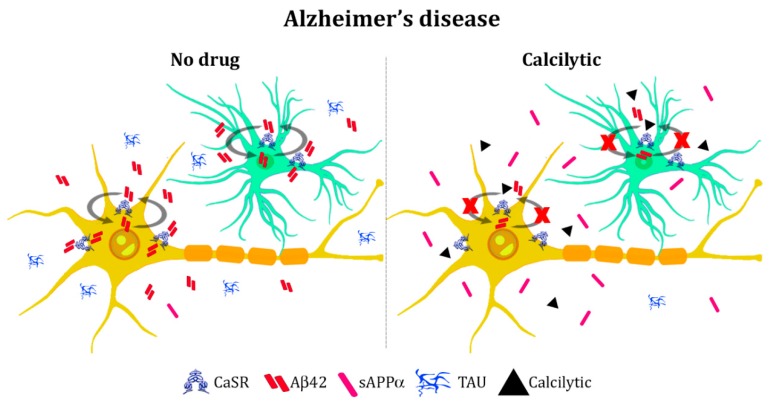
Model of the calcilytic effect in Alzheimer’s disease: Extracellular Aβ42, is over-secreted during Alzheimer’s disease (AD) and binds the CaSR at the plasma membrane of neurons (yellow cell) and astrocytes (green cell). The Aβ42/CaSR-activated signaling mediates a further release of de novo produced Aβ42 and hyperphosphorylated TAU, so feeding a vicious cycle. Moreover, the secretion of sAPPα is dramatically reduced. Treatment with a calcilytic blocks this signaling by reducing Aβ42 and TAU secretion while increasing the release of sAPPα.
Figure 3
Figure 3
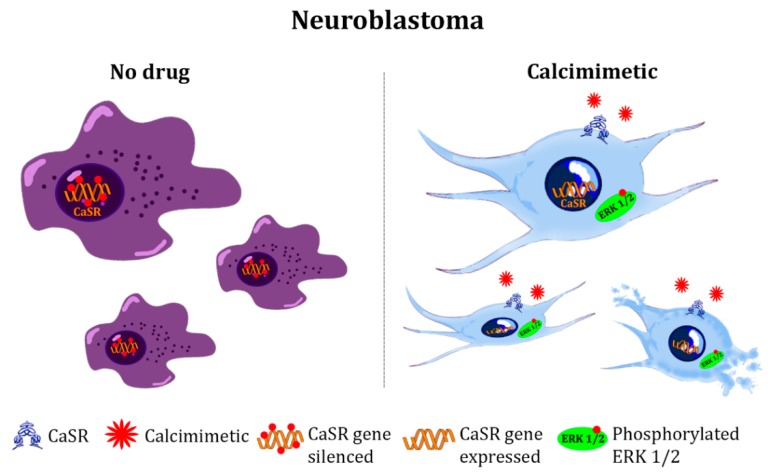
Proposed role of the CaSR in neuroblastoma: The CaSR functions as a tumor-suppressor in neuroblastic tumors. The receptor gene is silenced, while protein expression results to be low or absent in aggressive and high-proliferative neuroblastoma. The CaSR’s restored expression, associated with calcimimetic treatment, promotes tumor differentiation, growth inhibition, and cell death promoted by receptor-activated ERK1/2 phosphorylation.

References

    1. Brown E.M., Gamba G., Riccardi D., Lombardi M., Butters R., Kifor O., Sun A., Hediger M.A., Lytton J., Hebert S.C. Cloning and characterization of an extracellular Ca2+-sensing receptor from bovine parathyroid. Nature. 1993;366:575–580. doi: 10.1038/366575a0. - DOI - PubMed
    1. Hendy G.N., Canaff L. Calcium-Sensing Receptor Gene: Regulation of Expression. Front. Physiol. 2016;7:394. doi: 10.3389/fphys.2016.00394. - DOI - PMC - PubMed
    1. Canaff L., Hendy G.N. Human calcium-sensing receptor gene. Vitamin D response elements in promoters P1 and P2 confer transcriptional responsiveness to 1,25-dihydroxyvitamin D. J. Biol. Chem. 2002;277:30337–30350. doi: 10.1074/jbc.M201804200. - DOI - PubMed
    1. Zhang C., Zhang T., Zou J., Miller C.L., Gorkhali R., Yang J.-Y., Schilmiller A., Wang S., Huang K., Brown E.M., et al. Structural basis for regulation of human calcium-sensing receptor by magnesium ions and an unexpected tryptophan derivative co-agonist. Sci. Adv. 2016;2:e1600241. doi: 10.1126/sciadv.1600241. - DOI - PMC - PubMed
    1. Geng Y., Mosyak L., Kurinov I., Zuo H., Sturchler E., Cheng T.C., Subramanyam P., Brown A.P., Brennan S.C., Mun H., et al. Structural mechanism of ligand activation in human calcium-sensing receptor. elife. 2016;5:e13662. doi: 10.7554/eLife.13662. - DOI - PMC - PubMed

LinkOut - more resources