Review
. 2019 Jul 12;11(7):978.
doi: 10.3390/cancers11070978.

Are Integrins Still Practicable Targets for Anti-Cancer Therapy?

Affiliations
Review

Are Integrins Still Practicable Targets for Anti-Cancer Therapy?

Begoña Alday-Parejo et al. Cancers (Basel). .

Abstract

Correlative clinical evidence and experimental observations indicate that integrin adhesion receptors, in particular those of the αV family, are relevant to cancer cell features, including proliferation, survival, migration, invasion, and metastasis. In addition, integrins promote events in the tumor microenvironment that are critical for tumor progression and metastasis, including tumor angiogenesis, matrix remodeling, and the recruitment of immune and inflammatory cells. In spite of compelling preclinical results demonstrating that the inhibition of integrin αVβ3/αVβ5 and α5β1 has therapeutic potential, clinical trials with integrin inhibitors targeting those integrins have repeatedly failed to demonstrate therapeutic benefits in cancer patients. Here, we review emerging integrin functions and their proposed contribution to tumor progression, discuss preclinical evidence of therapeutic significance, revisit clinical trial results, and consider alternative approaches for their therapeutic targeting in oncology, including targeting integrins in the other cells of the tumor microenvironment, e.g., cancer-associated fibroblasts and immune/inflammatory cells. We conclude that integrins remain a valid target for cancer therapy; however, agents with better pharmacological properties, alternative models for their preclinical evaluation, and innovative combination strategies for clinical testing (e.g., together with immuno-oncology agents) are needed.

Keywords: angiogenesis; cancer; imaging; therapy; tumor microenvironment.


Conflict of interest statement

The authors declare no conflict of interest.

Figures

Figure 1
Figure 1
Integrin-dependent functions relevant to cancer. Integrins have been implicated in mediating several hallmarks of cancer, including cancer cell proliferation, dormancy, survival, stemness, metabolic adaptation, and metastatic niche formation. Integrins also promote epithelial-to-mesenchymal transition and invasion, which are two key steps of metastasis formation. In the tumor microenvironment, integrins promote endothelial cell survival and angiogenesis, the recruitment of immune and inflammatory cells, and stroma remodeling and fibrosis induced by cancer-associated fibroblasts. The role of integrins in these functions are described in more detail in Section 4.1–Section 4.6 and Sections 5.1, and Sections 5.2. This listing is non-exhaustive. Abbreviations: CAF, cancer-associated fibroblasts; CCN1, cysteine rich protein 61 (CYR61); CSC, cancer stem cell; endothelial cell; EC, endothelial cells, ECM, extracellular matrix; EMT, epithelial to mesenchymal transition; EXS, exosomes; LOX, lysyl oxidase; PC, pericytes; POSTN, periostin; TC, tumor cell; TNC, tenascin.
Figure 2
Figure 2
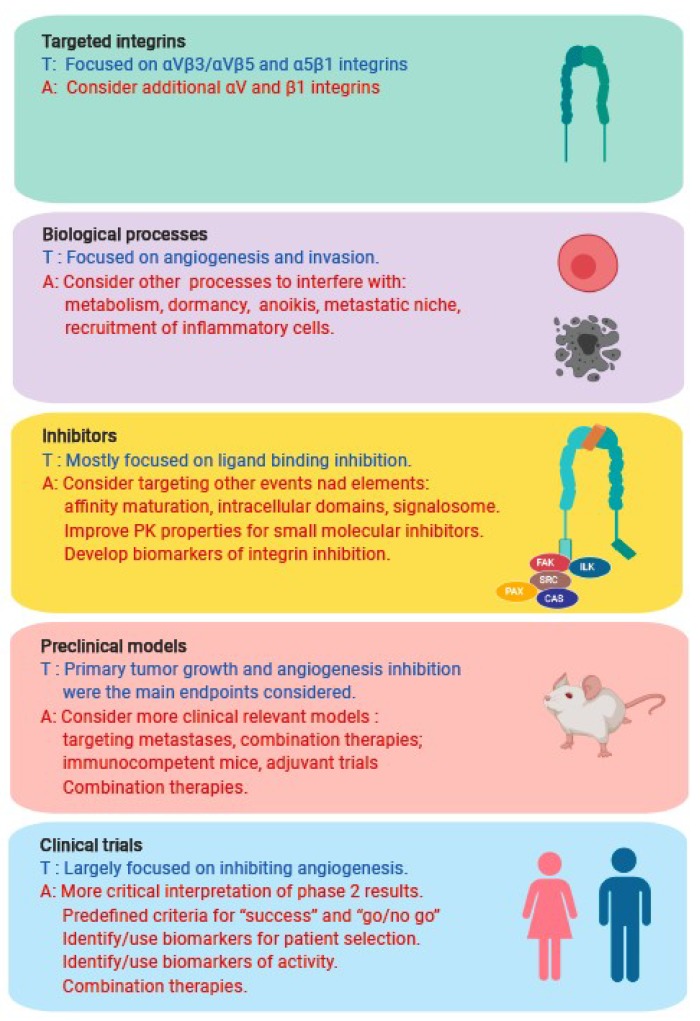
What went wrong with the development of integrin inhibitors in cancer, and what can we do different? The field focused largely on a few integrins, most notably αVβ3/αVβ5 and α5β1 based on early preclinical work with the purpose to target tumor angiogenesis, using a limited set of inhibitors (mostly interfering with ligand binding). A better understanding of integrin function and biology, and the accumulated experience with clinical studies, should stimulate us to think about developing new concepts, tools, and approaches to successfully exploit integrins as therapeutic targets in cancer. Here is a non-exhaustive summary of the concepts discussed in the text. T, tested in the past to present; A, alternative strategies to consider.
Figure 3
Figure 3
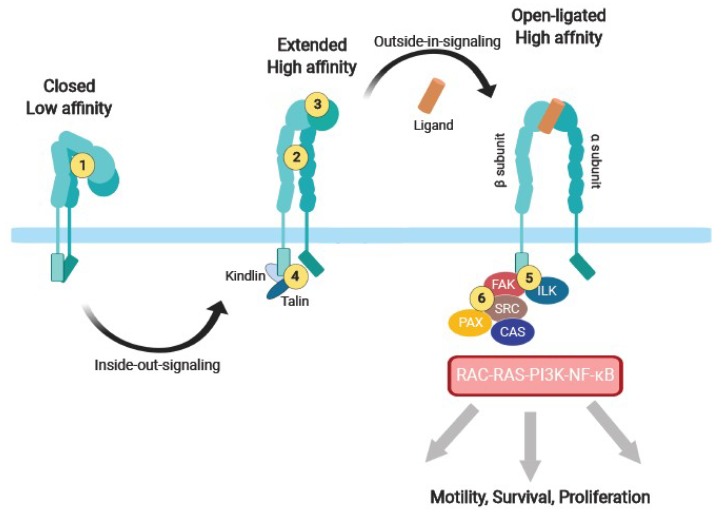
Alternative strategies to inhibit integrins. Current integrin inhibitors are mostly based on preventing ligand binding through direct competition or (allo)steric interference with the extracellular domains. However, some of these ligand-binding inhibitors may activate integrins and do not fully suppress integrin signaling. Alternative approaches to interfere with integrin function may be considered since integrin activation and signaling are complex events involving multiple and different steps. Strategies to consider include: 1, the retention of bent integrins in their low-affinity state; 2, the prevention of full integrin extension and affinity maturation; and 3, irreversible preclusion of ligand binding by covalent modification of the binding pocket. The intracellular domains and the adhesome also provide additional opportunities, including: 4, interfering with kindlin/talin-mediated activation; 5, the prevention of recruitments of signaling proteins of the adhesome (e.g., FAK) to the β cytodomain; 6, the prevention of adhesome maturation or induction of adhesome dissolution by interfering with protein–protein interactions.

References

    1. Hemler M.E. VLA proteins in the integrin family: Structures, functions, and their role on leukocytes. Annu. Rev. Immunol. 1990;8:365–400. doi: 10.1146/annurev.iy.08.040190.002053. - DOI - PubMed
    1. Ruoslahti E. Fibronectin and its integrin receptors in cancer. Adv. Cancer Res. 1999;76:1–20. - PubMed
    1. Hynes R.O. Integrins: Bidirectional, allosteric signaling machines. Cell. 2002;110:673–687. doi: 10.1016/S0092-8674(02)00971-6. - DOI - PubMed
    1. Luo B.H., Carman C.V., Springer T.A. Structural basis of integrin regulation and signaling. Annu. Rev. Immunol. 2007;25:619–647. doi: 10.1146/annurev.immunol.25.022106.141618. - DOI - PMC - PubMed
    1. Curley G.P., Blum H., Humphries M.J. Integrin antagonists. Cell Mol. Life Sci. 1999;56:427–441. doi: 10.1007/s000180050443. - DOI - PMC - PubMed

LinkOut - more resources