Review
. 2019 Jul 13;7(7):199.
doi: 10.3390/microorganisms7070199.

The Host-Microbe Interplay in Human Papillomavirus-Induced Carcinogenesis

Affiliations
Review

The Host-Microbe Interplay in Human Papillomavirus-Induced Carcinogenesis

Rei Wakabayashi et al. Microorganisms. .

Abstract

Every year nearly half a million new cases of cervix cancer are diagnosed worldwide, making this malignancy the fourth commonest cancer in women. In 2018, more than 270,000 women died of cervix cancer globally with 85% of them being from developing countries. The majority of these cancers are caused by the infection with carcinogenic strains of human papillomavirus (HPV), which is also causally implicated in the development of other malignancies, including cancer of the anus, penis cancer and head and neck cancer. HPV is by far the most common sexually transmitted infection worldwide, however, most infected people do not develop cancer and do not even have a persistent infection. The development of highly effective HPV vaccines against most common high-risk HPV strains is a great medical achievement of the 21st century that could prevent up to 90% of cervix cancers. In this article, we review the current understanding of the balanced virus-host interaction that can lead to either virus elimination or the establishment of persistent infection and ultimately malignant transformation. We also highlight the influence of certain factors inherent to the host, including the immune status, genetic variants and the coexistence of other microbe infections and microbiome composition in the dynamic of HPV infection induced carcinogenesis.

Keywords: genetic variation; human microbiome; human papilloma virus; immunosurveillance; virus induced carcinogenesis.


Conflict of interest statement

The authors declare no conflict of interest.

Figures
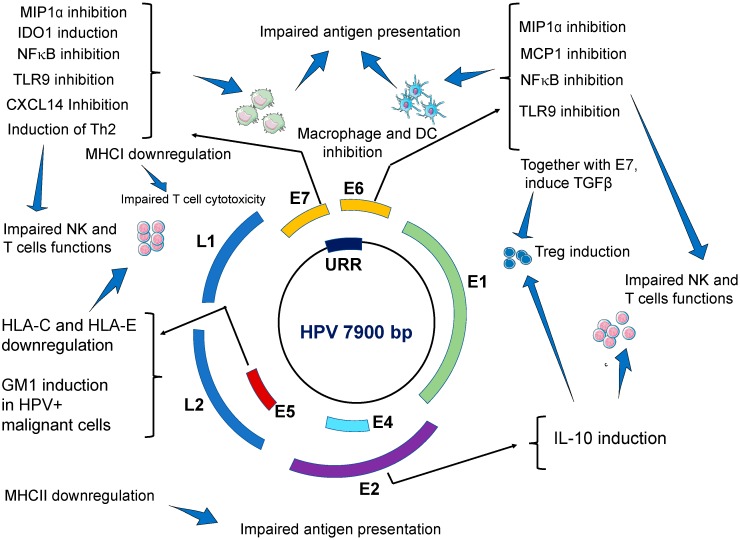
Figure 1
Figure 1
Viral gene products of HPVs and their effects on host immune response. Several HPV gene products, especially E2, E5, E6, and E7 exert a variety of inhibitory effects on several components of the host immune system which result in impaired antigen presentation, weakened natural killer (NK) cells and Treg (T) cells cytotoxic activities, and deficient immunosurveillance, which promotes the establishing a persistent infection that can ultimately result in malignant transformation.
Figure 2
Figure 2
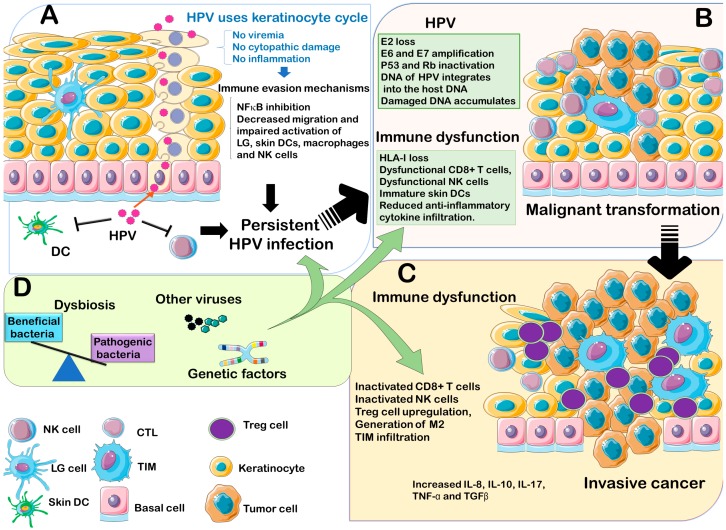
Main factors involved in HPV-induced carcinogenesis. (A) Establishing a persistent infection. HPVs have evolved to synchronize their viral cycle to the natural process of keratinocytes differentiation. During this process, the HPV virions are released once keratinocytes complete their differentiation process and therefore, no danger signals are activated and no inflammatory reaction is induced during this cycle. In addition, HPVs manage to avoid immune cells activation by several mechanisms, including inhibition NFκB in keratinocytes and in local immune cells, thus preventing the release of proinflammatory signals. HPVs induce the downregulation of TLR9 expression on keratinocytes, and also impair the local infiltration and activation of antigen presented cells and other components of the innate immune cells, such as skin dendritic cells, macrophages, Langerhans cells and NK cells, ultimately leading to the establishment and maintenance of a persistent infection. (B) Malignant transformation. Once a persistent infection has established, the immune system can eventually clear the virus after months or years but in some individuals the infection with high risk HPVs induces malignant transformation. During this process, the viral genome is integrated into the host DNA and is associated with the loss of E2 and the concomitant amplification of E6 and E7 which induces the inactivation of tumor repressors p53 and Rb. In parallel, the immune system fails to detect or eliminate transformed cells leading to tumor formation. (C) Tumor progression. During this step, mutations accumulate and immune cells are not only unresponsive to the virus transformed cells but also malignant cells hijack immune system inducing a chronic inflammatory environment with immune cells (Treg, M2 and TIM) that are hostile to anti-tumor immune cells and secrete cytokines and other growth factors that promote the proliferation and invasion of malignant cells. (D) Contributing factors. In addition to the viral oncogenic factors and the failure of the immune system to clear HPVs, other factors inherent to the host, such as genetic predisposition, co-infection with other microorganisms, and an altered microbiota may contribute to the carcinogenesis process by affecting the response of the host to the virus infection.

References

    1. Gravitt P.E., Winer R.L. Natural history of hpv infection across the lifespan: Role of viral latency. Viruses. 2017;9:267. doi: 10.3390/v9100267. - DOI - PMC - PubMed
    1. Bonagura V.R., Du Z., Ashouri E., Luo L., Hatam L.J., DeVoti J.A., Rosenthal D.W., Steinberg B.M., Abramson A.L., Gjertson D.W., et al. Activating killer cell immunoglobulin-like receptors 3ds1 and 2ds1 protect against developing the severe form of recurrent respiratory papillomatosis. Hum. Immunol. 2010;71:212–219. doi: 10.1016/j.humimm.2009.10.009. - DOI - PMC - PubMed
    1. DeVoti J., Hatam L., Lucs A., Afzal A., Abramson A., Steinberg B., Bonagura V. Decreased langerhans cell responses to il-36γ: Altered innate immunity in patients with recurrent respiratory papillomatosis. Mol. Med. 2014;20:372–380. doi: 10.2119/molmed.2014.00098. - DOI - PMC - PubMed
    1. Miyague A.H., Mauad F.M., Martins W.D.P., Benedetti A.C., Ferreira A.E., Mauad-Filho F. Ultrasound scan as a potential source of nosocomial and crossinfection: A literature review. Radiol. Bras. 2015;48:319–323. doi: 10.1590/0100-3984.2014.0002. - DOI - PMC - PubMed
    1. Wang X., Huang X., Zhang Y. Involvement of human papillomaviruses in cervical cancer. Front. Microbiol. 2018;9:2896. doi: 10.3389/fmicb.2018.02896. - DOI - PMC - PubMed

LinkOut - more resources