. 2019 Jul 13;8(7):721.
doi: 10.3390/cells8070721.

Primary Human Fibroblasts in Culture Switch to a Myofibroblast-Like Phenotype Independently of TGF Beta

Affiliations

Primary Human Fibroblasts in Culture Switch to a Myofibroblast-Like Phenotype Independently of TGF Beta

Ulrike Baranyi et al. Cells. .

Abstract

Fibroblasts are the prevalent cell type and main source for extracellular matrix (ECM) in connective tissue. Depending on their origin, fibroblasts play a central role in non-pathological tissue remodeling and disease like fibrosis. This study examined the effect of established culture conditions of primary human fibroblasts, from different origins on the myofibroblast-like phenotype formation. We isolated primary human fibroblasts from aortic adventitia, lung, juvenile- and adult skin and investigated the expression levels of CD90, alpha smooth muscle actin (αSMA) and procollagen I under different concentrations of fetal calf serum (FCS) and ascorbic acid (AA) in culture media by immunoblot and immunofluorescence assays. Furthermore, we determined the viability using XTT and migration/wound healing in scratch assays. Collagen 1 secretion was quantified by specific ELISA. Primary human fibroblasts show in part a myofibroblast-like phenotype even without addition of FCS. Supplemented AA reduces migration of cultured fibroblasts with no or low concentrations of FCS. Furthermore, AA and higher concentrations of FCS in culture media lead to higher levels of collagen 1 secretion instead of procollagen I accumulation. This study provides evidence for a partial switch of primary human fibroblasts of different origin to a myofibroblast-like phenotype under common culture conditions.

Keywords: CD90; alpha smooth muscle actin; ascorbic acid; fibroblast; myofibroblast phenotype; procollagen I.


Conflict of interest statement

The authors declare no conflicts of interest.

Figures
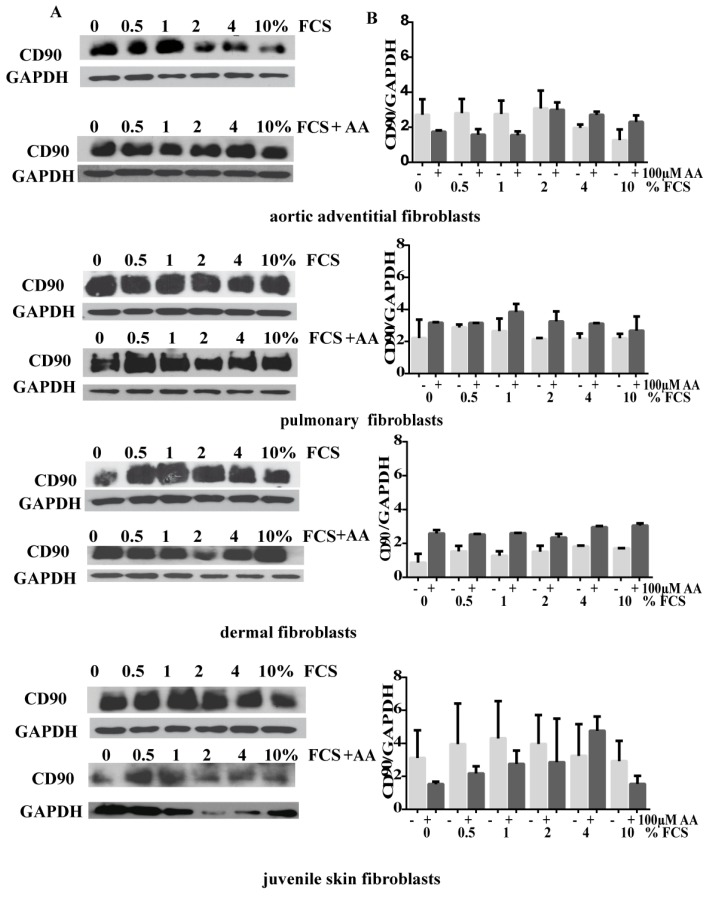
Figure 1
Figure 1
Expression levels of CD90 with different concentrations of fetal calf syndrome (FCS) and FCS plus 100 µM ascorbic acid (AA) within the culture medium of different fibroblast types. (A) Expression levels of CD90 are illustrated by immunoblots as indicated. For normalization, protein levels of GAPDH are demonstrated. (B) Quantification of CD90 is present as ratio of CD90/GAPDH signal. Data are the mean of at least 2–4 experiments with polyclonal and monoclonal Abs for CD90.
Figure 2
Figure 2
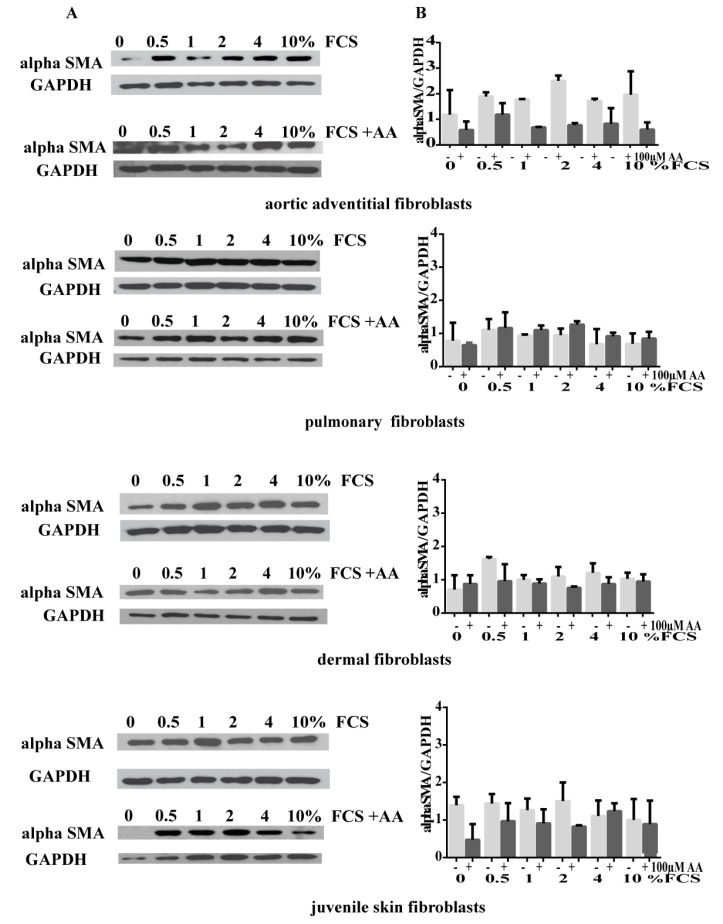
Expression levels of alpha SMA with different concentrations of FCS and FCS plus 100 µM Ascorbic acid in culture medium in fibroblasts. (A) Expression levels of αSMA are illustrated by immunoblots as indicated. For normalization, protein levels of GAPDH are demonstrated. (B) Quantification of αSMA is present as ratio of αSMA/GAPDH signal. Data are the mean of at least 2–4 experiments with polyclonal and monoclonal Abs for αSMA.
Figure 3
Figure 3
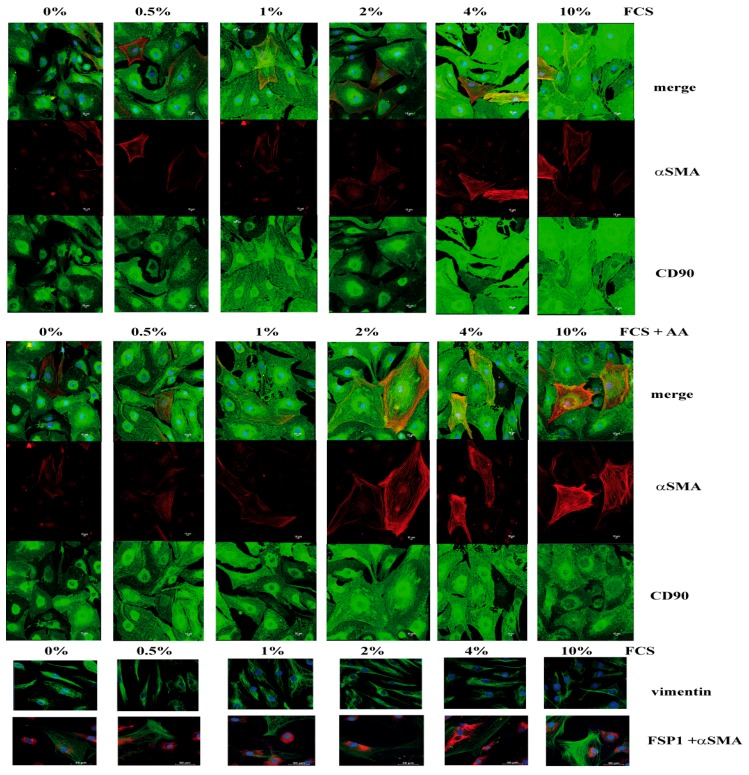
Expression levels of CD90 (green), FSP1 (red), vimentin (green) and αSMA (green) in AoAFs shown by immunofluorescence staining and confocal microscopy pictures. CD90 (Thy-1), FSP1, and vimentin are expressed in all fibroblasts, while αSMA is expressed only in individual cells. Nuclei were stained with TOPRO-3 or Hoechst-stain and are shown in blue.
Figure 4
Figure 4
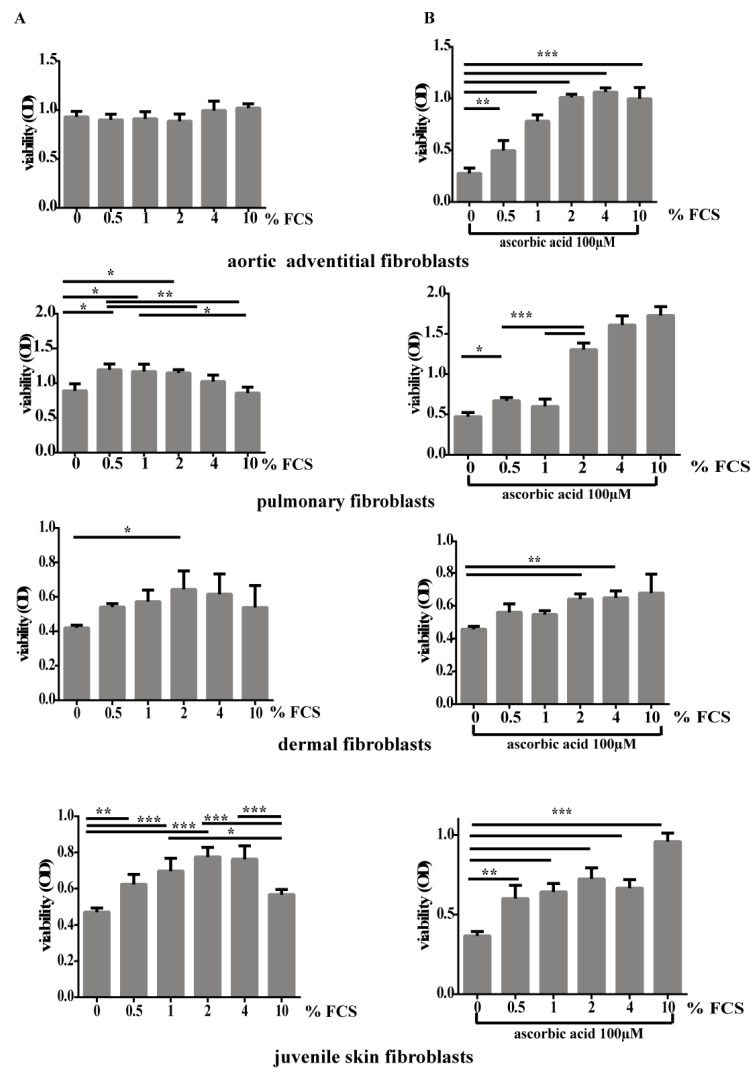
Determination of viability in different fibroblast types with increasing FCS concentrations with or without AA. (A) Incubation of AoAF, lung, adult dermal and juvenile skin fibroblasts with different concentrations of FCS increases viability, with the exception of AoAFs. (B) in contrast incubation of cells with AA without FCS reduces the cell viability, but addition of FCS increases viability to normal levels. Columns and error bars represent the mean and SD of optical density. * p < 0.05, ** p < 0.01, *** p < 0.001.
Figure 5
Figure 5
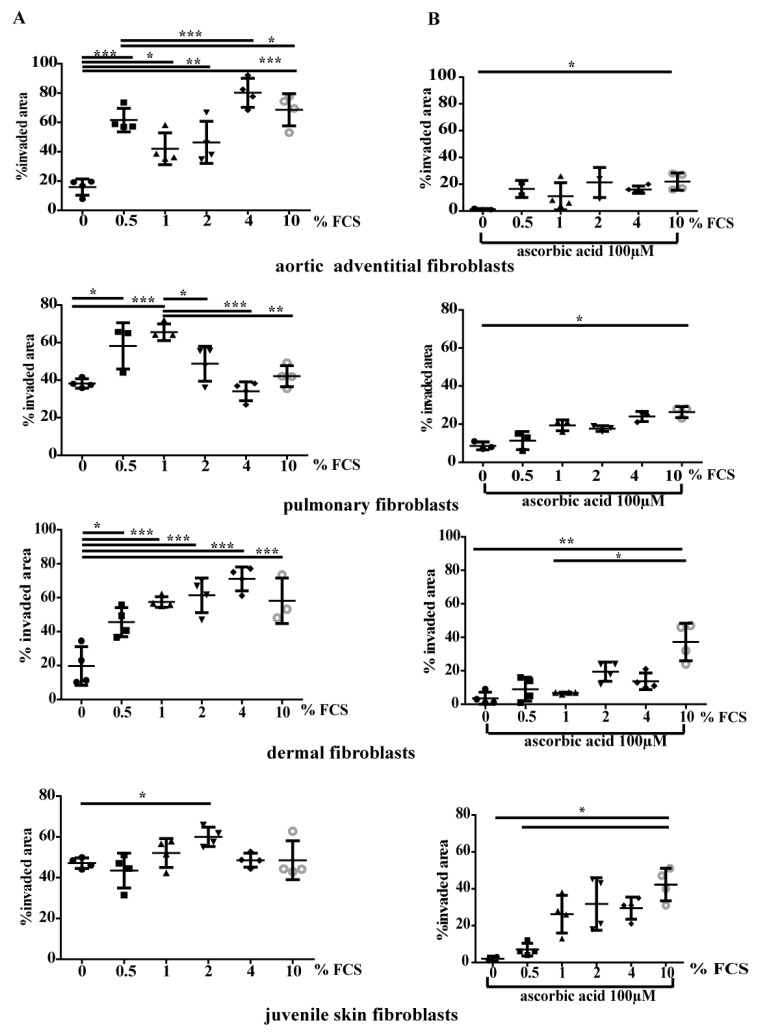
Migration of fibroblasts is reduced by addition of AA to FCS. (A) Migration of different fibroblast types incubated with different concentrations of FCS is demonstrated as % invaded area in scatter blots. In (B) migration with additional AA to different FCS concentrations is shown. * p < 0.05, ** p < 0.01, *** p < 0.001.
Figure 6
Figure 6
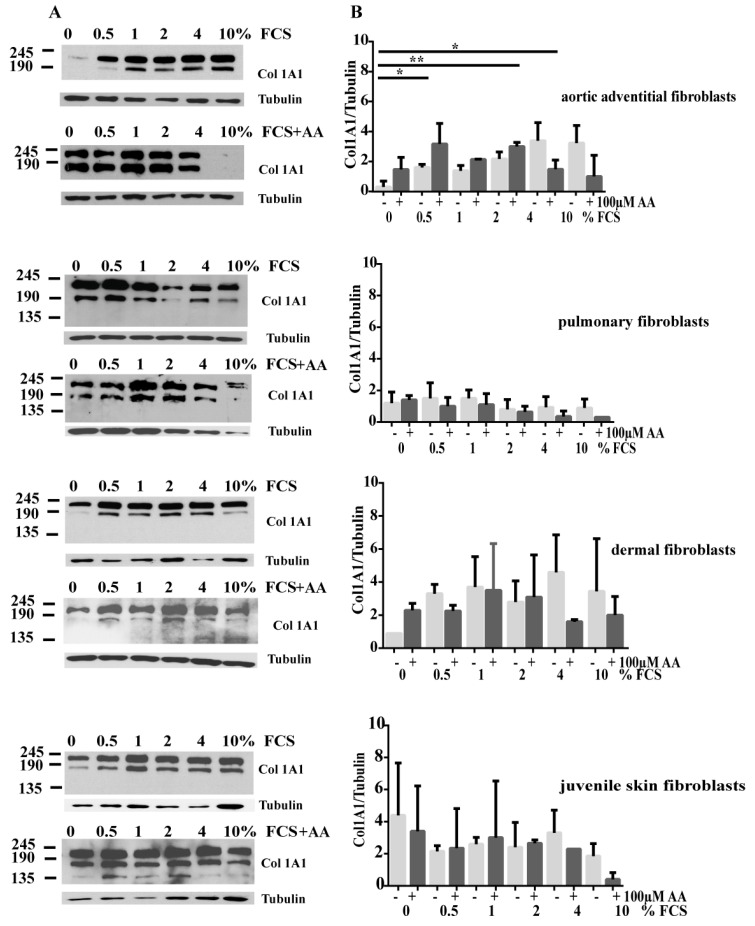
Procollagen I accumulates with increasing amounts of FCS in AoAF and skin fibroblasts, but is secreted after addition of AA. (A) Procollagen I (Col 1A1) expression after incubation with different amounts of FCS or without FCS is demonstrated in immunoblots. Tubulin is demonstrated as loading control. (B) Procollagen I expression in the presence of AA and with different amounts of FCS is demonstrated in immunoblots.
Figure 7
Figure 7
Ascorbic Acid enhances secretion of collagen IA1 in primary fibroblasts with different concentrations of FCS or without FCS. Secretion of collagen IA1 was quantified by ColIA1 specific ELISA: Amounts are demonstrated in ng/mL as columns with standard deviation. ** p < 0.01.

References

    1. Sorrell J.M., Caplan A.I. Fibroblasts-a diverse population at the center of it all. Int. Rev. Cell Mol. Biol. 2009;276:161–214. doi: 10.1016/S1937-6448(09)76004-6. - DOI - PubMed
    1. Humphrey J.D., Dufresne E.R., Schwartz M.A. Mechanotransduction and extracellular matrix homeostasis. Nat. Rev. Mol. Cell Biol. 2014;15:802–812. doi: 10.1038/nrm3896. - DOI - PMC - PubMed
    1. Tomasek J.J., Gabbiani G., Hinz B., Chaponnier C., Brown R.A. Myofibroblasts and mechano-regulation of connective tissue remodelling. Nat. Rev. Mol. Cell Biol. 2002;3:349–363. doi: 10.1038/nrm809. - DOI - PubMed
    1. Kendall R.T., Feghali-Bostwick C.A. Fibroblasts in fibrosis: Novel roles and mediators. Front. Pharmacol. 2014;5:123. doi: 10.3389/fphar.2014.00123. - DOI - PMC - PubMed
    1. Wynn T.A., Ramalingam T.R. Mechanisms of fibrosis: Therapeutic translation for fibrotic disease. Nat. Med. 2012;18:1028–1040. doi: 10.1038/nm.2807. - DOI - PMC - PubMed

Publication types

LinkOut - more resources