Review
. 2020 Jan 6:60:219-240.
doi: 10.1146/annurev-pharmtox-010919-023420. Epub 2019 Jul 23.

Pharmacology of Small- and Intermediate-Conductance Calcium-Activated Potassium Channels

Affiliations
Review

Pharmacology of Small- and Intermediate-Conductance Calcium-Activated Potassium Channels

Brandon M Brown et al. Annu Rev Pharmacol Toxicol. .

Abstract

The three small-conductance calcium-activated potassium (KCa2) channels and the related intermediate-conductance KCa3.1 channel are voltage-independent K+ channels that mediate calcium-induced membrane hyperpolarization. When intracellular calcium increases in the channel vicinity, it calcifies the flexible N lobe of the channel-bound calmodulin, which then swings over to the S4-S5 linker and opens the channel. KCa2 and KCa3.1 channels are highly druggable and offer multiple binding sites for venom peptides and small-molecule blockers as well as for positive- and negative-gating modulators. In this review, we briefly summarize the physiological role of KCa channels and then discuss the pharmacophores and the mechanism of action of the most commonly used peptidic and small-molecule KCa2 and KCa3.1 modulators. Finally, we describe the progress that has been made in advancing KCa3.1 blockers and KCa2.2 negative- and positive-gating modulators toward the clinic for neurological and cardiovascular diseases and discuss the remaining challenges.

Keywords: KCa2.2; KCa2.3; KCa3.1; calcium-activated potassium channel; gating modulation.


Figures
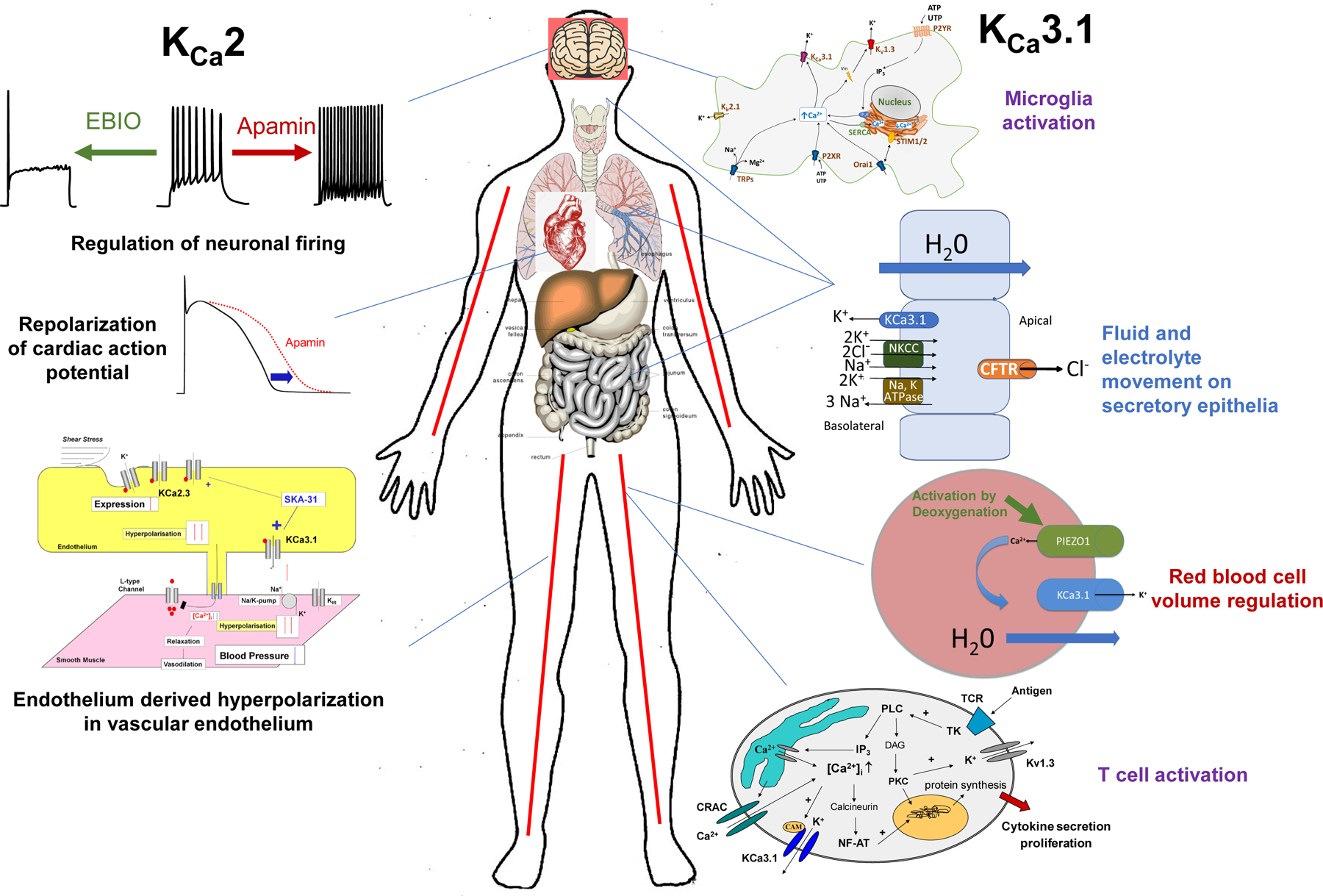
Figure 1
Figure 1
Physiological role of KCa2 and KCa3.1 channels.
Figure 2
Figure 2
Rosetta KCa2.2 homology model based on the KCa3.1 cryo-EM structure (open state 1, pdb: 6cnn). The longer N- and C-terminus of KCa2.2 was not modeled. For clarity only two of the four channel subunits are shown (dark gray). Calmodulin is shown in yellow. Potassium ions in the selectivity filter are colored dark purple. The bee venom apamin with its N-atoms colored dark blue and several small molecule modulators are docked where they have been shown to bind by mutagenesis: Apamin in the outer pore, NS8593 in the inner pore (dark green), CM-TMPF (sky blue) in the inner vestibule, and SKA-111 in the interface between the CaM N-lobe and the S45A helix in the S4-S5 linker. The chemical structures of other KCa2 blockers, negative gating modulators and activators are colored according to where they have either been shown to bind by mutagenesis or are suspected to bind. Potencies (IC50s for blockers and negative gating modulators; EC50s for activators): Apamin 60–400 pM, d-tubocurarine 5 μM, dequalinium 200 nM, UCL1684 200 pM, UCL1884 110 pM, BBP 400 nM, NS8593 600 nM, AP14145 1 μM, (–)-B-TMPF 31 nM for KCa2.1 and 1 μM for KCa2.2, CM-TMPF 24 nM for KCa2.1 and 290 nM for KCa2.2, SKA-111 8 μM, RA-2 ~100 nM, SKA-31 2 μM, NS309 620 nM, CyPPA 14 μM, NS13001 2 μM.
Figure 3
Figure 3
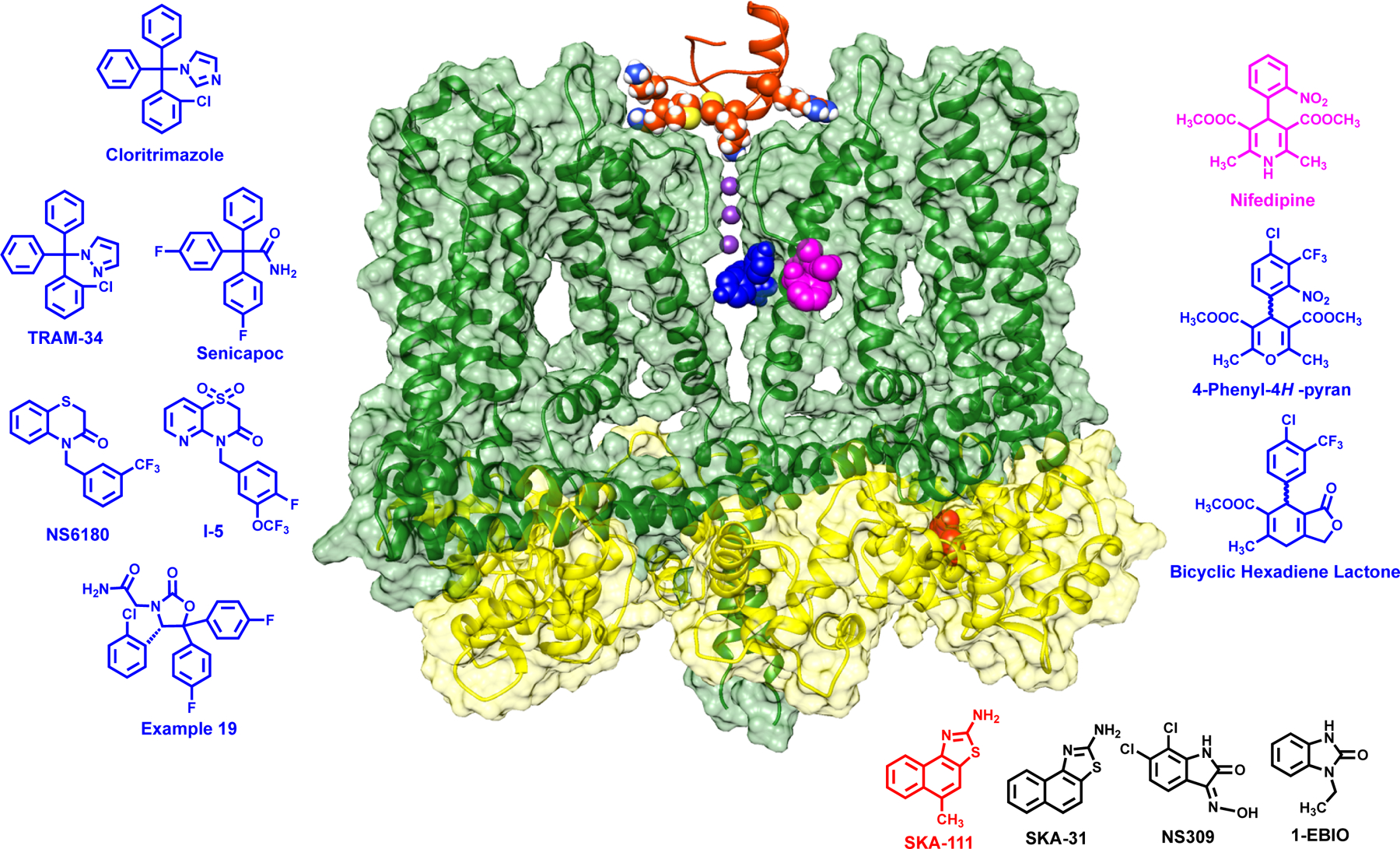
Rosetta refined model of the KCa3.1 cryo-EM structure (open state 1, pdb: 6cnn). For clarity only two of the four channel subunits are shown (dark green). Calmodulin is shown in yellow. Potassium ions in the selectivity filter are colored dark purple. The scorpion toxin charybdotoxin (ChTX) is shown docked into the outer vestibule. Various small molecule modulators are docked were they have been shown to bind by mutagenesis: Senicapoc as a representative triaryl-methane in the inner pore (blue), nifedipine in the fenestration region (pink), and SKA-111 in the interface between the CaM N-lobe and the S45A helix in the S4-S5 linker. The chemical structures of other KCa3.1 blockers and activators are colored according to where they have either been shown to bind by mutagenesis or are suspected to bind. Potencies (IC50s for blockers; EC50s for activators): ChTX 2–28 nM, clotrimazole 70–250 nM, TRAM-34 10–25 nM, senicapoc 11 nM, NS6180 11 nM, nifedipine 0.8–4 μM, 4-phenyl-4H-pyran 8 nM, SKA-111 150 nM, SKA-31 250 nM, NS309 10–30 nM, 1-EBIO 24–80 μM.

References

    1. Hille B. 2001. Ion Channels of Excitable Membranes Sunderland, MA: Sinauer Associates. 426 pp.
    1. Alexander SP, Kelly E, Marrion NV, Peters JA, Faccenda E, et al. 2017. THE CONCISE GUIDE TO PHARMACOLOGY 2017/18: Overview. Br. J. Pharmacol 174 Suppl 1:S1–S16 - PMC - PubMed
    1. Kaczmarek LK, Aldrich RW, Chandy KG, Grissmer S, Wei AD, Wulff H. 2017. International Union of Basic and Clinical Pharmacology. C. Nomenclature and Properties of Calcium-Activated and Sodium-Activated Potassium Channels. Pharmacol. Rev 69:1–11 - PMC - PubMed
    1. Monaghan AS, Benton DC, Bahia PK, Hosseini R, Shah YA, et al. 2004. The SK3 subunit of small conductance Ca2+-activated K+ channels interacts with both SK1 and SK2 subunits in a heterologous expression system. J. Biol. Chem 279:1003–9 - PubMed
    1. Kohler M, Hirschberg B, Bond CT, Kinzie JM, Marrion NV, et al. 1996. Small-conductance, calcium-activated potassium channels from mammalian brain. Science 273:1709–14 - PubMed

Publication types

MeSH terms

Substances