


Hyperreflective foci in OCT image as a biomarker of poor prognosis in diabetic macular edema patients treating with Conbercept in China
- PMID: 31337360
- PMCID: PMC6651859
- DOI: 10.1186/s12886-019-1168-0
Hyperreflective foci in OCT image as a biomarker of poor prognosis in diabetic macular edema patients treating with Conbercept in China
Abstract
Purpose: To investigate the dynamic changes of hyperreflective foci (HF) in diabetic macular edema (DME) patients during the intravitreal Conbercept treatment in China.
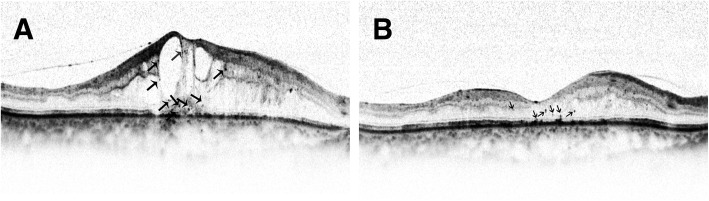
Methods: DME Patients receiving intravitreal Conbercept (IVC) injections during the year 2016-2017 were retrospectively investigated. Thirteen patients (26 eyes) were recruited in this study. They received IVC once a month for 3 consecutive months. The number and location of HFs, the best-corrected visual acuity (BCVA) and central macular thickness (CMT) at each visit were analyzed and compared.
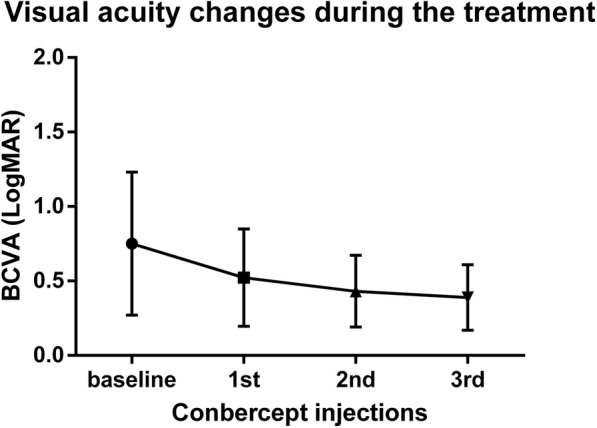
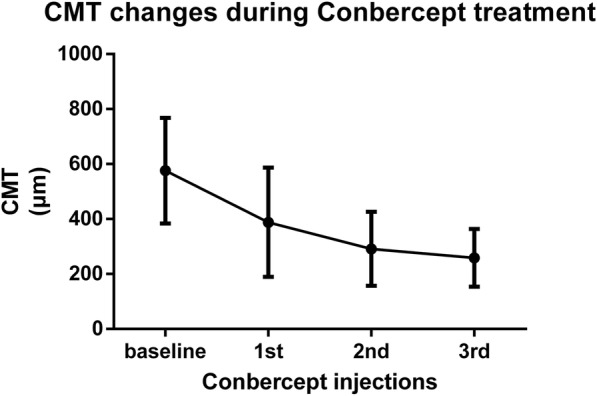
Results: After the first injection, BCVA (LogMAR) was increased from 0.75 ± 0.48 to 0.43 ± 0.24 (p < 0.05), CMT improved from 575.9 ± 191.9 to 388.2 ± 198.5 μm (p = 0.014). However, the BCVA and CMT had no statistical difference after the second and third injection as compared with those after the first injection respectively. The baseline number of HFs was 5.39 ± 4.24, 5.15 ± 5.17 and 0.88 ± 1.90 in the inner retinal, outer retinal and subretinal layer respectively. The number of HFs in these three retinal layers decreased significantly after the first injection (p = 0.0045, p < 0.0001 and p = 0.0045, respectively). However, after the second injection, only the number of HFs in the inner retinal layer experienced a further decrease. After the third injection, no statistically significant HFs changes was observed in each retinal layers. Correlation analysis showed that there was a positive significant correlation between the baseline number of HFs in the inner retina, outer retina, subretina and final BCVA (r = 0.571, p = 0.002; r = 0.464, p = 0.017; r = 0.405, p = 0.04 respectively). There was also a significant positive correlation between outer retinal HFs reduction, total retinal HFs reduction and increase of BCVA (r = 0.40, p = 0.043 and r = 0.393, p = 0.04 respectively). There were no severe ocular adverse reactions or systemic adverse events.
Conclusions: Conbercept is effective and safe in the treatment of DME. HFs can act as a biomarker of poor final visual outcome.
Keywords: Anti-VEGF; Conbercept; Diabetic macular edema; Hyperreflective foci.
Conflict of interest statement
The authors declare that they have no competing interests.
Figures

References
-
- Li X, Xu G, Wang Y, Xu X, Liu X, Tang S, Zhang F, Zhang J, Tang L, Wu Q, et al. Safety and efficacy of conbercept in neovascular age-related macular degeneration: results from a 12-month randomized phase 2 study: AURORA study. Ophthalmology. 2014;121(9):1740–1747. doi: 10.1016/j.ophtha.2014.03.026. - DOI - PubMed
-
- Huang Z, Ding Q, Yan M, Lian H, Chen Z, Chen X, Song Y. Short-term efficacy of CONBERCEPT and RANIBIZUMAB for POLYPOIDAL choroidal vasculopathy. Philadelphia, Pa: Retina; 2018. - PubMed
MeSH terms
Substances
Grants and funding
LinkOut - more resources
Full Text Sources
Medical
Research Materials
Miscellaneous
