


The effect of second hand smoke in patients with squamous cell carcinoma of the head and neck
- PMID: 31337433
- PMCID: PMC6652014
- DOI: 10.1186/s40463-019-0357-4
The effect of second hand smoke in patients with squamous cell carcinoma of the head and neck
Abstract
Background: Active tobacco smoking is a well-known risk factor for head and neck malignancy, and strong evidence has associated tobacco as the main carcinogenic factor in squamous cell cancers of this region. Evidence supporting a carcinogenic effect of second-hand smoke (SHS) on head and neck organs in non-smokers was also demonstrated with results consistent with those for active smokers. There is little data on the effects of SHS in patients previously treated for squamous cell carcinomas of the head and neck.
Objective: The purpose of this study was to prospectively evaluate the role of SHS on recurrence and survival in treated head and neck cancer patients.
Methods: We conducted a prospective cohort study to examine the association between self-reported SHS exposure and the risk of recurrence and mortality in patients treated for squamous cell cancers of the head and neck in a longitudinal fashion. Patients filled out an exhaustive smoking questionnaire on presentation and abbreviated questionnaires at each follow-up visit, which occurred every 6 months. Primary outcome measures were recurrence, development of a second primary malignancy, and recurrence-free survival. Chi square analysis was used to assess the association between SHS and the primary outcomes. A multivariate binary logistic regression analysis was applied to determine the independent predictors of recurrence. Cox proportional hazards and Kaplan Meier modeling were employed to assess the possible relationships between SHS exposure and time to develop the primary outcomes.
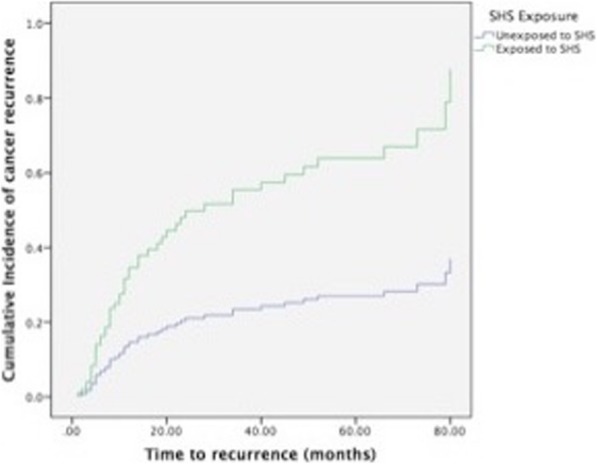
Results: Untreated new patients with a histologically confirmed diagnosis of first primary SCC of the UADT (defined as cancer of the oral cavity, the oropharynx, the hypopharynx, and the larynx) were recruited. Patients seen at The University of Texas Medical Branch (UTMB) Head and Neck oncology clinic from 1988 to 1996 were considered as cases in this study. One hundred and thirty-five patients were enrolled in the study. The median follow-up time for the sample was 54 months (3.92 years). Complete records were achieved for 92% of patients, thus 124 patients were included in the final analysis. SHS significantly correlated with recurrence and recurrence-free survival. The rate of recurrence was 46% in the group exposed to SHS and 22% in the non-exposed group. Based on multivariate binary logistic regression analysis, SHS exposure was detected as a significant independent predictor for recurrence (HR = 3.00 [95% CI 1.18-7.63]). Kaplan-Meier analysis demonstrated that patients who were not exposed to SHS had a statistically significant longer recurrence-free survival (log-rank P = 0.029). The mean survival for non SHS-exposed patients was 76 [63-89] months versus 54 [45-63] months for those exposed to SHS.
Conclusions: SHS exposure is an independent predictor of recurrence and survival after head and neck cancer treatment. These results support the importance and efforts of reducing smoking at home in in the work-place.
Keywords: Head and Neck Caner; Recurrence; Second-hand smoke; Survival.
Conflict of interest statement
The authors declare that they have no competing interests.
Figures

References
-
- Hashibe M, Brennan P, Benhamou S, Castellsague X, Chen C, Curado MP, et al. Alcohol drinking in never users of tobacco, cigarette smoking in never drinkers, and the risk of head and neck cancer: Pooled analysis in the international head and neck cancer epidemiology consortium. J Natl Cancer Inst. 2007;99(10):777–789. doi: 10.1093/jnci/djk179. - DOI - PubMed
-
- Hashibe M, Boffetta P, Zaridze D, Shangina O, Szeszenia-Dabrowska N, Mates D, et al. Evidence for an important role of alcohol-and aldehyde-metabolizing genes in cancers of the upper aerodigestive tract. Cancer Epidemiol Biomarkers Prev. 2006;15(4):696–703. doi: 10.1158/1055-9965.EPI-05-0710. - DOI - PubMed
MeSH terms
Substances
LinkOut - more resources
Full Text Sources
Medical
Research Materials
