. 2019 Jul 23;9(1):10622.
doi: 10.1038/s41598-019-47040-8.

Citrate anion improves chronic dialysis efficacy, reduces systemic inflammation and prevents Chemerin-mediated microvascular injury

Affiliations

Citrate anion improves chronic dialysis efficacy, reduces systemic inflammation and prevents Chemerin-mediated microvascular injury

Sergio Dellepiane et al. Sci Rep. .

Abstract

Systemic inflammation and uremic toxins (UT) determine the increased cardiovascular mortality observed in chronic hemodialysis (HD) patients. Among UT, the adipokine Chemerin induces vascular dysfunction by targeting both endothelial and vascular smooth muscular cells (EC and VSMC). As Citrate anion modulates oxidative metabolism, systemic inflammation and vascular function, we evaluated whether citrate-buffered dialysis improves HD efficiency, inflammatory parameters and chemerin-mediated microvascular injury. 45 patients were treated in sequence with acetate, citrate and, again, acetate-buffered dialysis solution (3 months per interval). At study admission and after each treatment switch, we evaluated dialysis efficacy and circulating levels of chemerin and different inflammatory biomarkers. In vitro, we stimulated EC and VSMC with patients' plasma and we investigated the role of chemerin as UT. Citrate dialysis increased HD efficacy and reduced plasma levels of CRP, fibrinogen, IL6 and chemerin. In vitro, patients' plasma induced EC and VSMC dysfunction. These effects were reduced by citrate-buffered solutions and paralleled by the decrease of chemerin levels. Consistently, chemerin receptor knockdown reduced EC and VSMC dysfunction. In conclusion, Switching from acetate to citrate improved dialysis efficacy and inflammatory parameters; in vitro, chemerin-induced EC and VSMC injury were decreased by using citrate as dialysis buffer.


Conflict of interest statement

The authors declare no competing interests.

Figures
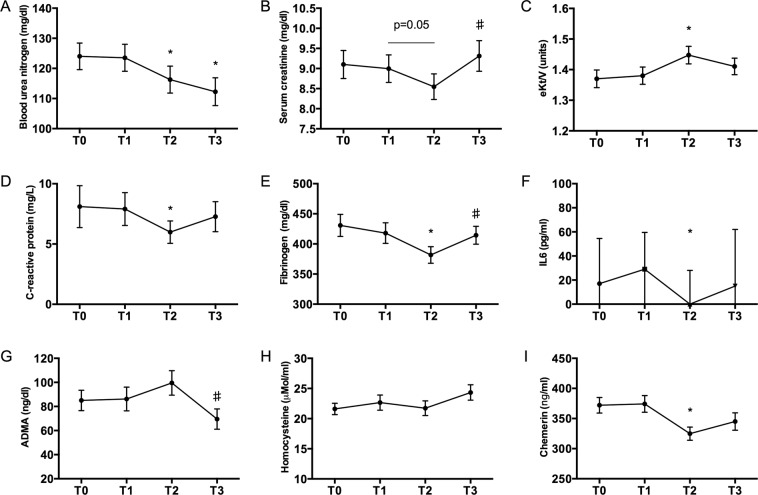
Figure 1
Figure 1
Patients’ clinical data at the different study time points. (A) Pre-dialysis blood urea nitrogen levels, (B) pre-dialysis serum creatinine values, (C) dialysis efficacy estimated with the eKt/V Daugirdas formula (D), pre-dialysis values of plasma C-Reactive Protein (CRP), (E) pre-dialysis plasma fibrinogen, (F) pre-dialysis serum IL6, (G) pre-dialysis serum ADMA values, (H) pre-dialysis serum homocystein values and (I) pre-dialysis serum Chemerin measured at the different study time-points. T0: study start; T1: end of 1st acetate period (3 months from study start); T2 end of citrate (6 months); T3 end of 2nd acetate period (9 months). *p < 0.05 when data were compared with T1; p < 0.05 when data were compared with T2.
Figure 2
Figure 2
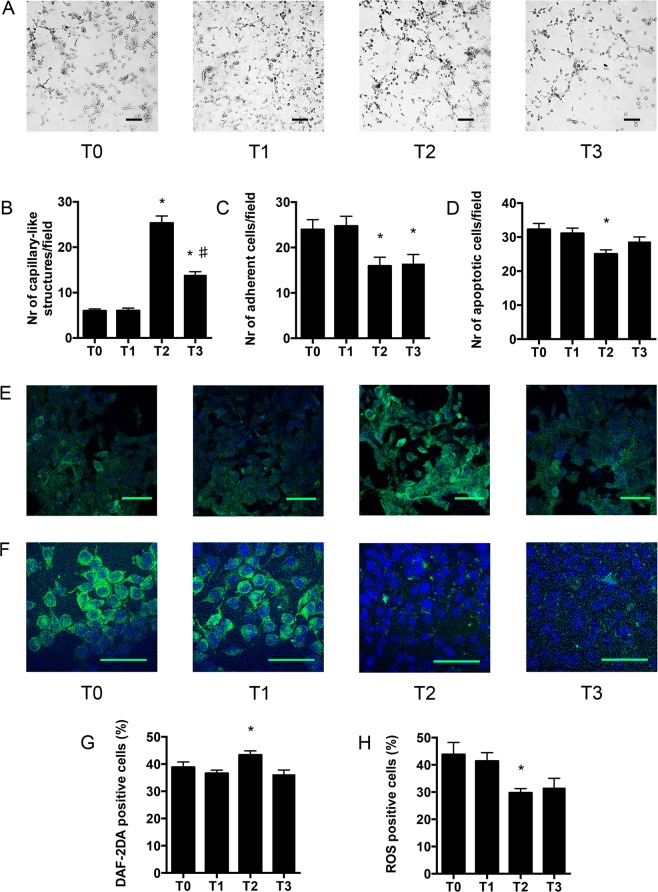
Effect of Citrate buffered-dialysis on human endothelial cells (EC). In all the experiments EC were incubated with patients’ plasma collected at different study time points. (A) Representative micrographs of EC angiogenesis on matrigel. (B) Quantification of the capillary-like structures generated by EC on matrigel-coated plates. (C) Number of adherent Peripheral Blood Mononuclear Cells (PBMC) on a layer of confluent EC. (D) % of EC apoptosis (TUNEL test). (E) Representative immunofluorescence micrographs of DAF2DA probe staining in EC. (F) Representative immunofluorescence micrographs of ROS probe staining in EC. (G) Flow cytometry (FACS) quantification of Nitric Oxygen (NO) bioavailability by DAF2A probe staining. (H) Flow cytometry (FACS) Quantification of Reactive Oxygen Species (ROS) generation in EC by appropriate fluorescent probe. T0: serum from study start; T1: end of 1st acetate period (3 months from study start); T2 end of citrate treatment (6 months); T3 end of 2nd acetate period (9 months). *p < 0.05 when data were compared with T1; p < 0.05 when data were compared with T2. Scale bar length is 50 μm in all micrographs.
Figure 3
Figure 3
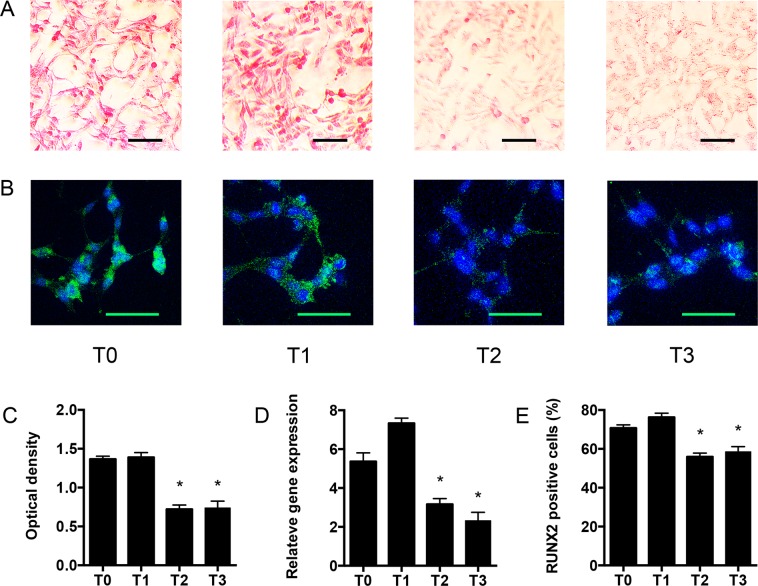
Effect of Citrate buffered-dialysis on human vascular smooth muscle cell (VSMC). In all the experiments VSMC were incubated with patients’ plasma collected at different study time points. (A) Representative micrographs of red alizarin staining of VSMC. (B) Representative immunofluorescence micrographs of RUNX2 staining of VSMC. (C) Spectrophotometry quantification of red alizarin internalization by VSMC. (D) RUNX-2 mRNA relative quantification by qRT-PCR (quantitative Reverse Transcription Polymerase Chain Reaction) in VSMC. (E) Flow cytometry (FACS) quantification of RUNX-2 positive VSMC. T0: serum from study start; T1: end of 1st acetate period (3 months from study start); T2 end of citrate treatment (6 months); T3 end of 2nd acetate period (9 months); O.D.; optical density. *p < 0.05 when data were compared with T1; p < 0.05 when data were compared with T2. Scale bar length is 50 μm in all micrographs.
Figure 4
Figure 4
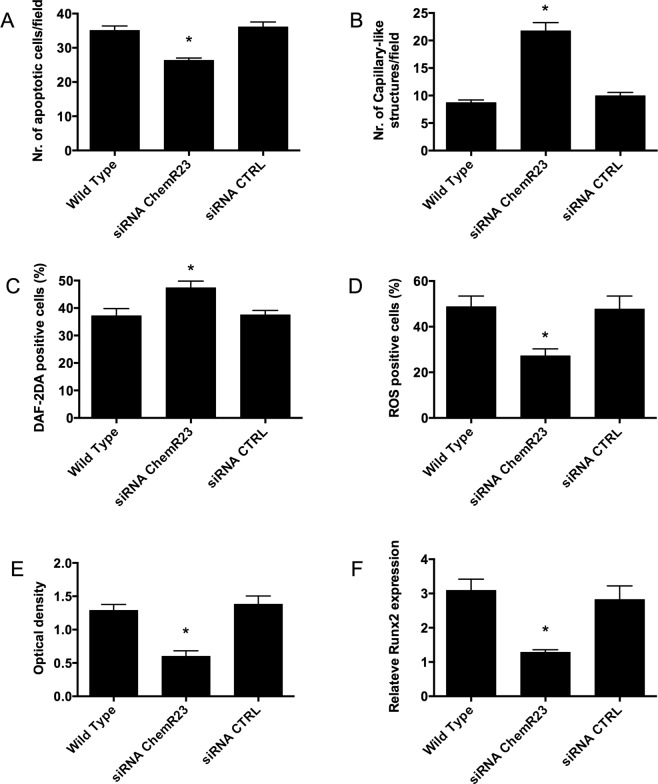
Effect of Chemerin knockdown on human endothelial and Vascular Smooth Muscle Cell (EC and VSMC). Human EC and VSMC were stimulated with the plasma from patients showing the highest chemerin levels at study start (n = 5). The following experiments were performed in non-engineered wild type cells (WT), after silencing of Chemerin receptor (siRNA ChemR23) or with an irrelevant control siRNA (siRNA CTRL). (A) Quantification of apoptotic EC number (TUNEL assay). (B) Quantification of capillary-like structures (angiogenesis assay) generated by EC on Matrigel-coated plates. (C) Flow cytometry (FACS) Quantification of Nitric Oxygen (NO) bioavailability by DAF2A probe staining in EC. (D) Flow cytometry (FACS) Quantification of Reactive Oxygen Species (ROS) generation in EC by appropriate fluorescent probe. (E) Spectrophotometry quantification of red alizarin internalization by VSMC. (F) RUNX2 mRNA expression by qRT-PCR (quantitative Reverse Transcription Polymerase Chain Reaction). *p < 0.05 siRNA ChemR23 vs. wild type or siRNA control.

References

    1. Ok E, et al. Mortality and cardiovascular events in online haemodiafiltration (OL-HDF) compared with high-flux dialysis: results from the Turkish OL-HDF Study. Nephrol. Dial. Transplant. Off. Publ. Eur. Dial. Transpl. Assoc. - Eur. Ren. Assoc. 2013;28:192–202. - PubMed
    1. Neves KB, et al. Chemerin Regulates Crosstalk Between Adipocytes and Vascular Cells Through Nox. Hypertens. Dallas Tex 1979. 2015;66:657–666. - PubMed
    1. Darios ES, et al. The adipokine chemerin amplifies electrical field-stimulated contraction in the isolated rat superior mesenteric artery. Am. J. Physiol. Heart Circ. Physiol. 2016;311:H498–507. doi: 10.1152/ajpheart.00998.2015. - DOI - PMC - PubMed
    1. Noris M, et al. Effect of acetate, bicarbonate dialysis, and acetate-free biofiltration on nitric oxide synthesis: implications for dialysis hypotension. Am. J. Kidney Dis. Off. J. Natl. Kidney Found. 1998;32:115–124. doi: 10.1053/ajkd.1998.v32.pm9669432. - DOI - PubMed
    1. Pizzarelli F, Cerrai T, Dattolo P, Ferro G. On-line haemodiafiltration with and without acetate. Nephrol. Dial. Transplant. Off. Publ. Eur. Dial. Transpl. Assoc. - Eur. Ren. Assoc. 2006;21:1648–1651. - PubMed

Publication types

MeSH terms