. 2019 Jul 23;9(1):10663.
doi: 10.1038/s41598-019-47216-2.

Altered serum acylcarnitine profile is associated with the status of nonalcoholic fatty liver disease (NAFLD) and NAFLD-related hepatocellular carcinoma

Affiliations

Altered serum acylcarnitine profile is associated with the status of nonalcoholic fatty liver disease (NAFLD) and NAFLD-related hepatocellular carcinoma

Kenichiro Enooku et al. Sci Rep. .

Abstract

Metabolic disturbance of lipids is a hallmark of nonalcoholic fatty liver disease (NAFLD). In this study, we measured the serum levels of 15 acylcarnitine species of various carbon chain lengths from 2 to 18 in 241 patients with biopsy-proven NAFLD, including 23 patients with hepatocellular carcinoma (HCC), and analyzed the relationship between serum acylcarnitine profile and NAFLD status. Long-chain acylcarnitines AC14:1 and AC18:1 increased gradually with the progression of fibrosis and further increased in patients with HCC, whereas the middle-chain acylcarnitine AC5:0 exhibited the opposite trend. In particular, AC18:1, which we previously showed to possess a tumor promoting effect, was significantly elevated in patients with HCC compared to those without HCC. In addition, long-chain acylcarntines including AC18:1 were positively correlated with serum levels of inflammatory cytokines. Although none of the acylcarnitine species were independently associated with the presence of HCC, (AC16:0 + AC18:1)/AC2:0, an index for the diagnosis of carnitine palmitoyltransferase 2 (CPT2) deficiency, was independently associated with the presence of HCC after adjusting for age and liver fibrosis stage, likely reflecting the downregulation of CPT2 in HCC tissues. Thus, serum acylcarnitine profiles changed significantly according to the status of NAFLD, which may be implicated in the pathogenesis of NAFLD.


Conflict of interest statement

The authors declare no competing interests.

Figures

Figure 1
Figure 1
Serum levels of acylcarnitine species in nonalcoholic fatty liver disease (NAFLD) patients with and without hepatocellular carcinoma (HCC). Patients without HCC were classified according to their fibrosis stage. The box plot indicates the mean (horizontal line), interquartile range (box), 10th and 90th percentiles (whiskers), and outliers outside the 10th and 90th percentiles (dots).
Figure 2
Figure 2
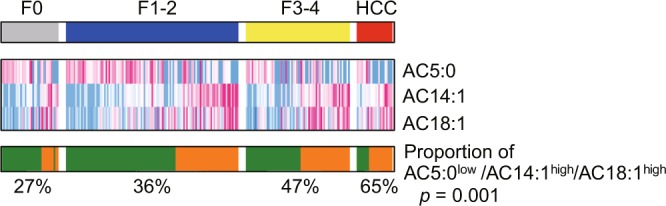
The proportion of patients with the AC5:0low/AC14:1high/AC18:1high signature according to NAFLD status.
Figure 3
Figure 3
The values of the (AC16:0 + AC18:1)/AC2:0 index in NAFLD patients with or without HCC. Patients without HCC were classified according to their fibrosis stage (a) and non-classified (b). The box plot indicates the mean (horizontal line), interquartile range (box), 10th and 90th percentiles (whiskers), and outliers outside the 10th and 90th percentiles (dots).

References

    1. Younossi ZM, et al. Global epidemiology of nonalcoholic fatty liver disease-Meta-analytic assessment of prevalence, incidence, and outcomes. Hepatology (Baltimore, Md.) 2016;64:73–84. doi: 10.1002/hep.28431. - DOI - PubMed
    1. Lebeaupin C, et al. Endoplasmic reticulum stress signalling and the pathogenesis of non-alcoholic fatty liver disease. J Hepatol. 2018;69:927–947. doi: 10.1016/j.jhep.2018.06.008. - DOI - PubMed
    1. Nakagawa H. Recent advances in mouse models of obesity- and nonalcoholic steatohepatitis-associated hepatocarcinogenesis. World J Hepatol. 2015;7:2110–2118. doi: 10.4254/wjh.v7.i17.2110. - DOI - PMC - PubMed
    1. Noureddin M, et al. NASH Leading Cause of Liver Transplant in Women: Updated Analysis of Indications For Liver Transplant and Ethnic and Gender Variances. The American journal of gastroenterology. 2018;113:1649–1659. doi: 10.1038/s41395-018-0088-6. - DOI - PMC - PubMed
    1. Donnelly KL, et al. Sources of fatty acids stored in liver and secreted via lipoproteins in patients with nonalcoholic fatty liver disease. The Journal of clinical investigation. 2005;115:1343–1351. doi: 10.1172/jci23621. - DOI - PMC - PubMed

Publication types