. 2019 Jul 5:10:638.
doi: 10.3389/fgene.2019.00638. eCollection 2019.

Epigenetic Regulation at the Interplay Between Gut Microbiota and Host Metabolism

Affiliations

Epigenetic Regulation at the Interplay Between Gut Microbiota and Host Metabolism

Joan Miro-Blanch et al. Front Genet. .

Abstract

Gut microbiota communities have coevolved for millions of years in a symbiotic relationship with their mammalian hosts. Elucidating and understanding the molecular mechanisms by which microbiota interacts with its host and how this contributes to the homeostasis of the host is crucial. One of these molecular relationships is the so-called chemical crosstalk between microbiota and host metabolisms, including the poorly explored epigenetic regulation of host tissues by the metabolic activity of gut microbiota in response to changes in diet. DNA methylation and histone modifications are epigenetic marks partly regulated by enzymes such as methylases and acetylases, whose activity depend on host and microbiota metabolites that act as substrates and cofactors for these reactions. However, providing a complete mechanistic description of the regulatory interactions between both metabolisms and the impact on the expression of host genes through an epigenetic modulation, remains elusive. This article presents our perspective on how metabolomic, metagenomic, transcriptomic, and epigenomic data can be used to investigate the "microbiota-nutrient metabolism-epigenetics axis." We also discuss the implications and opportunities this knowledge may have for basic and applied science, such as the impact on the way we structure future research, understand, and prevent diseases like type 2 diabetes or obesity.

Keywords: epigenetics; histones; metabolism; metabolomics; microbiota; omics.


Figures
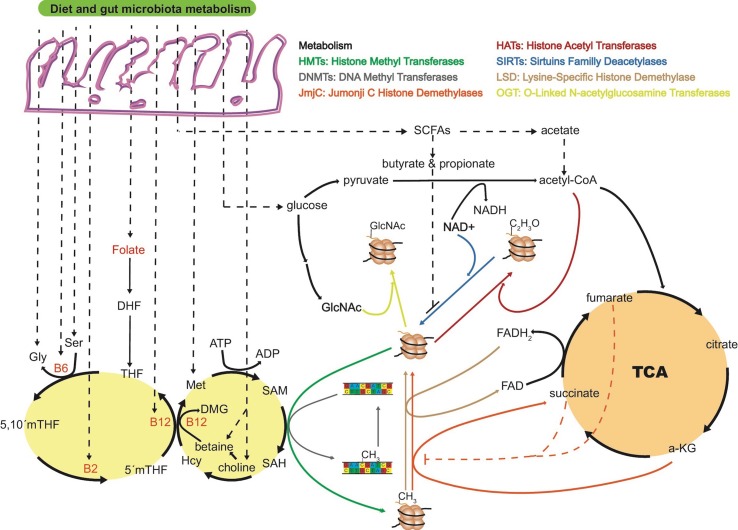
Figure 1
Figure 1
The “microbiota–nutrient metabolism–epigenetics” axis. Most of the key molecules involved in one-carbon metabolism are dietary- and microbiota-dependent, being susceptible to gut dysbiosis or diet intervention. Folate is the precursor of dihydrofolate (DHF) and tetrahydrofolate (THF), and dietary intake is the only source for humans. Together with vitamin B12, 5’methy-THF is in charge of remethylating homocysteine (Hcy) to methionine (Met), a crucial step in the process of transferring a methyl group to DNA or histones through SAM. The ratio of S-adenosyl homocysteine (SAH) to SAM regulates the overall methylation status of the genome at the DNA or histone level. Vitamins B12, B2, and B6 are key cofactors in the folate cycle that are produced by the microbiota or ingested through diet. Intermediates of the tricarboxylic acid cycle (TCA) are known to positively or negatively regulate histone methylation. For example, alpha-ketoglutarate (α-KG) is known to be an essential substrate for jumonji C histone demethylases (jmjC), and levels of succinate and fumarate can inhibit jmjC demethylases. α-Ketoglutarate is a co-substrate of TET dioxygenases in charge of demethylation processes of histones and DNA. As for jmjC demethylases, increased levels of fumarate and succinate can inhibit TET enzymes with the consequent increased levels of histone and DNA methylation. Short-chain fatty acids (SCFAs) produced by the gut microbiota are also known to inhibit or promote histone PTMs. Butyrate and propionate are inhibitors of sirtuins deacetylases enzymes. Acetate from gut fermentation contributes to the pool of intermediate molecules known to form acetyl-coenzyme A, the major acetyl group donor for histone acetyl transferases (HATs). Acetate is also known to be an inhibitor of histone deacetylases (HDAC), increasing histone acetylation levels and regulating chromatin accessibility. Whether levels of FAD/FADH2, NAD/NADH, TCA intermediates, and other host endogenous epigenetically relevant metabolites are modulated by gut microbiota metabolism needs to be further investigated. DMG, dimethylglycine; ATP, adenosine triphosphate; ADP, adenosine diphosphate; FAD/FADH2, Flavin adenine dinucleotide; NAD+/NADH, nicotinamide adenine dinucleotide.
Figure 2
Figure 2
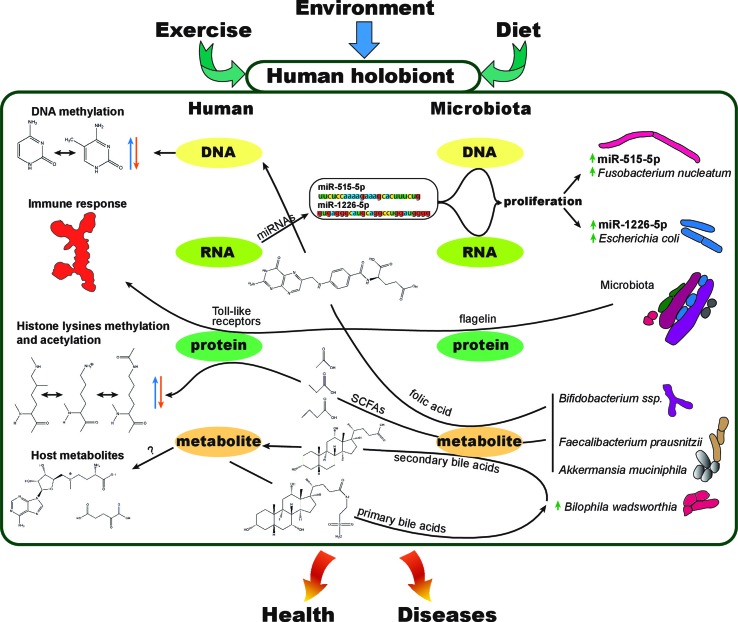
The human holobiont. Representation of few examples of known interactions between different molecular levels within a holobiont. Exercise, environment, and diet can affect the physiology and molecular interactions between human (host) and its microbiota at the DNA, RNA, protein, or metabolite level. As an example, fecal host micro RNAs (miRNAs) are used by the host to modulate the composition of its own gut microbiota, interacting at the microbiota RNA and DNA levels to control microbial growth (Liu et al., 2016). Short-chain fatty acids (SCFAs), products of gut bacterial anaerobic fermentation of dietary fiber, have been proved to cause changes in histone PTMs in multiple host tissues (Krautkramer et al., 2016). Butyrate is a potent histone deacetylase inhibitor (HDACi), regulating the transcription levels of genes involved in colorectal tumorigenesis (Hassig et al., 1997). The direct transformation of dietary nutrients (Sharon et al., 2014) and secondary products of host metabolites such as primary bile acids (Wahlström et al., 2016) evidencies the strong interdependency between host and microbiota. Folate production by Biffidobacterium spp. is another example of how gut microbiota products can affect epigenetics such as DNA or histone methylation (Paul et al., 2015). Microbiota diversity shifts, products, or bacterial structural components such as flagellin can cause the activation of the immune system as well as impact the immune reconstitution after certain diseases or immunotherapy (Manzo and Bhatt, 2015). Immune system maturation and allergic disease development are other examples of how the host and its microbiome interact (Christmann et al., 2015).

References

    1. Aleksandrova K., Romero-Mosquera B., Hernandez V. (2017). Diet, gut microbiome and epigenetics: emerging links with inflammatory bowel diseases and prospects for management and prevention. Nutrients 9, 1–13. 10.3390/nu9090962 - DOI - PMC - PubMed
    1. An J., Rao A., Ko M. (2017). TET family dioxygenases and DNA demethylation in stem cells and cancers. Exp. Mol. Med. 49, 1–12. 10.1038/emm.2017.5 - DOI - PMC - PubMed
    1. Arumugam M., Raes J., Pelletier E., Le Paslier D., Yamada T., Mende D. R., et al. (2011). Enterotypes of the human gut microbiome. Nature 473, 174–180. 10.1038/nature09944 - DOI - PMC - PubMed
    1. Bäckhed F., Manchester J. K., Semenkovich C. F., Gordon J. I. (2007). Mechanisms underlying the resistance to diet-induced obesity in germ-free mice. Proc. Natl. Acad. Sci. 104, 979–984. 10.1073/pnas.0605374104 - DOI - PMC - PubMed
    1. Barski A., Wei G., Chepelev I., Wang Z., Cui K., Zhao K., et al. (2007). High-resolution profiling of histone methylations in the human genome. Cell 129, 823–837. 10.1016/j.cell.2007.05.009 - DOI - PubMed

LinkOut - more resources