


Estimation of influenza- and respiratory syncytial virus-attributable medically attended acute respiratory infections in Germany, 2010/11-2017/18
- PMID: 31339223
- PMCID: PMC6692544
- DOI: 10.1111/irv.12666
Estimation of influenza- and respiratory syncytial virus-attributable medically attended acute respiratory infections in Germany, 2010/11-2017/18
Abstract
Background: The burden of influenza in primary care is difficult to assess, since most patients with symptoms of a respiratory infection are not tested. The case definition of "medically attended acute respiratory infection" (MAARI) in the German physician sentinel is sensitive; however, it requires modelling techniques to derive estimates of disease attributable to influenza and respiratory syncytial virus (RSV).
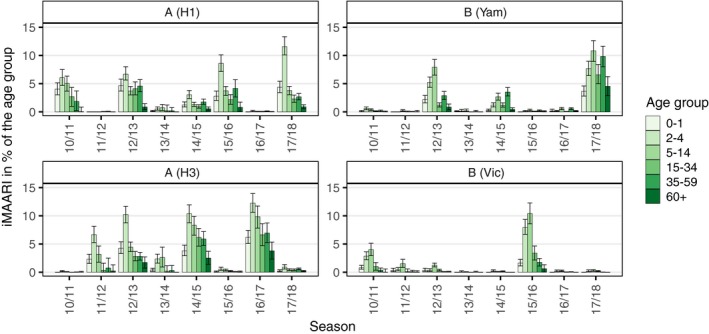
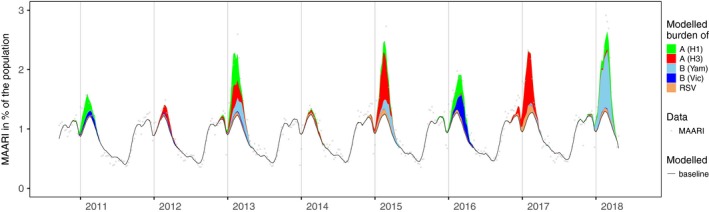
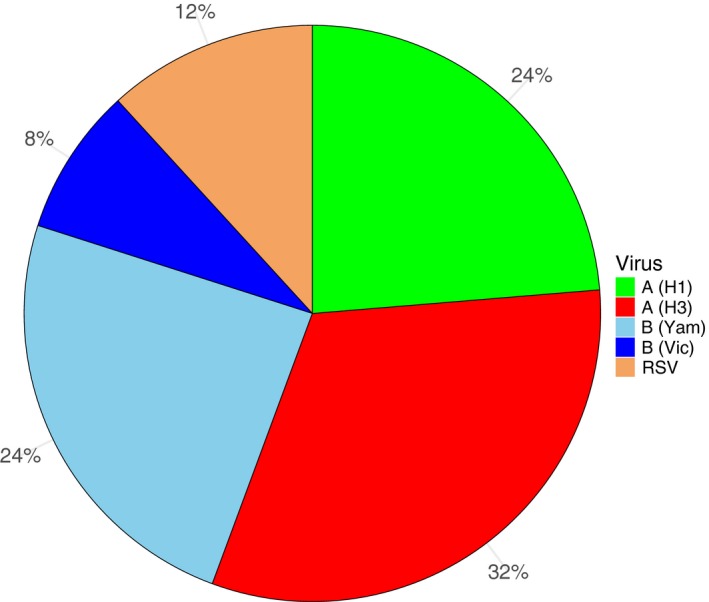
Objectives: The objective of this paper was to review and extend our previously published model in order to estimate the burden of RSV and the differential burden of the two influenza B lineages (Victoria, Yamagata) as well as both influenza A subtypes on primary care visits.
Methods: Data on MAARI and virological results of respiratory samples (virological sentinel) were available from 2010/11 until 2017/18. We updated the previously published generalized additive regression model to include RSV.
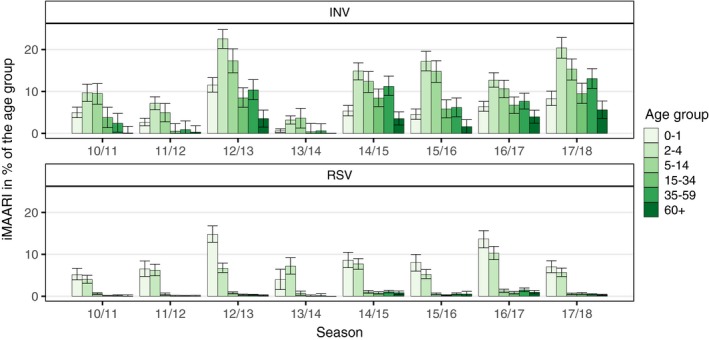
Results: We found that the proportion of MAARI due to RSV is substantial only in the 0-1- and 2-4-year-old age groups (0-1 years old: median 7.5%, range 4.0%-14.8%; 2-4 years old: median 6.5%, range 4.0%-10.3%); in the 0-1 years old age group, RSV leads in almost all seasons to a higher burden than any influenza type or subtype, but this is reversed in the age group 2-4 years old.
Conclusions: We succeeded in rearranging our previously published model on MAARI to incorporate RSV as well as the two influenza B lineages (Victoria, Yamagata) in the time period 2010 to 2018.
Keywords: Germany; burden of disease; generalized additive model; influenza; influenza type/subtype; medically attended acute respiratory infection; respiratory syncytial virus.
© 2019 The Authors. Influenza and Other Respiratory Viruses Published by John Wiley & Sons Ltd.
Figures
References
-
- Falkenhorst G, Remschmidt C, Weidemann F, et al. Wissenschaftliche Begründung für die Empfehlung des quadrivalenten saisonalen Influenzaimpfstoffs. Epidemiologisches Bulletin. 2018;2:19‐28.
LinkOut - more resources
Full Text Sources
