


Prevalence and Risk Factors for Schistosomiasis among Schoolchildren in two Settings of Côte d'Ivoire
- PMID: 31340504
- PMCID: PMC6789509
- DOI: 10.3390/tropicalmed4030110
Prevalence and Risk Factors for Schistosomiasis among Schoolchildren in two Settings of Côte d'Ivoire
Abstract
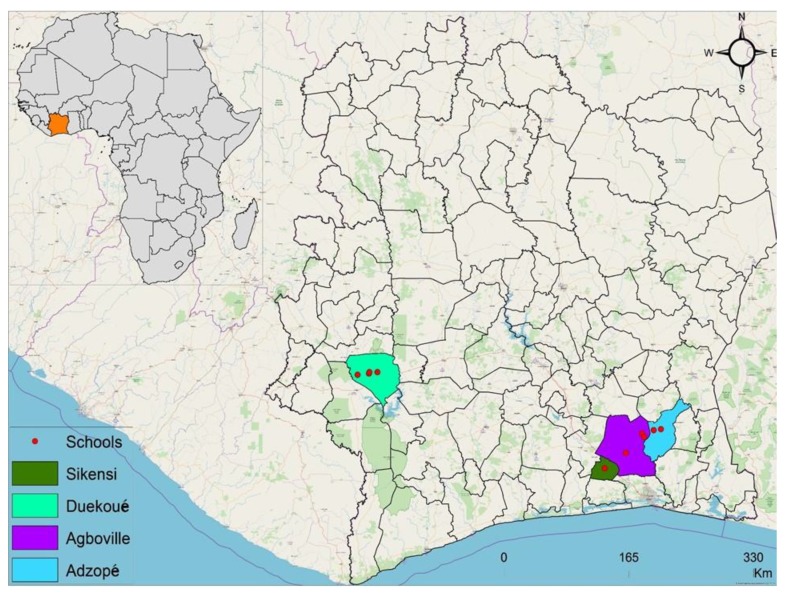
Schistosomiasis is a parasitic disease affecting more than 250 million people, primarily in sub-Saharan Africa. In Côte d'Ivoire both Schistosoma haematobium (causing urogenital schistosomiasis) and Schistosoma mansoni (causing intestinal schistosomiasis) co-exist. This study aimed to determine the prevalence of S. haematobium and S. mansoni and to identify risk factors among schoolchildren in the western and southern parts of Côte d'Ivoire. From January to April 2018, a cross-sectional study was carried out including 1187 schoolchildren aged 5-14 years. Urine samples were examined by a filtration method to identify and count S. haematobium eggs, while stool samples were subjected to duplicate Kato-Katz thick smears to quantify eggs of S. mansoni and soil-transmitted helminths. Data on sociodemographic, socioeconomic, and environmental factors were obtained using a pretested questionnaire. Multivariate logistic regression was employed to test for associations between variables. We found a prevalence of S. haematobium of 14.0% (166 of 1187 schoolchildren infected) and a prevalence of S. mansoni of 6.1% (66 of 1089 schoolchildren infected). In the southern part of Côte d'Ivoire, the prevalence of S. haematobium was 16.1% with a particularly high prevalence observed in Sikensi (35.6%), while S. mansoni was most prevalent in Agboville (11.2%). Swimming in open freshwater bodies was the main risk factor for S. haematobium infection (adjusted odds ratio (AOR) = 127.0, 95% confidence interval (CI): 25.0-634.0, p < 0.001). Fishing and washing clothes in open freshwater bodies were positively associated with S. haematobium and S. mansoni infection, respectively. Preventive chemotherapy using praziquantel should be combined with setting-specific information, education, and communication strategies in order to change children's behavior, thus avoiding contact with unprotected open freshwater.
Keywords: Côte d’Ivoire; Schistosoma haematobium; Schistosoma mansoni; prevalence; risk factors; schistosomiasis.
Conflict of interest statement
The authors declare no conflict of interest.
Figures
References
-
- Hotez P.J., Alvarado M., Basáñez M.-G., Bolliger I., Bourne R., Boussinesq M., Brooker S.J., Brown A.S., Buckle G., Budke C.M., et al. The Global Burden of Disease Study 2010: Interpretation and implications for the neglected tropical diseases. PLoS Negl. Trop. Dis. 2014;8:e2865. doi: 10.1371/journal.pntd.0002865. - DOI - PMC - PubMed
-
- GBD 2017 DALYs and Hale Collaborators Global, regional, and national disability-adjusted life-years (DALYs) for 359 diseases and injuries and healthy life expectancy (HALE) for 195 countries and territories, 1990-2017: A systematic analysis for the Global Burden of Disease study 2017. Lancet. 2018;392:1736–1788. - PMC - PubMed
LinkOut - more resources
Full Text Sources
Miscellaneous
