. 2019 Jul 23;11(7):674.
doi: 10.3390/v11070674.

Evidence for West Nile Virus and Usutu Virus Infections in Wild and Resident Birds in Germany, 2017 and 2018

Affiliations

Evidence for West Nile Virus and Usutu Virus Infections in Wild and Resident Birds in Germany, 2017 and 2018

Friederike Michel et al. Viruses. .

Abstract

Wild birds play an important role as reservoir hosts and vectors for zoonotic arboviruses and foster their spread. Usutu virus (USUV) has been circulating endemically in Germany since 2011, while West Nile virus (WNV) was first diagnosed in several bird species and horses in 2018. In 2017 and 2018, we screened 1709 live wild and zoo birds with real-time polymerase chain reaction and serological assays. Moreover, organ samples from bird carcasses submitted in 2017 were investigated. Overall, 57 blood samples of the live birds (2017 and 2018), and 100 organ samples of dead birds (2017) were positive for USUV-RNA, while no WNV-RNA-positive sample was found. Phylogenetic analysis revealed the first detection of USUV lineage Europe 2 in Germany and the spread of USUV lineages Europe 3 and Africa 3 towards Northern Germany. USUV antibody prevalence rates were high in Eastern Germany in both years. On the contrary, in Northern Germany, high seroprevalence rates were first detected in 2018, with the first emergence of USUV in this region. Interestingly, high WNV-specific neutralizing antibody titers were observed in resident and short-distance migratory birds in Eastern Germany in 2018, indicating the first signs of a local WNV circulation.

Keywords: Germany; Usutu virus; West Nile virus; monitoring; wild bird.


Conflict of interest statement

The authors declare no conflict of interest.

Figures
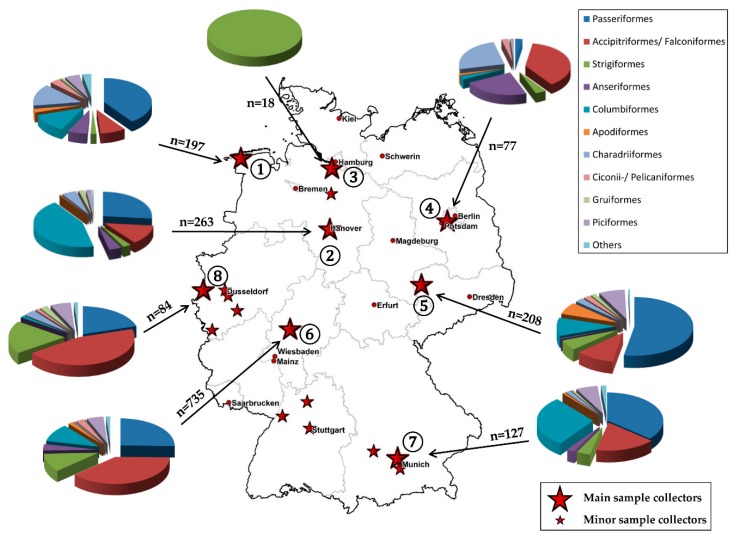
Figure 1
Figure 1
Total number of samples (first sample panel) collected in 2017 and 2018 per sampling site divided into the different zoological bird orders (big red stars = main sample collectors, small red stars = minor sample collectors). The encircled numbers next to the sample collectors allow a geographical allocation to the respective sample collector: ① “Seehundstation Nationalpark-Haus Norden-Norddeich”; ②“Clinic for Small Mammals, Reptiles, and Birds of the University of Veterinary Medicine Hannover”; ③ “Wildpark Schwarze Berge, Rosengarten”; ④ “Department of Veterinary Medicine, Small Animal Clinic of the Freie Universität Berlin; ⑤ “Clinic for Birds and Reptiles (Faculty of Veterinary Medicine) of the Leipzig University”; ⑥ “Clinic for Birds, Reptiles, Amphibians and Fish of the Justus Liebig University Giessen”; ⑦ “Clinic for Birds, Small Mammals, Reptiles and Ornamental Fish, Centre for Clinical Veterinary Medicine of the Ludwig Maximilians University Munich”; ⑧ “Birds of Prey Rehab Center Rhineland”.
Figure 2
Figure 2
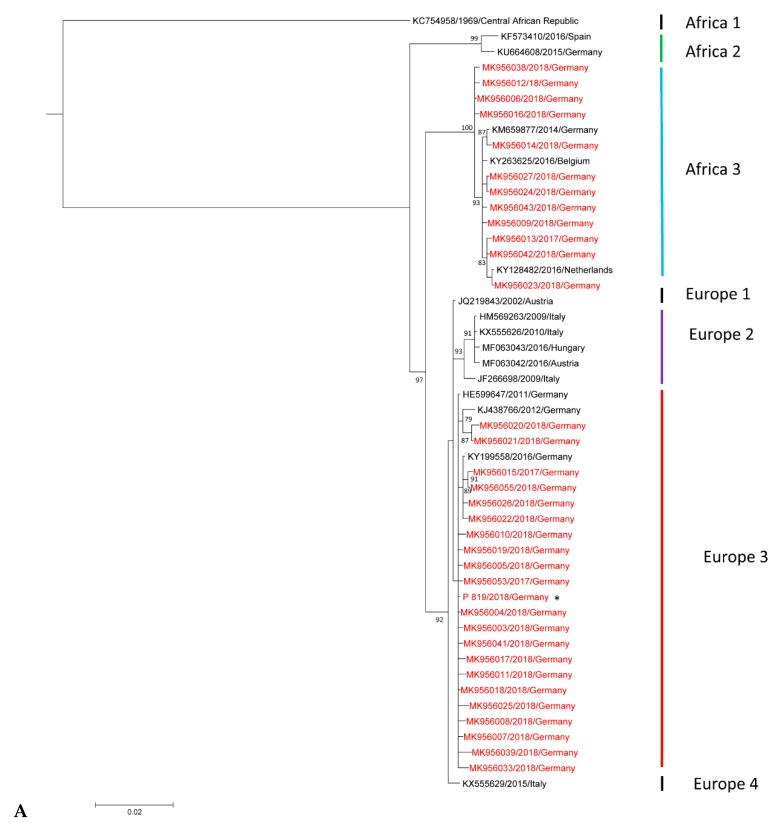
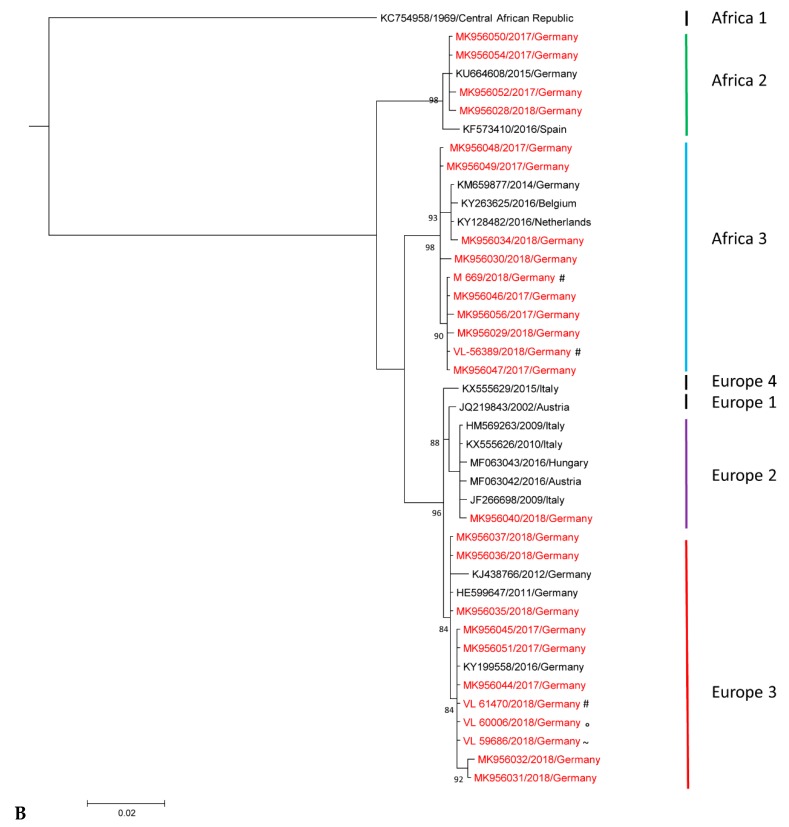
Phylogeny of the Usutu virus (USUV) isolates in 2017 and 2018. Sequences detected in 2017 and 2018 are highlighted in red. Taxon information includes the GenBank accession numbers, detection years, and countries of origin of the viruses. Scale bars indicate the mean number of nucleotide substitutions per site. Some samples had identical partial sequences, but are also depicted as they are from a different geographic region or year, respectively: (* = sequence identical to MK956004; # = sequence identical to MK956046; ° = sequence identical to MK956045; ~ = sequence identical to MK956044) (A) Phylogenetic tree of the detected USUV strains from Germany and Europe constructed from partial envelope genome nucleotide sequences (1066 nucleotides) sequenced by the FLI (Friedrich-Loeffler-Institute). (B) Phylogenetic tree of the detected USUV strains from Germany and Europe constructed from partial nucleotide sequences for the envelope protein (726 nucleotides) sequenced by the University of Leipzig.
Figure 2
Figure 2
Phylogeny of the Usutu virus (USUV) isolates in 2017 and 2018. Sequences detected in 2017 and 2018 are highlighted in red. Taxon information includes the GenBank accession numbers, detection years, and countries of origin of the viruses. Scale bars indicate the mean number of nucleotide substitutions per site. Some samples had identical partial sequences, but are also depicted as they are from a different geographic region or year, respectively: (* = sequence identical to MK956004; # = sequence identical to MK956046; ° = sequence identical to MK956045; ~ = sequence identical to MK956044) (A) Phylogenetic tree of the detected USUV strains from Germany and Europe constructed from partial envelope genome nucleotide sequences (1066 nucleotides) sequenced by the FLI (Friedrich-Loeffler-Institute). (B) Phylogenetic tree of the detected USUV strains from Germany and Europe constructed from partial nucleotide sequences for the envelope protein (726 nucleotides) sequenced by the University of Leipzig.
Figure 3
Figure 3
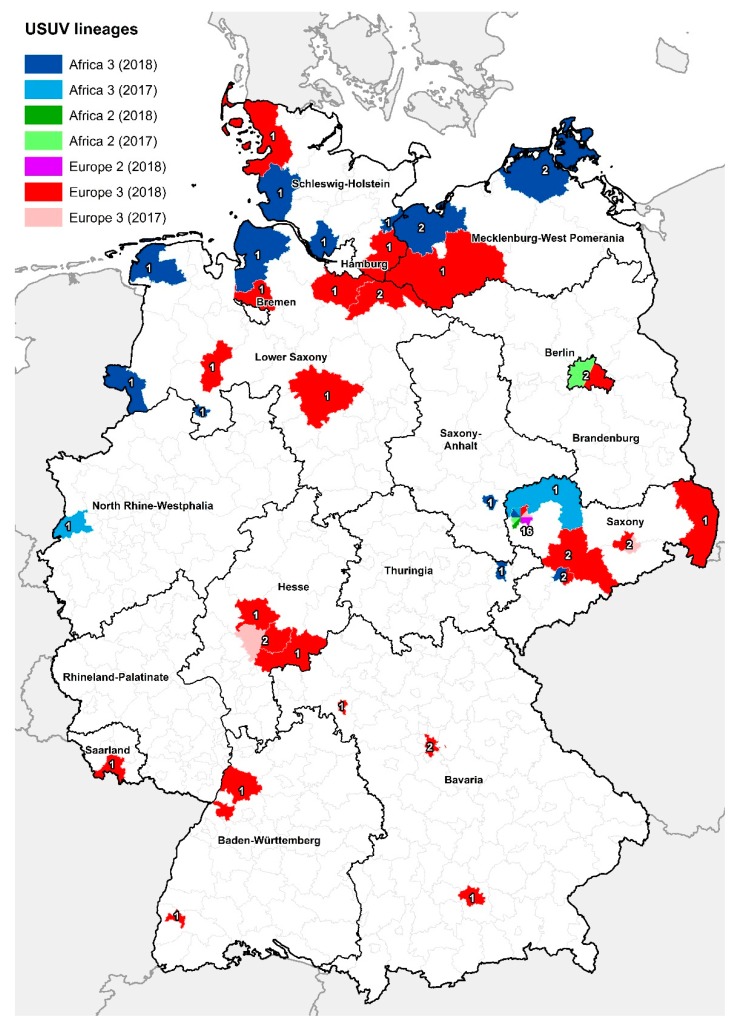
Distribution of the different USUV lineages in 2017 and 2018 (depicted on district level). For sequencing, both the birds of our live bird sample panel and the dead birds submitted to the National reference laboratory were used. The total number of birds sequenced per district is also embedded in this map.
Figure 4
Figure 4
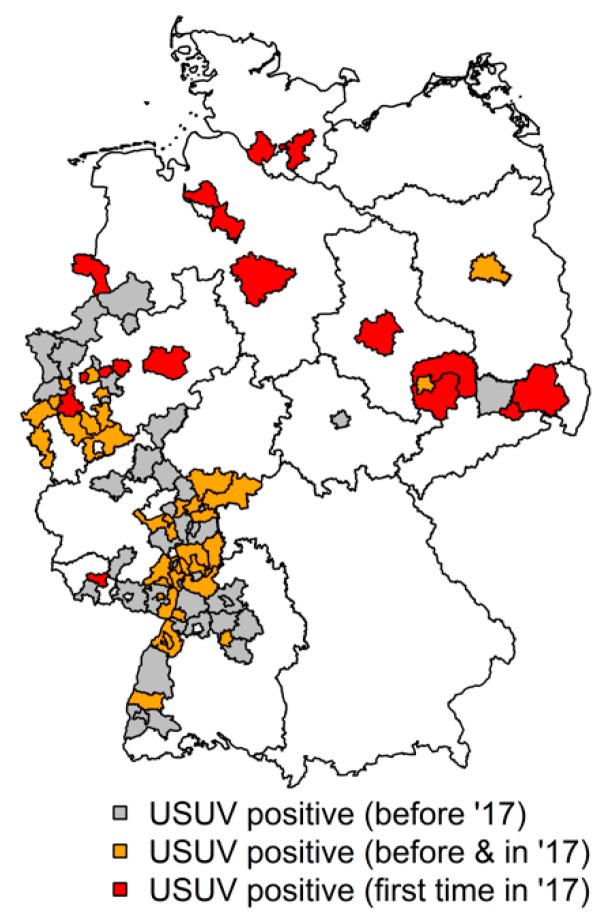
USUV detection in dead birds (second sample panel) in 2017 (red areas = USUV-positive birds detected for the first time in 2017, yellow areas = USUV-positive birds detected before and in 2017, grey areas = distribution of USUV-positive birds in the previous years, but no cases in 2017).

References

    1. Hubalek Z. An annotated checklist of pathogenic microorganisms associated with migratory birds. J. Wildl Dis. 2004;40:639–659. doi: 10.7589/0090-3558-40.4.639. - DOI - PubMed
    1. Rappole J.H., Hubalek Z. Migratory birds and West Nile virus. J. Appl. Microbiol. 2003;94:47–58. doi: 10.1046/j.1365-2672.94.s1.6.x. - DOI - PubMed
    1. Seidowski D., Ziegler U., von Rönn J.A., Müller K., Hüppop K., Müller T., Freuling C., Mühle R.U., Nowotny N., Ulrich R.G., et al. West Nile virus monitoring of migratory and resident birds in Germany. Vector Borne Zoonotic Dis. 2010;10:639–647. doi: 10.1089/vbz.2009.0236. - DOI - PubMed
    1. Ziegler U., Seidowski D., Angenvoort J., Eiden M., Müller K., Nowotny N., Groschup M.H. Monitoring of West Nile virus infections in Germany. Zoonoses Public Health. 2012;59:95–101. doi: 10.1111/zph.12015. - DOI - PubMed
    1. Michel F., Fischer D., Eiden M., Fast C., Reuschel M., Müller K., Rinder M., Urbaniak S., Brandes F., Schwehn R., et al. West Nile Virus and Usutu Virus Monitoring of Wild Birds in Germany. Int. J. Environ. Res. Public Health. 2018;15:171. doi: 10.3390/ijerph15010171. - DOI - PMC - PubMed

Publication types

Supplementary concepts

LinkOut - more resources