


Extending the Grazing Period for Bulls, Prior to Finishing on a Concentrate Ration: Composition, Collagen Structure and Organoleptic Characteristics of Beef
- PMID: 31340599
- PMCID: PMC6678992
- DOI: 10.3390/foods8070278
Extending the Grazing Period for Bulls, Prior to Finishing on a Concentrate Ration: Composition, Collagen Structure and Organoleptic Characteristics of Beef
Abstract
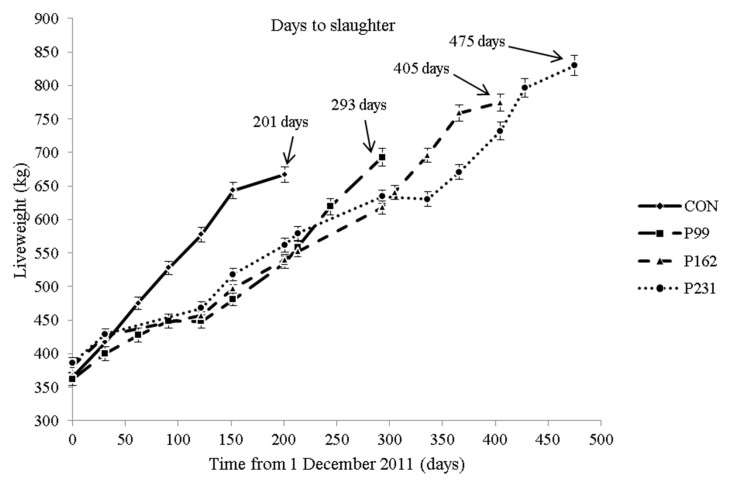
The biochemical and organoleptic characteristics of the longissimus thoracis muscle from suckler bulls (n = 56) finished on a concentrate-based system (C) or raised in a pasture-based system (P) incorporating 99 (P99), 162 (P162) or 231 days (P231) of grazing prior to indoor finishing on the concentrate-based diet were investigated. Age at slaughter increased with increasing period at pasture. Intramuscular fat concentration was lower (p < 0.001) for P99 than for C, P162 and P231 bulls, which did not differ. Soluble collagen proportion was lower (p < 0.01) for P162 and P231 than for P99 and C bulls. Collagen cross-link content was higher (p < 0.05) for P231 than for P99 and C bulls and for P162 than for C bulls. The proportion of type I muscle fibres was higher (p < 0.01) for P231 and P162 than for P99 and C bulls. Sensory tenderness was higher (p < 0.001) for C and P162 than for P99 and P231 bulls and overall liking was higher (p < 0.01) for C than for P99 and P231 bulls but similar to P162 bulls. Extending the grazing period to 162 days did not negatively influence the sensory qualities of beef compared to the intensive concentrate-based system.
Keywords: beef; fat score; fibre type; intramuscular fat; sensory quality.
Conflict of interest statement
The authors declare no conflict of interest.
Figures
References
-
- Teagasc . Beef Production System Guidelines. Teagasc; Carlow, Ireland: 2015.
-
- O’Riordan E.G., Crosson P., McGee M. Finishing male cattle from the beef suckler herd. Ir. Grassl. Anim. Prod. Assoc. J. 2011;45:131–146.
-
- Finneran E., Crosson P., O’Kiely P., Shalloo L., Forristal D., Wallace M. Stochastic simulation of the cost of home-produced feeds for ruminant livestock systems. J. Agric. Sci. 2011;150:123–139. doi: 10.1017/S002185961100061X. - DOI
LinkOut - more resources
Full Text Sources
