. 2019 Jul 24;19(1):150.
doi: 10.1186/s12862-019-1483-3.

Divergence in larval jaw gene expression reflects differential trophic adaptation in haplochromine cichlids prior to foraging

Affiliations

Divergence in larval jaw gene expression reflects differential trophic adaptation in haplochromine cichlids prior to foraging

Ehsan Pashay Ahi et al. BMC Evol Biol. .

Abstract

Background: Understanding how variation in gene expression contributes to morphological diversity is a major goal in evolutionary biology. Cichlid fishes from the East African Great lakes exhibit striking diversity in trophic adaptations predicated on the functional modularity of their two sets of jaws (oral and pharyngeal). However, the transcriptional basis of this modularity is not so well understood, as no studies thus far have directly compared the expression of genes in the oral and pharyngeal jaws. Nor is it well understood how gene expression may have contributed to the parallel evolution of trophic morphologies across the replicate cichlid adaptive radiations in Lake Tanganyika, Malawi and Victoria.

Results: We set out to investigate the role of gene expression divergence in cichlid fishes from these three lakes adapted to herbivorous and carnivorous trophic niches. We focused on the development stage prior to the onset of exogenous feeding that is critical for understanding patterns of gene expression after oral and pharyngeal jaw skeletogenesis, anticipating environmental cues. This framework permitted us for the first time to test for signatures of gene expression underlying jaw modularity in convergent eco-morphologies across three independent adaptive radiations. We validated a set of reference genes, with stable expression between the two jaw types and across species, which can be important for future studies of gene expression in cichlid jaws. Next we found evidence of modular and non-modular gene expression between the two jaws, across different trophic niches and lakes. For instance, prdm1a, a skeletogenic gene with modular anterior-posterior expression, displayed higher pharyngeal jaw expression and modular expression pattern only in carnivorous species. Furthermore, we found the expression of genes in cichlids jaws from the youngest Lake Victoria to exhibit low modularity compared to the older lakes.

Conclusion: Overall, our results provide cross-species transcriptional comparisons of modularly-regulated skeletogenic genes in the two jaw types, implicating expression differences which might contribute to the formation of divergent trophic morphologies at the stage of larval independence prior to foraging.

Keywords: Adaptive radiation; East African lakes; Haplochromine cichlids; Modularity; Trophic specialization; jaw development.


Conflict of interest statement

The authors declare that they have no competing interests.

Figures
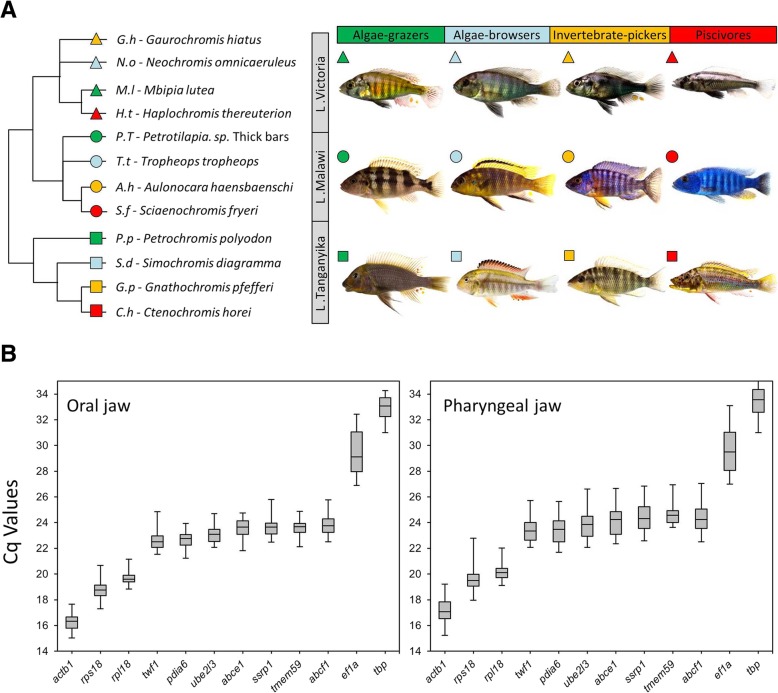
Fig. 1
Fig. 1
Relatedness, habitats, trophic specialization and expression levels of candidate reference genes in the jaws of haplochromine cichlid species used in this study. a A simplified phylogenetic tree of the East African haplochromine cichlids displaying the relatedness between the species specified by their habitats/lakes and trophic specializations. The symbol colour for each species represents related trophic niche whereas the symbol shape refers to its habitat/lake. b Expression levels of candidate reference genes based on raw Cq values in oral or pharyngeal jaws across all of the species. In each box plot, the middle line represents the median and boxes lower and upper limits indicate the 25/75 percentiles
Fig. 2
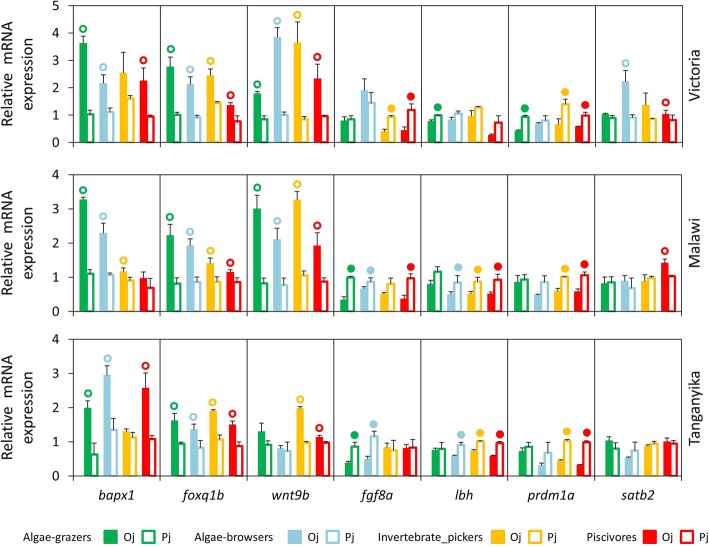
Fig. 2
The oral versus pharyngeal jaws expression differences of seven target genes in haplochromine cichlids from three East African lakes at the end of larval phase. (A) Comparisons of relative expression levels between oral and pharyngeal jaws for seven candidate target genes in different lakes in East Africa at the yolk sac absorption stage marking the end of larval development and the onset of juvenile phase. Circles above bars indicate significantly elevated expression (P < 0.05) in comparisons between oral and pharyngeal jaws (i.e., compared to the bar matching the colour code of the circle); the comparisons were restricted within the species
Fig. 3
Fig. 3
Oral jaws expression differences of seven target genes between distinct trophic niches in each lake at the end of larval phase. (A) Comparisons of relative expression levels of seven target genes between oral jaws of haplochromine species belonging to distinct trophic niche in each East African lake at the yolk sac absorption stage marking the end of larval development and the onset of juvenile phase. Circles above bars indicate significantly elevated expression (P < 0.05) in comparisons between oral jaws (i.e., compared to the bar matching the colour code of the circle)
Fig. 4
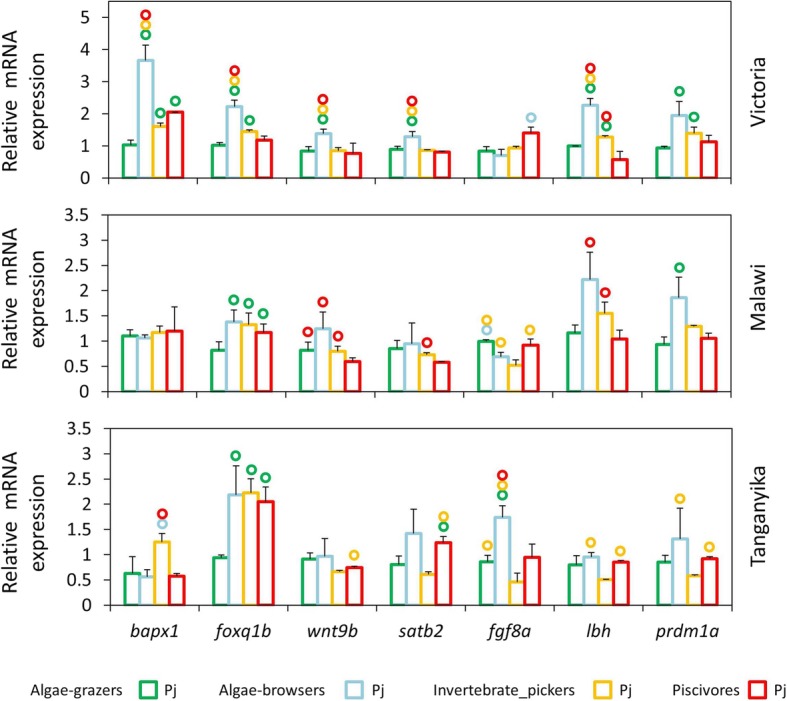
Fig. 4
Pharyngeal jaws expression differences of seven target genes between distinct trophic niches in each lake at the end of larval phase. (A) Comparisons of relative expression levels of seven target genes between pharyngeal jaws of haplochromine species belonging to distinct trophic niche in each East African lake at the yolk sac absorption stage marking the end of larval development and the onset of juvenile phase. Circles above bars indicate significantly elevated expression (P < 0.05) in comparisons between pharyngeal jaws (i.e., compared to the bar matching the colour code of the circle)

References

    1. Mallat J. Ventilation and the origin of jawed vertebrates: a new mouth. Zool J Linn Soc. 1996;117:329–404. doi: 10.1111/j.1096-3642.1996.tb01658.x. - DOI
    1. Brazeau MD, Friedman M. The origin and early phylogenetic history of jawed vertebrates. Nature. 2015;520:490–497. doi: 10.1038/nature14438. - DOI - PMC - PubMed
    1. Shigetani Y, Sugahara F, Kuratani S. A new evolutionary scenario for the vertebrate jaw. BioEssays. 2005;27:331–338. doi: 10.1002/bies.20182. - DOI - PubMed
    1. Grant PR, Grant BR. Genetics and the origin of bird species. Proc Natl Acad Sci U S A. 1997;94:7768–7775. doi: 10.1073/pnas.94.15.7768. - DOI - PMC - PubMed
    1. Adams DC, Rohlf FJ. Ecological character displacement in Plethodon: biomechanical differences found from a geometric morphometric study. Proc Natl Acad Sci U S A. 2000;97:4106–4111. doi: 10.1073/pnas.97.8.4106. - DOI - PMC - PubMed

Publication types

LinkOut - more resources