


Improving recruitment to a study of telehealth management for COPD: a cluster randomised controlled 'study within a trial' (SWAT) of a multimedia information resource
- PMID: 31340853
- PMCID: PMC6657092
- DOI: 10.1186/s13063-019-3496-z
Improving recruitment to a study of telehealth management for COPD: a cluster randomised controlled 'study within a trial' (SWAT) of a multimedia information resource
Abstract
Background: Good quality information is critical for valid informed consent to trials, but current paper-based consent procedures are potentially unwieldy and can be difficult to comprehend, which may deter people from participating. Multimedia resources may be able to provide more accessible and user-friendly information. We aimed to test whether offering access to a multimedia information resource alongside standard, printed patient information impacted on recruitment rates by conducting a pragmatic 'study within a trial' (SWAT) embedding a trial of a multimedia resource within an existing trial.
Methods: The PSM COPD study involved people with mild symptoms of chronic obstructive pulmonary disease (COPD) recruited from primary care being randomised to a nurse-delivered telephone health coaching intervention, or usual primary care. For the SWAT of recruitment procedures, practices recruiting participants were cluster randomised to use either the standard printed patient information materials or standard printed patient information materials with access to a multimedia information resource. The multimedia resource was developed by patient and public involvement (PPI) contributors and researchers, and included study-specific information (e.g. study purpose, risks), and generic information about trials (e.g. confidentiality, randomisation). We developed a list of components and used animations as well as video clips of patients discussing their experiences of participation, matched to these components. The primary outcome was the proportion of participants randomised.
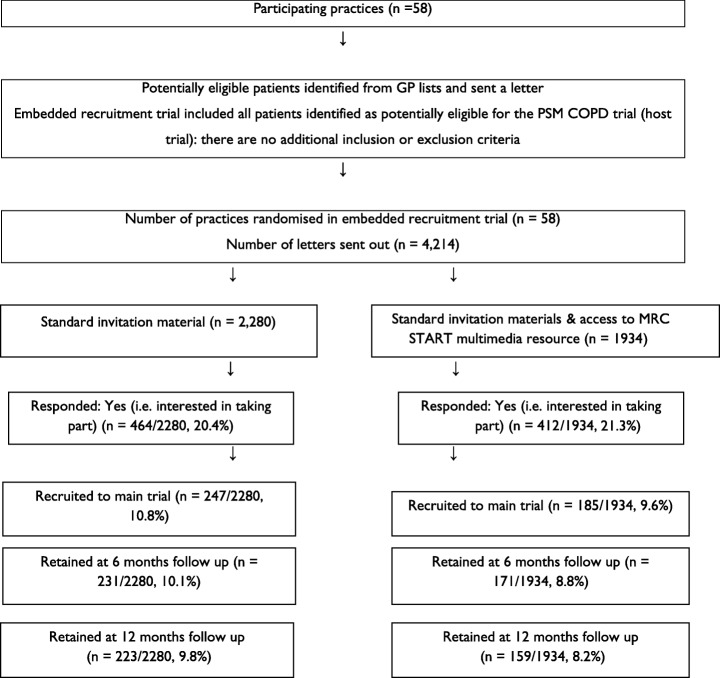
Results: Nine point six percent of those receiving standard printed patient information materials and access to the multimedia information resource were recruited, compared to 10.8% in those receiving standard printed materials alone (odds ratio (OR) = 0.844, 95% confidence interval (CI) 0.58 to 1.22). We also found no effects on the proportion of people responding to the invitation (OR = 1.02, 95% CI 0.79 to 1.33) or retention in the trial at 6 (ORs 0.84, 95% CI 0.57 to 1.22) and 12 months after randomisation (ORs 0.80, 95% CI 0.54 to 1.18), respectively.
Conclusions: The study suggests no benefits of access to a multimedia information resource alongside patient information materials on recruitment. This may reflect the limited engagement of patients with the multimedia resource. Further uses of multimedia resources will need to explore how content can be explicitly matched to user needs and preferences and methods to encourage engagement to see if effects can be enhanced. More SWATs of multimedia into ongoing trials will provide a more precise estimate of effect, and explore further how effects vary by trial context and recruitment process, intervention, and patient population.
Trial registration: Current controlled trials ISRCTN 06710391 . Registered on 21 November 2013.
Swat registration: SWAT 23: Systematic Techniques for Assisting Recruitment to Trials (MRC START). Registered on 11 January 2012.
Keywords: Patient information; Randomised controlled trial; Recruitment; Research methodology.
Conflict of interest statement
The authors declare that they have no competing interests.
References
-
- Treweek S, Parker A, Torgerson D, Clarke M.:Why the NIHR’s new funding stream for ‘Studies Within A Trial’ (SWATs) is potentially game-changing. 2018. https://www.nihr.ac.uk/blogs/why-the-nihrs-new-funding-stream-for-studie.... Accessed 17 June 2019.
Publication types
MeSH terms
Grants and funding
LinkOut - more resources
Full Text Sources
Medical
Miscellaneous
