. 2019 Jul 24;10(1):3302.
doi: 10.1038/s41467-019-11102-2.

A safe and non-flammable sodium metal battery based on an ionic liquid electrolyte

Affiliations

A safe and non-flammable sodium metal battery based on an ionic liquid electrolyte

Hao Sun et al. Nat Commun. .

Abstract

Rechargeable sodium metal batteries with high energy density could be important to a wide range of energy applications in modern society. The pursuit of higher energy density should ideally come with high safety, a goal difficult for electrolytes based on organic solvents. Here we report a chloroaluminate ionic liquid electrolyte comprised of aluminium chloride/1-methyl-3-ethylimidazolium chloride/sodium chloride ionic liquid spiked with two important additives, ethylaluminum dichloride and 1-ethyl-3-methylimidazolium bis(fluorosulfonyl)imide. This leads to the first chloroaluminate based ionic liquid electrolyte for rechargeable sodium metal battery. The obtained batteries reached voltages up to ~ 4 V, high Coulombic efficiency up to 99.9%, and high energy and power density of ~ 420 Wh kg-1 and ~ 1766 W kg-1, respectively. The batteries retained over 90% of the original capacity after 700 cycles, suggesting an effective approach to sodium metal batteries with high energy/high power density, long cycle life and high safety.


Conflict of interest statement

The authors declare no competing interests.

Figures

Fig. 1
Fig. 1
Properties of the buffered Na–Cl–IL electrolyte. a Schematic illustration of the battery configuration and electrolyte composition of the IL electrolyte. b Raman spectra of ILs based on AlCl3/[EMIm]Cl = 1.5 with different additives. c Ionic conductivities of buffered Na–Cl–IL and other IL-based electrolytes for Na batteries at 25 °C. df Thermal stability (d) and flammability tests using buffered Na–Cl–IL (e) and conventional 1.0 M NaClO4 in EC:DEC (1:1 by vol) with 5 wt% FEC electrolytes (f). Scale bars in (e, f), 1 cm
Fig. 2
Fig. 2
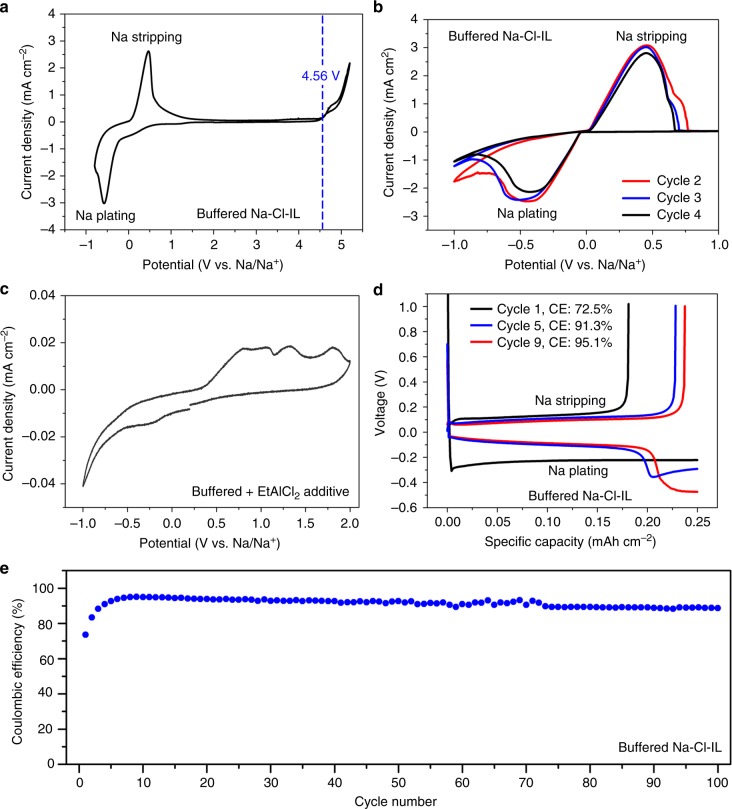
Electrochemical properties of the buffered Na–Cl–IL electrolyte. a Linear sweep voltammetry profile of buffered Na–Cl–IL electrolyte. Working electrode, carbon fibre paper. Counter and reference electrode, Na foil. Scan rate, 2 mV s−1. b, c CV curves of Na/Pt cells using buffered + EtAlCl2 additive and buffered Na–Cl–IL electrolyte at a scan rate of 2 mV s−1, respectively. d Na plating/stripping profiles of Na/Pt cells using buffered Na–Cl–IL electrolyte at a current density of 0.5 mA cm−2. e Na plating/stripping Coulombic efficiency of a Na/Pt cell using Buffered Na–Cl–IL electrolyte at 0.5 mA cm−2. The plating capacity in (d, e): 0.25 mAh cm−2
Fig. 3
Fig. 3
Na/NVP/@GO cell performances in buffered Na–Cl–IL electrolyte. a CV curves of a Na/NVP@rGO cell using buffered Na–Cl–IL electrolyte at a scan rate of 2 mV s−1. b Initial galvanostatic charge-discharge curves of a Na/NVP@rGO cell using buffered Na–Cl–IL electrolytes with and without [EMIm]FSI additive at 25 mA g−1. c Galvanostatic charge-discharge curves of a Na/NVP@rGO cell using buffered Na–Cl–IL electrolyte at varied current densities from 25 to 400 mA g−1. d, e Rate and cyclic stability of a Na/NVP@rGO cell using buffered Na–Cl–IL electrolyte. The boxed region of (e) corresponds to the rate performance of (d) at varied current densities from 20 to 500 mA g−1. After that, a current density of 150 mA g−1 was used for cycling
Fig. 4
Fig. 4
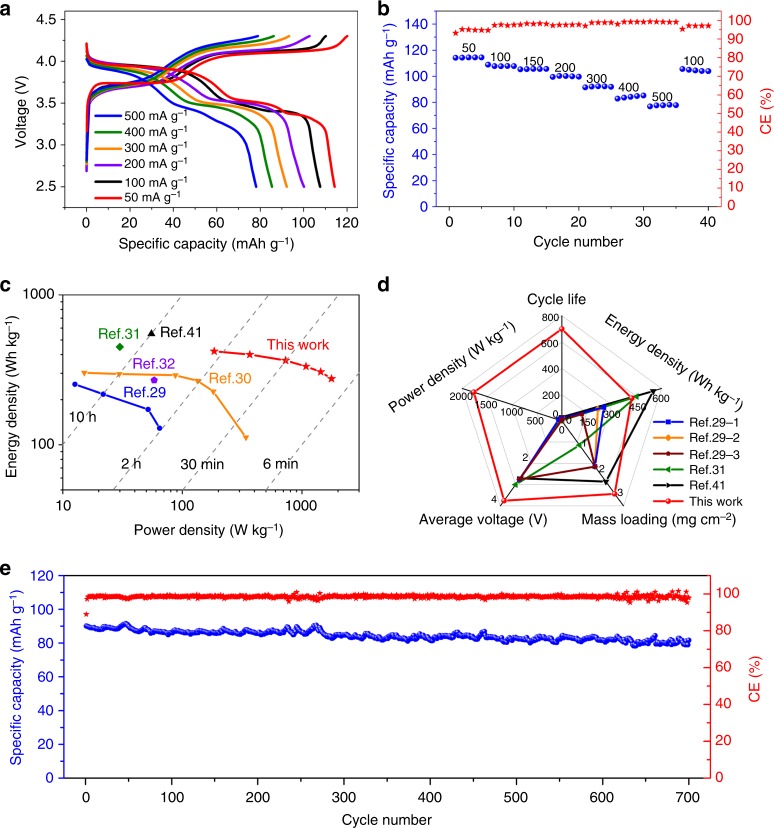
Na/NVPF@GO cell performances in buffered Na–Cl–IL electrolyte. a Galvanostatic charge-discharge curves of a Na/NVPF@rGO cell at varied current density from 50 to 500 mA g−1. b Capacity and Coulombic efficiency retention of a Na/NVPF@rGO cell when cycled at different current densities from 50 to 500 mA g−1. c, d Ragone and Radar plots of this work compared with other reported room-temperature Na batteries based on IL electrolytes, respectively–,. The specific capacity, energy and power density in this work and previous literatures were all calculated based on the mass of active materials on positive electrode. The cycle life in (d) is determined by the cycle number when the capacity dropped below 90% of the original capacity. 1, 2 and 3 represent three different IL electrolytes based on 1 M NaBF4, NaClO4 and NaPF6 salts, respectively. e Cyclic stability of a Na/NVPF@rGO cell using buffered Na–Cl–IL electrolyte at 300 mA g−1
Fig. 5
Fig. 5
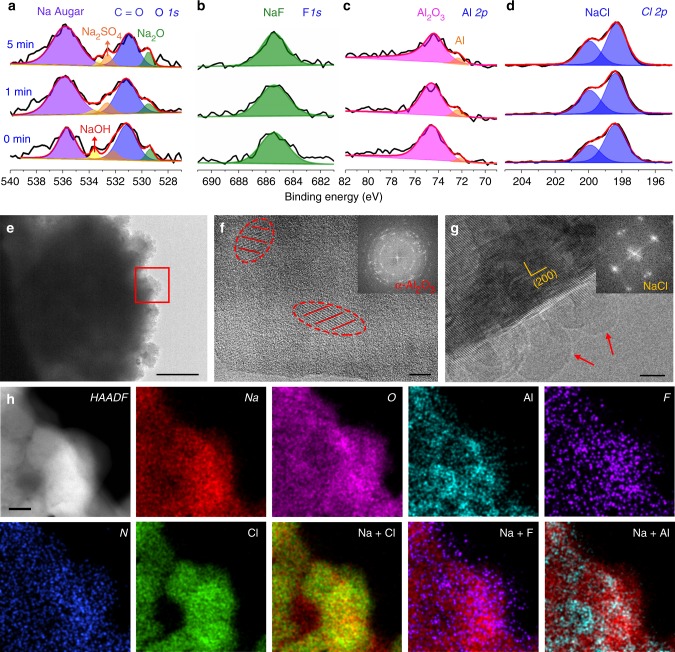
Morphology and solid-electrolyte interphase (SEI) probing of the plated Na in buffered Na–Cl–IL electrolyte. a–d High-resolution XPS spectra for Na Auger and O1s (a), F 1s (b), Al 2p (c) and Cl 2p (d) of the Na negative electrode from a Na/NVP@rGO cell with NVP@rGO mass loading of 5.0 mg cm−2 at different depths, respectively. The cell was cycled at 100 mA g−1 (~0.5 mA cm−2) for 20 cycles and stopped at fully charged state prior to characterization. e Cryo-TEM image of Na-plated Cu grid at a current density of 0.1 mA cm−2. Scale bar, 500 nm. f, g High-resolution Cryo-TEM images and diffraction patterns (inset) of SEI concerning Al2O3 and NaCl. Scale bars in (f, g), 5 nm. h High-angle annular dark-field (HAADF) and the corresponding element mapping images for SEI composition probing using STEM. Scale bar, 100 nm

References

    1. Armand M, Tarascon JM. Building better batteries. Nature. 2008;451:652. doi: 10.1038/451652a. - DOI - PubMed
    1. Cano ZP, et al. Batteries and fuel cells for emerging electric vehicle markets. Nat. Energy. 2018;3:279–289. doi: 10.1038/s41560-018-0108-1. - DOI
    1. Dunn B, Kamath H, Tarascon J-M. Electrical energy storage for the grid: a battery of choices. Science. 2011;334:928–935. doi: 10.1126/science.1212741. - DOI - PubMed
    1. Xu X, et al. A room-temperature sodium–sulfur battery with high capacity and stable cycling performance. Nat. Commun. 2018;9:3870. doi: 10.1038/s41467-018-06443-3. - DOI - PMC - PubMed
    1. Zhou D, et al. A stable quasi-solid-state sodium–sulfur battery. Angew. Chem. Int. Ed. 2018;57:10168–10172. doi: 10.1002/anie.201805008. - DOI - PubMed