Review
. 2019 Jul 22:2:72.
doi: 10.1038/s41746-019-0150-9. eCollection 2019.

Wearable sensors for monitoring the physiological and biochemical profile of the athlete

Affiliations
Review

Wearable sensors for monitoring the physiological and biochemical profile of the athlete

Dhruv R Seshadri et al. NPJ Digit Med. .

Abstract

Athletes are continually seeking new technologies and therapies to gain a competitive edge to maximize their health and performance. Athletes have gravitated toward the use of wearable sensors to monitor their training and recovery. Wearable technologies currently utilized by sports teams monitor both the internal and external workload of athletes. However, there remains an unmet medical need by the sports community to gain further insight into the internal workload of the athlete to tailor recovery protocols to each athlete. The ability to monitor biomarkers from saliva or sweat in a noninvasive and continuous manner remain the next technological gap for sports medical personnel to tailor hydration and recovery protocols per the athlete. The emergence of flexible and stretchable electronics coupled with the ability to quantify biochemical analytes and physiological parameters have enabled the detection of key markers indicative of performance and stress, as reviewed in this paper.

Keywords: Diagnostic markers; Predictive medicine.


Conflict of interest statement

Competing interestsThe authors declare no competing interests.

Figures
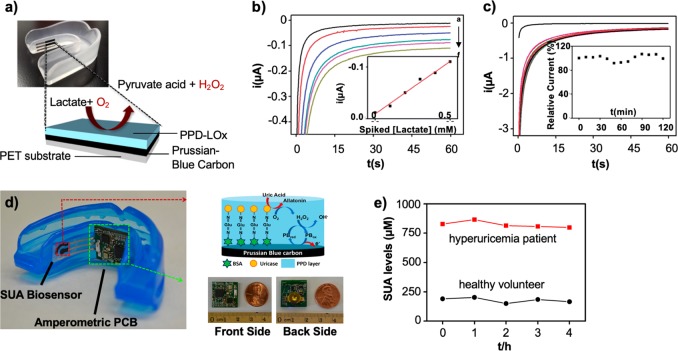
Fig. 1
Fig. 1
Mouthguard biosensor for the continuous monitoring of metabolites from saliva. a Mouthguard biosensor with the integrated printable electrodes. The Prussian Blue working electrode is coated with the PPD-LOX layer for salivary lactate monitoring. b Testing of the mouthguard biosensor from (a) in human saliva showed that the device responded favorably to changes in lactate level with a correlation coefficient of 0.988. c Testing of the mouthguard biosensor from (a) to untreated human saliva over a 2-h period demonstrated a highly stable response. The good stability is reflective of the PPD coating against co-existing fouling constituents. d Salivary uric acid biosensor with a wireless amperometric circuit board. Chemically modified Prussian-Blue carbon comprised the working electrode. The amperometric printed circuit board (PCB) was the size of a 1 cent coin. e Translational utility of the mouthguard demonstrated the ability of the device to measure salivary uric acid levels over a 5-h period in a healthy volunteer (black) vs. that of a patient with hyperuricemia (black). Figures were reproduced with permission from Kim et al. (a–c) and Kim et al. (d, e).
Fig. 2
Fig. 2
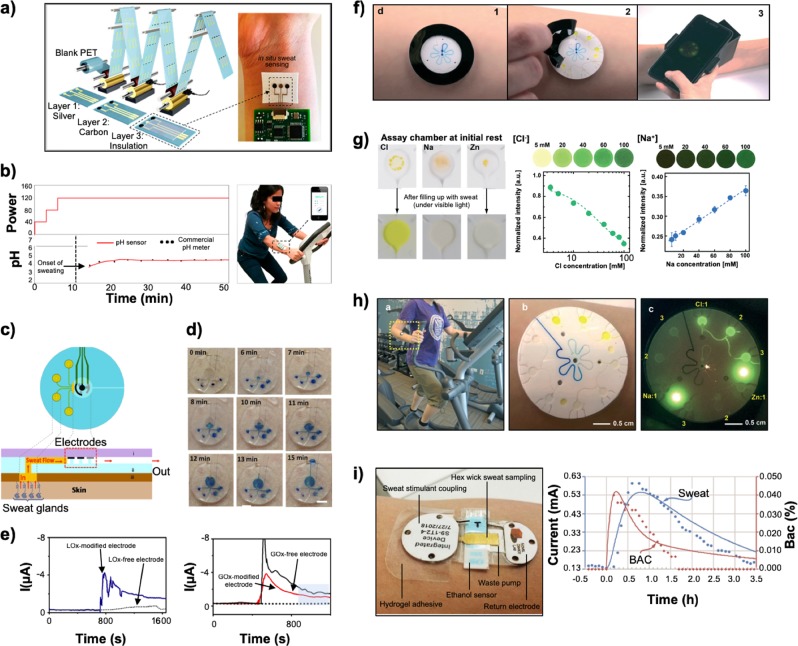
Wearable sensors to monitor the biochemical status of the athlete by detecting biomarkers from eccrine sweat. a R2R gravure manufacturing of electrochemical sensors on PET substrates. b Real time, in situ measurement of sweat pH from the sensor depicted in panel (a). c Schematic of the microfluidic sweat collection device. Top-down and cross-sectional views are provided. d Photographs depicting the time needed to fill the microfluidic reservoir from panel (c) using an optimized four-inlet design when sweat is generated during nonstationary conditions. e Continuous lactate and glucose monitoring via the Lox and GOx-modified electrodes from panel (c) on a healthy subject. f Protocol for performing a fluorometric assay using a microfluidic device to detect zinc, sodium, and chloride levels: (1) collecting sweat using a skin-interfaced microfluidic device, (2) peeling away the black shield, and (3) capturing a photo of the device using a smartphone interfaced with the device with an optics module. g Fluorescence images of the detected analytes from the microfluidic device detailed in panel (f) and the dependence on fluorescence intensity on concentration. Images of the microreservoirs for the assays before (upper) and after (lower) filling with sweat collected under visible light illumination. Changes of the fluorescence and its normalized intensity are shown at various concentrations and depicted for sodium and chloride. h Subject wearing the microfluidic device from panel (f) during testing. Photographs of the device without the black shield after sweat collection is shown under visible light and under blue light emitted by a smartphone. i After the patch is applied, sweat stimulation involved the iontophoretic delivery of carbachol. Sweat is picked up from the skin by the hex-wick and transported to the sensors to measure ethanol concentration and then transported onto the waste pump. In vivo test data carried over 3.5 h on a subject is shown. The ethanol bolus occurred at the start time and only thirty minutes of sensor results are depicted previous to the ethanol bolus. Figures were reproduced with permission from Bariya et al. (a, b), Martín et al. (c–e), Sekine et al. (f–h), and Hauke et al. (i)
Fig. 3
Fig. 3
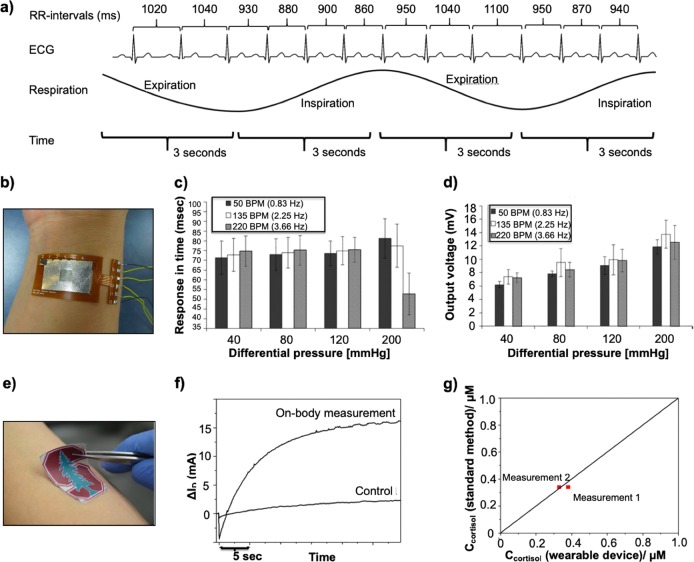
Monitoring the mental acuity of the athlete via measurement of heart rate variability, skin conductivity (galvanic skin response), or biomarkers from eccrine sweat. a Schematic illustrating the derivation of heart rate variability from an ECG. The ECG presented herein is depicting respiratory sinus arrhythmia. Heart rate increases thus decreasing the time between successive RR intervals during inhalation and exhalation. The change in time between successive RR intervals is called heart rate variability, expressed in ms. Short heart rate variability is indicative of high-stress levels whereas long heart rate variability is indicative of a calm period. b Human stress monitoring patch affixed to a human wrist (c) Performance of the pulsewave sensor from panel (b) for varying differential pressure of heart beat depending on the heart rate of 50 BPM, 145 BPM, and 220 BPM as a function of the change in time. d Performance of the pulsewave sensor from panel (b) for varying differential pressure of heart beat depending on the heart rate of 50 BPM, 145 BPM, and 220 BPM as a function of output voltage. e Image of an epidermal sensor applied to the forearm of a healthy volunteer to detect cortisol levels from eccrine sweat. f Real-time response of the molecularly selective and control devices after completion of physical exercise. The cortisol response was recorded using the output measurement and the data were represented as a change of drain current vs. time at a low voltage. g The data demonstrated a good correlation with standard cortisol ELISA methods for cortisol detection with an RSD of 5% for the two measurements. Figures were reproduced with permission from Firstbeat Technologies (a), Yoon et al. (b–d), and Parlak et al. (e-g)
Fig. 4
Fig. 4
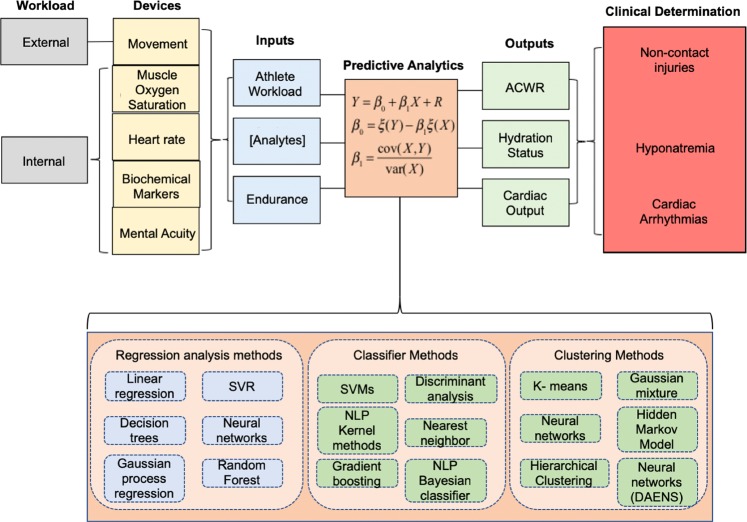
Emergence of machine learning could heighten the translational utility of wearable sensor technology for sports. Data acquired from wearable sensors can be inputted into machine learning models to predict athlete performance, likelihood of suffering a noncontact injury, inform hydration status to alleviate soft-tissue injuries, or accurately diagnose cardiac arrhythmias

References

    1. Li X, et al. Digital health: tracking physiomes and activity using wearable biosensors reveals useful health-related information. PLOS Biol. 2017;15:e2001402. doi: 10.1371/journal.pbio.2001402. - DOI - PMC - PubMed
    1. Grayson ACR, et al. A BioMEMS review: MEMS technology for physiologically integrated devices. Proc. IEEE. 2004;92:6–21. doi: 10.1109/JPROC.2003.820534. - DOI
    1. Bandodkar AJ, Wang J. Non-invasive wearable electrochemical sensors: a review. Trends Biotechnol. 2014;32:363–371. doi: 10.1016/j.tibtech.2014.04.005. - DOI - PubMed
    1. Lee SP, et al. Highly flexible, wearable, and disposable cardiac biosensors for remote and ambulatory monitoring. npj Digit. Med. 2018;1:2. doi: 10.1038/s41746-017-0009-x. - DOI - PMC - PubMed
    1. Taelman, J., Adriaensen, T., Horst, C. van der, Linz, T. & Spaepen, A. Textile Integrated Contactless EMG Sensing for Stress Analysis. In Proc 2007 29th Annual International Conference of the IEEE Engineering in Medicine and Biology Society 3966–3969 10.1109/IEMBS.2007.4353202 (2007). - PubMed