. 2019 Jul 19:2:266.
doi: 10.1038/s42003-019-0487-2. eCollection 2019.

Canine osteosarcoma genome sequencing identifies recurrent mutations in DMD and the histone methyltransferase gene SETD2

Affiliations

Canine osteosarcoma genome sequencing identifies recurrent mutations in DMD and the histone methyltransferase gene SETD2

Heather L Gardner et al. Commun Biol. .

Abstract

Osteosarcoma (OS) is a rare, metastatic, human adolescent cancer that also occurs in pet dogs. To define the genomic underpinnings of canine OS, we performed multi-platform analysis of OS tumors from 59 dogs, including whole genome sequencing (n = 24) and whole exome sequencing (WES; n = 13) of primary tumors and matched normal tissue, WES (n = 10) of matched primary/metastatic/normal samples and RNA sequencing (n = 54) of primary tumors. We found that canine OS recapitulates features of human OS including low point mutation burden (median 1.98 per Mb) with a trend towards higher burden in metastases, high structural complexity, frequent TP53 (71%), PI3K pathway (37%), and MAPK pathway mutations (17%), and low expression of immune-associated genes. We also identified novel features of canine OS including putatively inactivating somatic SETD2 (42%) and DMD (50%) aberrations. These findings set the stage for understanding OS development in dogs and humans, and establish genomic contexts for future comparative analyses.

Keywords: Bone cancer; Cancer genomics; Dog; Sarcoma.


Conflict of interest statement

Competing interestsK.A.J. has received research funding from Amgen and Pfizer, and travel support from Loxo. C.A.L. has performed consulting work for The One Health Company, Anivive, Karyopharm therapeutics, Zoetis, and Blue Buffalo. W.P.D.H. has performed consulting work for The One Health Company, received research funding from Ethos Veterinary Health, and received travel support from Pathway Vet Alliance. The other authors declare no competing interests.

Figures
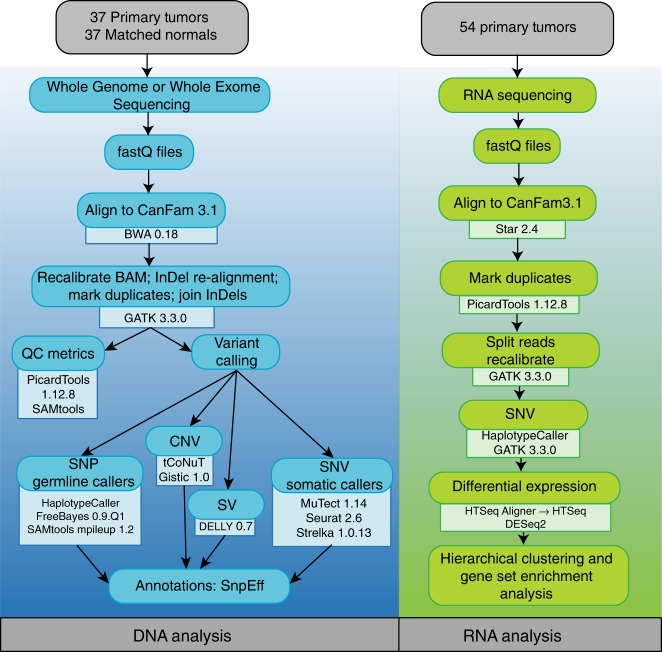
Fig. 1
Fig. 1
Analysis Pipeline for WGS, WES and RNA-seq. Flow-chart demonstrates sequential use of tools in evaluation of DNA and RNA samples
Fig. 2
Fig. 2
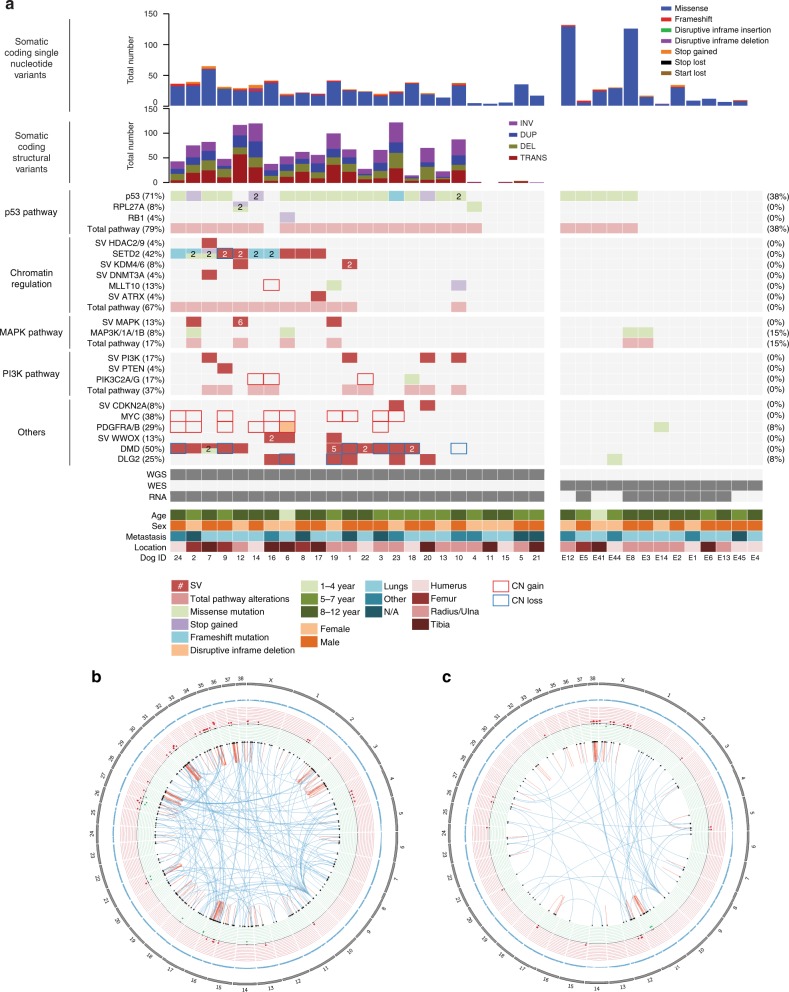
Recurrently mutated genes in canine osteosarcoma. a Single nucleotide variants were reported in samples subjected to both WGS and WES. Copy number variants (Log2FC < −0.9 and >0.4) and structural variants were reported in WGS samples. All mutations were clustered based on mutational burden in genes associated with chromatin/histones, TP53 and DMD. b, c Circos plots on DogID #14 and #18. Blue triangles = SNVs; red dots = amplifications; green dots = deletions; dark red arrows = intra-chromosomal translocations; dark blue arrows = inter-chromosomal translocations. WGS whole genome sequencing, WES whole exome sequencing, SNV single nucleotide variant
Fig. 3
Fig. 3
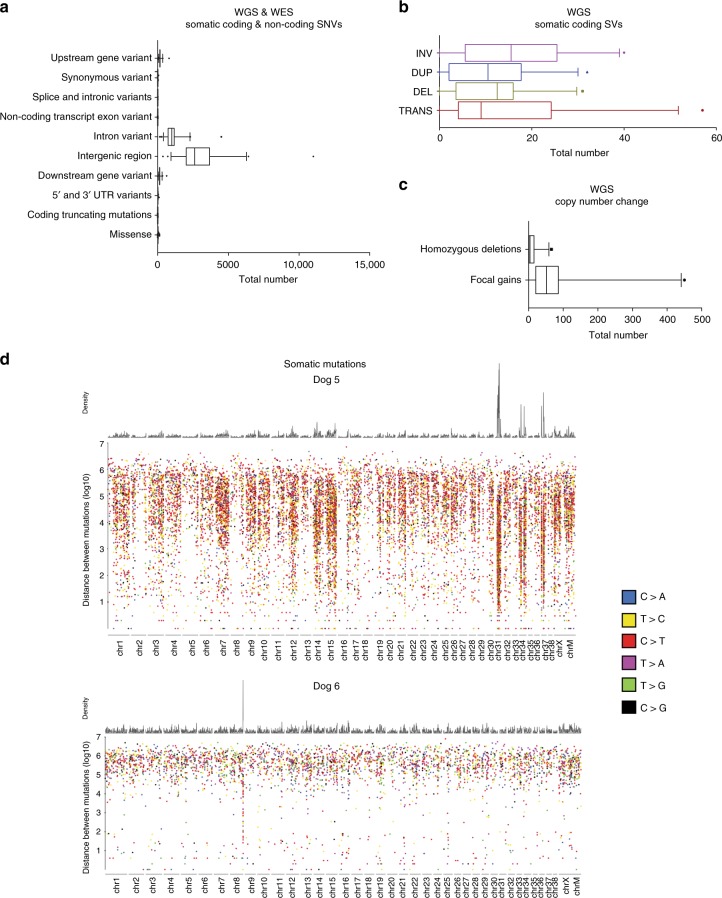
Somatic CNVs, SNVs, and SVs. Frequency of somatic coding and non-coding CNVs, SNVs and SVs across both WGS and WES samples. a WGS and WES somatic coding and non-coding SNVs. b WGS somatic coding SVs. Whiskers represent the 5-95th percentile. c WGS copy number changes. Whiskers represent the 5-95th percentile. d Rainfall plots illustrating the density and distribution of somatic mutations in two WGS samples. Base-pair distance between events represented on the y-axis
Fig. 4
Fig. 4
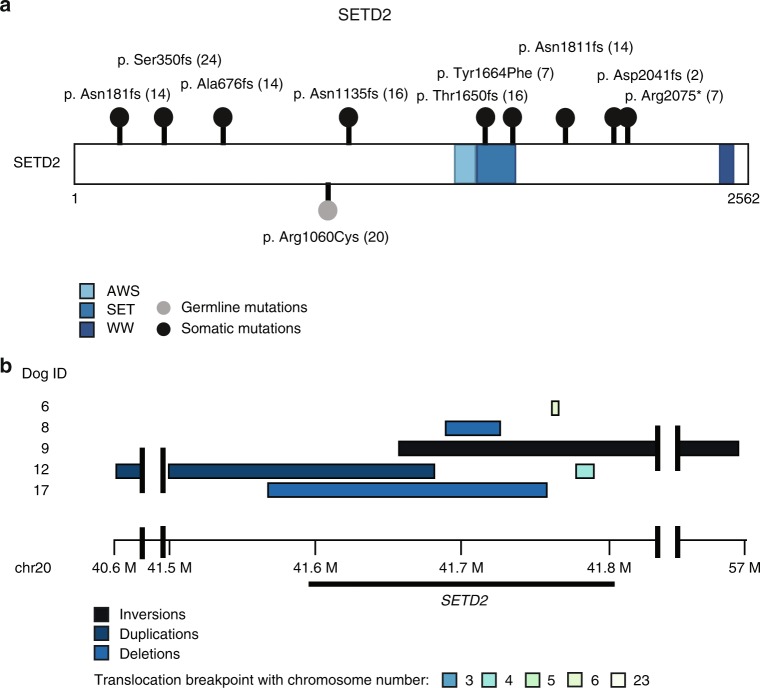
SETD2 mutation burden in primary canine OS. a Lollipop plot demonstrating location of SETD2 single nucleotide variants in canine OS. b Recurrent Copy Number Variations and Structural variants mutations found in five tumors defined by the region surrounding SETD2. c All somatic and germline SNV and SV calls affecting SETD2
Fig. 5
Fig. 5
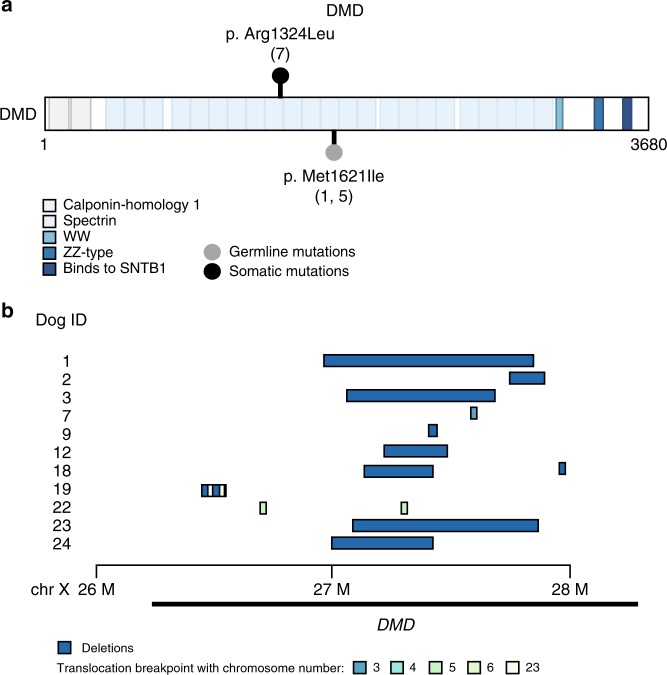
DMD mutation burden in primary canine OS. a Lollipop plot demonstrating location of DMD single nucleotide variants in canine OS. b Recurrent Copy Number Variations and Structural variants found in eleven tumors defined by the region surrounding DMD

References

    1. Fenger JM, London CA, Kisseberth WC. Canine osteosarcoma: a naturally occurring disease to inform pediatric oncology. ILAR J. 2014;55:69–85. doi: 10.1093/ilar/ilu009. - DOI - PubMed
    1. Bielack SS, et al. Prognostic factors in high-grade osteosarcoma of the extremities or trunk: an analysis of 1,702 patients treated on neoadjuvant cooperative osteosarcoma study group protocols. J. Clin. Oncol. 2002;20:776–790. doi: 10.1200/JCO.2002.20.3.776. - DOI - PubMed
    1. Meyers PA, et al. Osteosarcoma: a randomized, prospective trial of the addition of ifosfamide and/or muramyl tripeptide to cisplatin, doxorubicin, and high-dose methotrexate. J. Clin. Oncol. 2005;23:2004–2011. doi: 10.1200/JCO.2005.06.031. - DOI - PubMed
    1. Perry JA, et al. Complementary genomic approaches highlight the PI3K/mTOR pathway as a common vulnerability in osteosarcoma. Proc. Natl. Acad. Sci. USA. 2014;111:E5564–E5573. doi: 10.1073/pnas.1419260111. - DOI - PMC - PubMed
    1. Kovac M, et al. Exome sequencing of osteosarcoma reveals mutation signatures reminiscent of BRCA deficiency. Nat. Commun. 2015;6:8940. doi: 10.1038/ncomms9940. - DOI - PMC - PubMed

Publication types

Substances