. 2019 Dec;19(6):1404-1417.
doi: 10.3758/s13415-019-00736-w.

Sex differences in reward- and punishment-guided actions

Affiliations

Sex differences in reward- and punishment-guided actions

Tara G Chowdhury et al. Cogn Affect Behav Neurosci. 2019 Dec.

Abstract

Differences in the prevalence and presentation of psychiatric illnesses in men and women suggest that neurobiological sex differences confer vulnerability or resilience in these disorders. Rodent behavioral models are critical for understanding the mechanisms of these differences. Reward processing and punishment avoidance are fundamental dimensions of the symptoms of psychiatric disorders. Here we explored sex differences along these dimensions using multiple and distinct behavioral paradigms. We found no sex difference in reward-guided associative learning but a faster punishment-avoidance learning in females. After learning, females were more sensitive than males to probabilistic punishment but less sensitive when punishment could be avoided with certainty. No sex differences were found in reward-guided cognitive flexibility. Thus, sex differences in goal-directed behaviors emerged selectively when there was an aversive context. These differences were critically sensitive to whether the punishment was certain or unpredictable. Our findings with these new paradigms provide conceptual and practical tools for investigating brain mechanisms that account for sex differences in susceptibility to anxiety and impulsivity. They may also provide insight for understanding the evolution of sex-specific optimal behavioral strategies in dynamic environments.

Keywords: ADHD; Addiction; Anxiety; Avoidance; Reward; Sex differences.


Figures
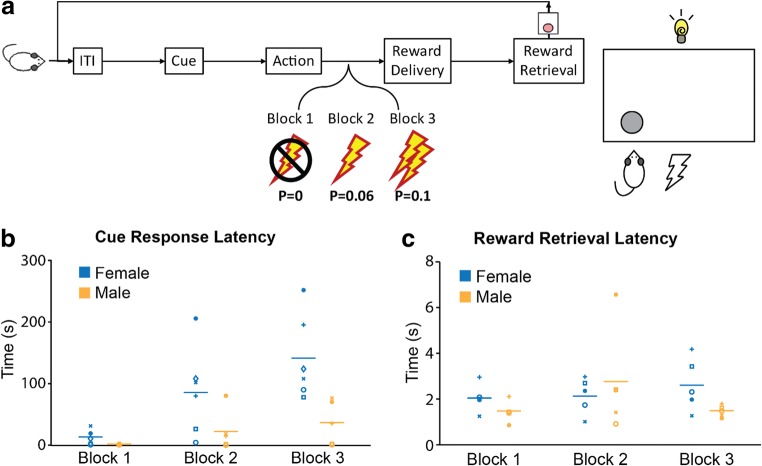
Fig. 1
Fig. 1
Sex differences measured during reward-seeking with a variable risk of punishment in the Punishment Risk Task. Reward–seeking behavior was measured in a FR1 task in three blocks of 30 trials. The first block was a standard FR1 task with no risk of punishment, followed by two blocks that introduced risk of a foot shock immediately after the rewarded action and before reward delivery (A). In females, block 1 response times were significantly shorter than block 2 (p< 0.0038) as well as block 3 (< 0.001), with an additional decrease between blocks 2 and 3 (p = 0.0349). There were no significant differences in latency between any of the individual blocks in males. When male and female groups were combined, we found a significant effect of block (B; RM-ANOVA: F (2, 18) = 15.8; p = 0.0001), with increasing cue response latency as the shock probability increased. Significant differences were found between blocks 1 and 2 (p = 0.0075), 2 and 3 (p = 0.0611), and 1 and 3 (< 0.0001). RM-ANOVA indicates a significant effect of sex (F(1,9)=6.949; = 0.0271) with an additional interaction of sex and block (F(2,18)=5.044; = 0.0182). No significant differences were found in reward retrieval latency (C).
Fig. 2
Fig. 2
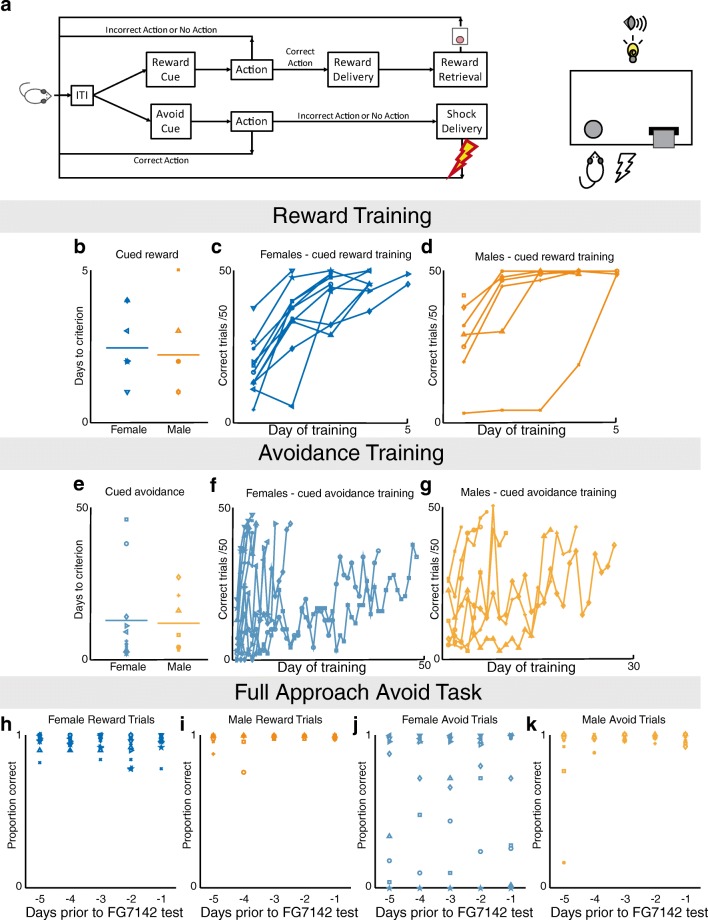
Sex differences in acquisition of reward-seeking and punishment–avoidance behaviors. Rats were initially shaped on the reward-seeking and punishment-avoidance components of the task separately, before being trained on the combined full task (A) until stable performance emerged. Cued-action-for-reward performance was observed daily until animals achieved a criterion of 70% correct trials (B shows days to criterion of all individuals). Average and individual performance in females (C) and males (D) is shown, and sex differences were not observed in reward learning acquisition (males: 2.1 ± 0.4 days; females: 2.5 ± 0.3 days; t(16) = -0.583; p = 0.568). Cued-action-to-avoid performance is shown in similar fashion (E–G), again with no sex differences observed (males: 10.7 ± 3.1 days; females: 12.5 ± 4.6; t(16) = -0.288; p = 0.777). Performance in the full task over the five days before drug treatment is shown in H–K. No sex difference was found in the average performance on reward trials (males (N = 7): 49.2 ± 0.4 trials; females (N = 11): 47.5 ± 0.7 trials; t(16) = 1.733; p = 0.1). In the avoidance trials, on average, males successfully avoided the shock in more trials than did females (males (N = 7): 47 ± 1 trials; females (N = 11): 31 ± 6 trials; t(10.9) = 2.524; p = 0.03 (equal variances not assumed)).
Fig. 3
Fig. 3
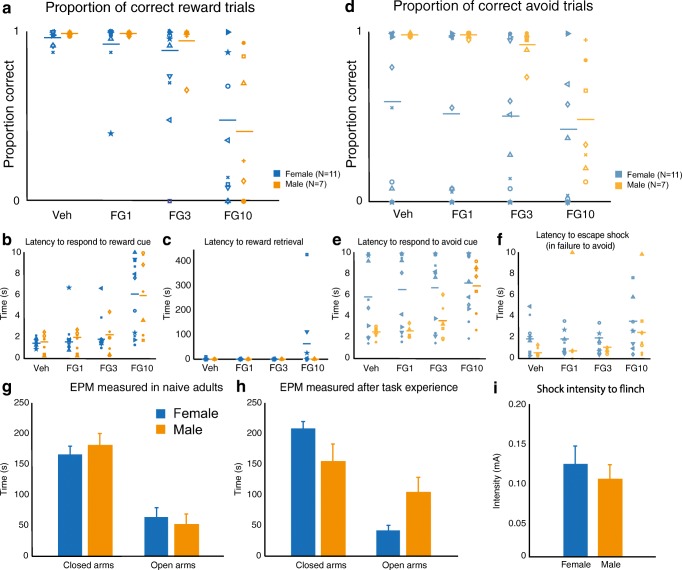
Sex differences in the Approach Avoid Task with administration of varying doses of FG7142. Anxiety induced by FG-7142 affected male and female performance equally on reward trials. There was a significant effect of dose on correct reward trials completed (RM-ANOVA; F(3, 48) = 17.465; p < 0.001), no significant effect of sex (F(1,16) = 0.373; p = 0.55), and no interaction between dose and sex (F(3, 48) = 0.559; p = 0.643) (A). A significant main effect of dose was found in the latency to respond to the approach cue (F(1,16) = 30.818; p < 0.001), but no main effect of sex (F(1, 16) = 0.096; p = 0.761) and no interaction between dose and sex (F(3, 48) = 0.101; p = 0.959) (B). No significant main effects of dose (F(3, 36) = 0.994; p = 0.4), sex (F(1, 12) = 1.431; p = 0.3), or interaction (F(3, 36) = 0.961; p = 0.4) were found in the latency to retrieve the sugar pellet reward (C). Avoidance behavior was diminished with administration of FG7142, as quantified by successfully avoided shock trials. RM-ANOVA indicated a significant effect of dose (F(3, 48) = 12.294; p < 0.001), a marginally significant effect of sex, with males showing greater sensitivity to FG7142 (F(1,16) = 4.269; p = 0.055), and a significant interaction between dose and sex (F(3, 48) = 4.782; p = 0.005) (D). Latency to respond to the avoidance cue was affected by dose of FG7142 (RM-ANOVA; F(3, 48) = 12.643; p <0.001) and sex (F(1, 16) = 4.794; p = 0.04), and there was a significant dose * sex interaction (F(3, 48) = 5.107; p = 0.004) (E). In the cases where the animal did not avoid the shock, latency to escape the shock (by performing the avoidance action during the shock) is shown in panel F. Generalized anxiety-like behavior was assayed using the EPM. When tested as naïve adults, males and females showed similar behavior on the EPM. No difference was found between males and females in time spent in the closed arms (males: 181 ± 20 s (N = 6); females: 165 ± 17 s (N = 6); t(10) = 0.578; p = 0.576) or the open arms (males: 52 ± 13 s; females: 64 ± 16 s; t(10) = -0.567; p = 0.583) (G). After experience on the AAT, females spent more time than males in the closed arms (males: 154 ± 29 s (N = 7); females: 208 ± 12 s (N = 11); t(16) = -2.005; p = 0.062) and significantly less time than males in the open arms (males: 103 ± 26 s; females: 43 ± 8 s; t(16) = 2.609; p = 0.019) (H). Shock intensity required to elicit a flinch response was compared between males and females via Student’s t-test. No significant sex difference in sensitivity to shock was detected (t(10) = 0.617; p = 0.55) (I).
Fig. 4
Fig. 4
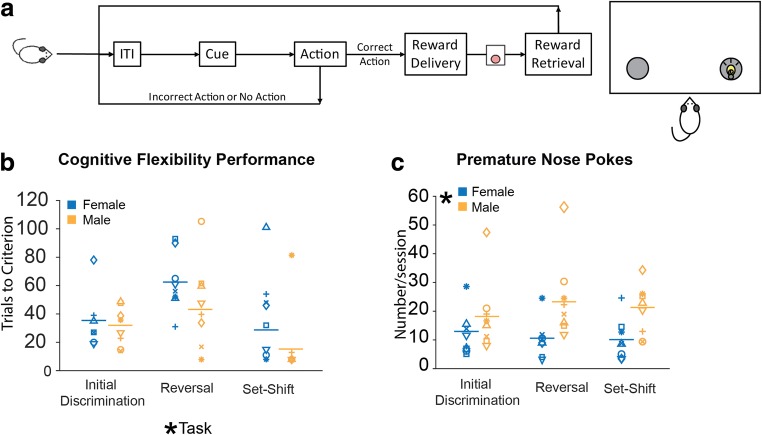
Sex differences in performance and premature responses during cognitive flexibility tasks (A). There was no effect of sex on performance (F(1,14) = 2.44, p > 0.05). However, there was a significant effect of task on performance, with all rats requiring more trials to reach criterion on the reversal learning task than either the initial discrimination or the set-shift (F(2,28) = 7.42, p < 0.05) (B). There was a sex difference in premature nose-pokes, with males making significantly more premature responses than females (F(1,14) = 5.45, p < 0.05). Although not a statistical outlier, one male exhibited unusually high levels of premature responding. The sex difference in premature nose-pokes persisted even when this male was excluded from analysis (F(1,13) = 7.33, p < 0.05) (C). However, there was no effect of task on this measure and no sex x task interaction.

References

    1. Abuse, S. (2013). Mental Health Services Administration,(SAMHSA), 2013 Results from the 2012 National Survey on Drug Use and Health: Summary of National Findings, NSDUH Series H-46, HHS Publication No.(SMA) 13-4795. Substance Abuse and Mental Health Services Administration, Rockville.
    1. Andrews N, File SE. Handling history of rats modifies behavioural effects of drugs in the elevated plus-maze test of anxiety. Eur J Pharmacol. 1993;235(1):109–112. doi: 10.1016/0014-2999(93)90827-5. - DOI - PubMed
    1. Bangasser DA, Valentino RJ. Sex differences in stress-related psychiatric disorders: neurobiological perspectives. Front Neuroendocrinol. 2014;35(3):303–319. doi: 10.1016/j.yfrne.2014.03.008. - DOI - PMC - PubMed
    1. Becker JB, McClellan ML, Reed BG. Sex differences, gender and addiction. J Neurosci Res. 2017;95(1-2):136–147. doi: 10.1002/jnr.23963. - DOI - PMC - PubMed
    1. Cahill L, Haier RJ, White NS, Fallon J, Kilpatrick L, Lawrence C, et al. Sex-related difference in amygdala activity during emotionally influenced memory storage. Neurobiol Learn Mem. 2001;75(1):1–9. doi: 10.1006/nlme.2000.3999. - DOI - PubMed

Publication types

LinkOut - more resources