


Tobacco-21 laws and young adult smoking: quasi-experimental evidence
- PMID: 31342591
- PMCID: PMC7233410
- DOI: 10.1111/add.14653
Tobacco-21 laws and young adult smoking: quasi-experimental evidence
Abstract
Aims: To estimate the impact of tobacco-21 laws on smoking among young adults who are likely to smoke, and consider potential social multiplier effects. Design Quasi-experimental, observational study using new 2016-17 survey data.
Setting: United States.
Participants/cases: A total of 1869 18-22-year-olds who have tried a combustible or electronic cigarette.
Intervention and comparators: Tobacco-21 laws raise the minimum legal sales age of cigarettes to 21 years. Logistic regressions compared the association between tobacco-21 laws and smoking among 18-20-year-olds with that for 21-22-year-olds. The older age group served as a comparison group that was not bound by these restrictions, but could have been affected by correlated factors. Age 16 peer and parental tobacco use were considered as potential moderators.
Measurements: Self-reported recent smoking (past 30-day smoking) and current established smoking (recent smoking and life-time consumption of at least 100 cigarettes).
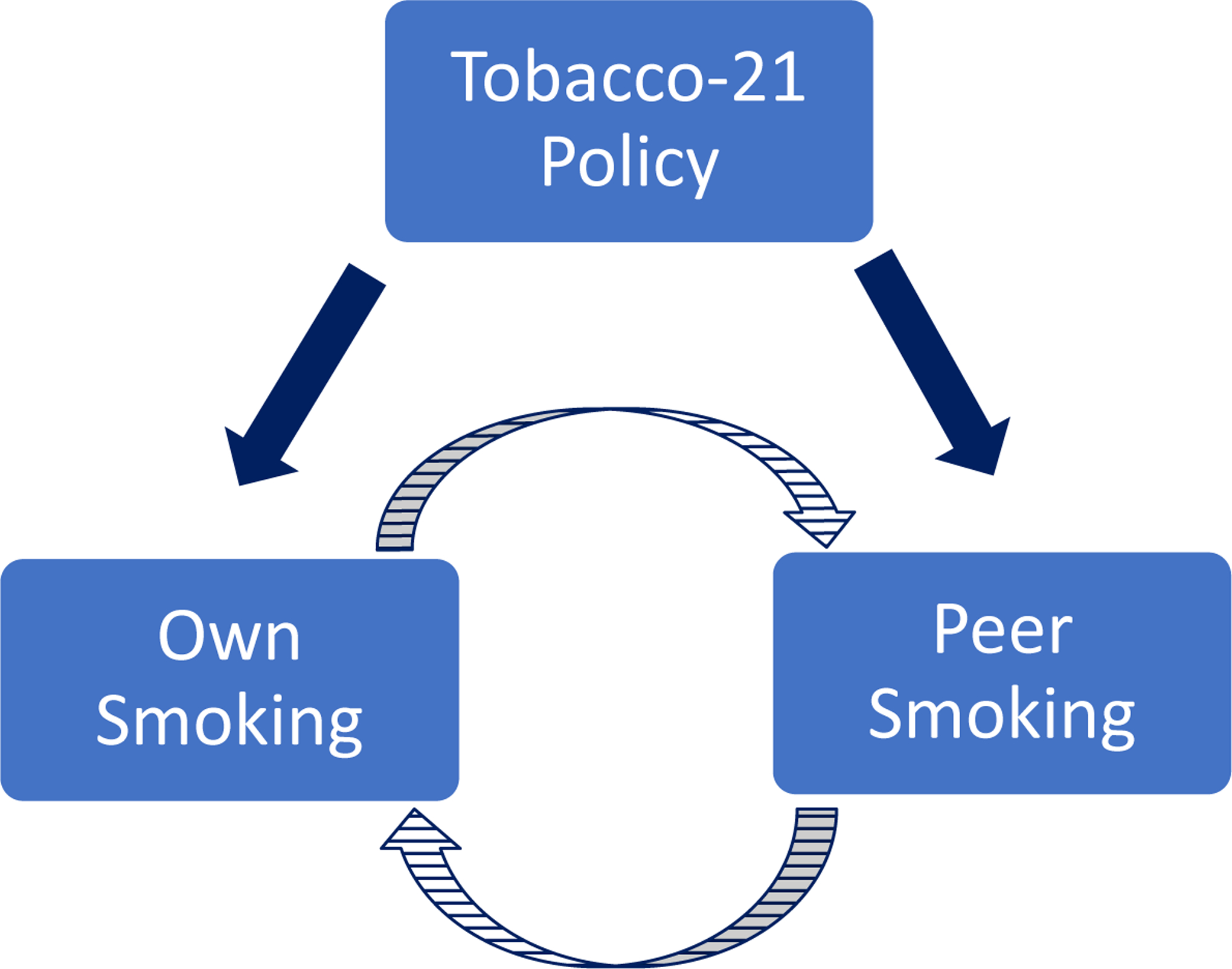
Findings: Exposure to tobacco-21 laws yielded a 39% reduction in the odds of both recent smoking [odds ratio (OR) = 0.61; 95% confidence interval (CI) = 0.42, 0.89] and current established smoking (OR = 0.61; 95% CI = 0.39, 0.97) among 18-20-year-olds who had ever tried cigarettes. This association exceeded the policy's relationship with smoking among 21-22-year-olds. For current established smoking, the tobacco-21 reduction was amplified among those whose closest friends at age 16 used cigarettes (OR = 0.50; 95% CI = 0.29, 0.87), consistent with peer effects moderating the policy's impact on young adult smoking.
Conclusions: Tobacco-21 laws appear to reduce smoking among 18-20-year-olds who have ever tried cigarettes.
Keywords: Cigarettes; policy; smoking; tobacco control; tobacco-21; young adults.
© 2019 Society for the Study of Addiction.
Conflict of interest statement
Figures
References
-
- Institute of Medicine. Public health implications of raising the minimum age of legal access to tobacco products [Internet]. 2015. URL:https://www.nap.edu/download/18997. Accessed: 2018-12-11. (Archived by WebCite® at http://www.webcitation.org/74aapMt4w) - PubMed
-
- Schneider KS, Buka SL, Dash K, Winickoff JP, Donnell L. Community reductions in youth smoking after raising the minimum tobacco sales age to 21. Tob Control. 2016;25(3):355. - PubMed
-
- Jason LA, Ji PY, Anes MD, Birkhead SH. Active enforcement of cigarette control laws in the prevention of cigarette sales to minors. JAMA. 1991;266(22):3159–61. - PubMed
-
- Ross H, Chaloupka FJ. The Effect of Public Policies and Prices on Youth Smoking. South Econ J. 2004;70(4):796–815.
Publication types
MeSH terms
Grants and funding
LinkOut - more resources
Full Text Sources
Medical
Miscellaneous
