. 2019 Oct;133(5):478-488.
doi: 10.1037/bne0000333. Epub 2019 Jul 25.

Histone deacetylase inhibition differentially attenuates cue-induced reinstatement: An interaction of environment and acH3K9 expression in the dorsal striatum

Affiliations

Histone deacetylase inhibition differentially attenuates cue-induced reinstatement: An interaction of environment and acH3K9 expression in the dorsal striatum

David L Arndt et al. Behav Neurosci. 2019 Oct.

Abstract

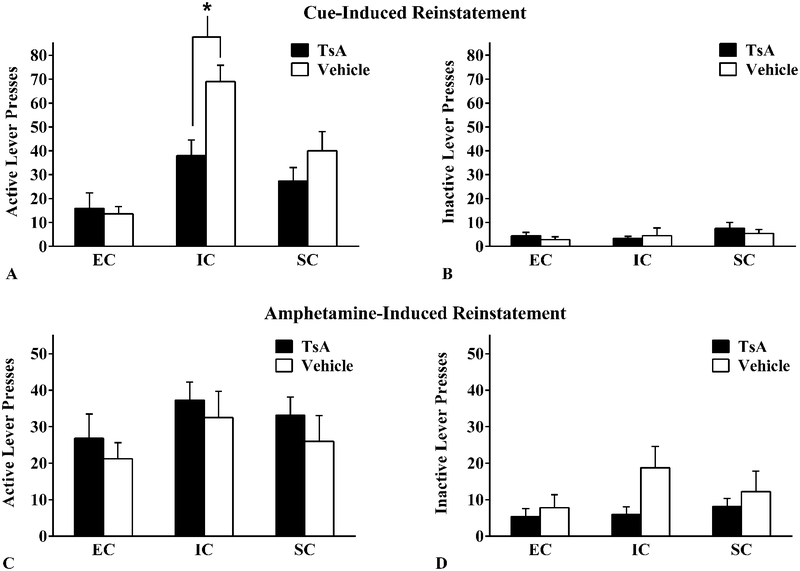
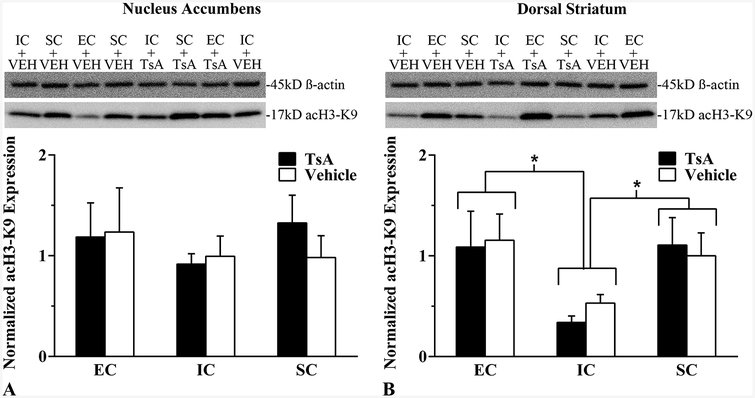
Substance use disorder is driven by complex gene-environment interactions. Epigenetic histone regulation is a significant contributor to several behavioral phenotypes of drug abuse. The primary epigenetic mechanisms that drive drug taking and drug seeking are still being investigated, and it is unclear how environmental conditions alter epigenetic histone acetylation to change behaviors geared toward drug reward. This study examined the effects of environmental condition on amphetamine self-administration, and whether drug-taking and drug-seeking behaviors could be influenced through inhibition of an epigenetic regulator, histone deacetylase (HDAC). Male rats reared for 30 days in enriched (EC), isolated (IC), or standard conditions (SC) prior to amphetamine (0.03, 0.05, 0.1 mg/kg/infusion, IV) self-administration, extinction, and reinstatement sessions. The HDAC inhibitor, Trichostatin A (TsA; 0.3 mg/kg, IV), was injected 30 min prior to operant sessions. After amphetamine-induced reinstatement (0.25 mg/kg, subcutaneous [s.c.]), tissue was extracted for Western blot analyses of acetylated histone H3 lysine 9 (acH3K9) in the nucleus accumbens (NAc) and dorsal striatum (DSt). While TsA did not significantly affect amphetamine self-administration or extinction, TsA decreased cue-, but not drug-induced reinstatement in IC rats only. In the DSt, but not in the NAc, IC rats exhibited significantly less acH3K9 expression than EC and SC rats, irrespective of TsA treatment. HDAC inhibition decreases cue-induced reinstatement of amphetamine seeking in IC rats. While IC rats exhibit less acH3K9 expression in the DSt, future studies are needed to elucidate the critical epigenetic factors that drive substance abuse, particularly in vulnerable populations. (PsycINFO Database Record (c) 2019 APA, all rights reserved).


Figures
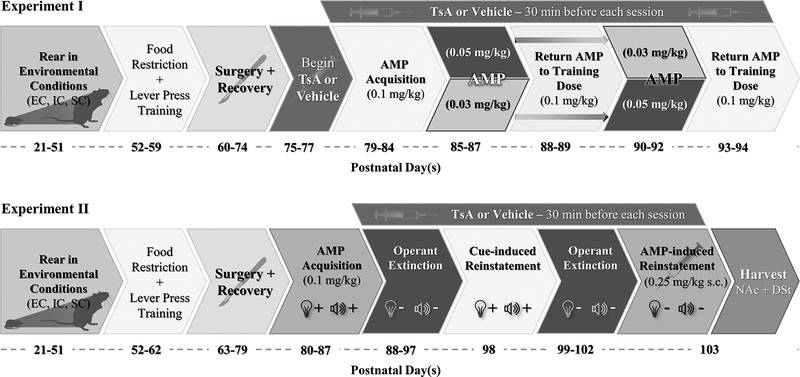
Figure 1.
Figure 1.
Study design: Rats arrived in lab at postnatal day 21 (PND 21) and were differentially-reared in enriched (EC), isolated (IC), or standard (SC) conditions. Trichostatin A (TsA; 0.3 mg/kg, i.v.) or vehicle (10% DMSO in saline) injections were administered 30 minutes prior to operant sessions and continued through the final day of experimentation. Abbreviations: AMP, amphetamine; DMSO, dimethyl sulfoxide; DSt, dorsal striatum; EC, enriched condition; IC, isolated condition; NAc, nucleus accumbens; SC, standard condition; TsA, Trichostatin A
Figure 2.
Figure 2.
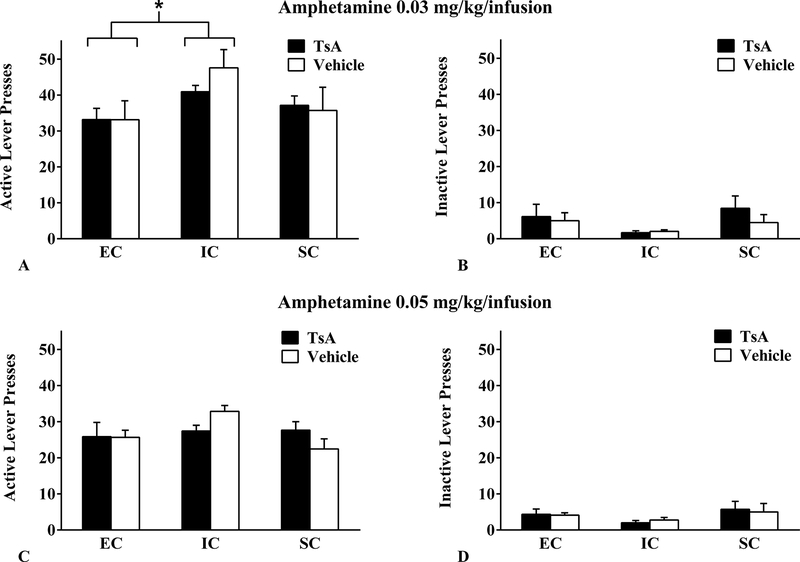
Mean ± SEM (A & C) active and (B & D) inactive lever presses for amphetamine 0.03 mg/kg/infusion, i.v. (upper panels) and 0.05 mg/kg/infusion, i.v. (lower panels) between EC, IC, and SC rats following Trichostatin A (TsA; 0.3 mg/kg, i.v.) or Vehicle (10% DMSO in saline) pretreatment. These data reflect the average active lever presses of all three of the 0.03 and 0.05 mg/kg/infusion amphetamine sessions. EC rats exhibited significantly fewer active lever responses for amphetamine at 0.03 mg/kg/infusion than IC rats (*=p < .05), but there were no significant differences between EC, IC and SC rats at the 0.05 mg/kg/infusion dose. There were no significant differences between any of the drug pretreatment conditions and there were no significant differences in inactive lever responding between EC, IC, or SC rats in any treatment condition or at any dose. Abbreviations: DMSO, dimethyl sulfoxide; EC, enriched condition; IC, isolated condition; SC, standard condition; TsA, Trichostatin A
Figure 3.
Figure 3.
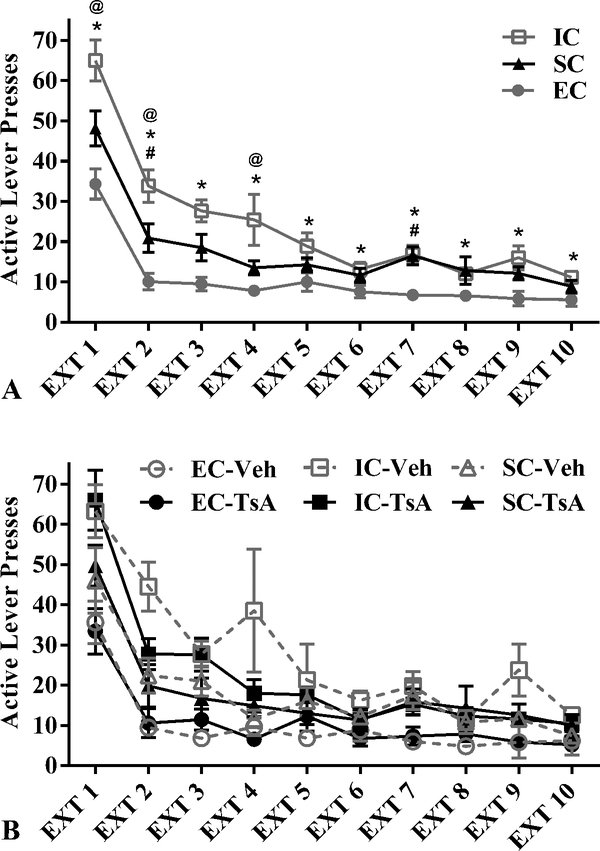
Mean ± SEM active lever presses during Extinction sessions 1–10 for (A) EC, IC, and SC, rats and (B) EC, IC, and SC rats following Trichostatin A (TsA; 0.3 mg/kg, i.v.) or Vehicle (10% DMSO in saline) pretreatment. (A) Asterisks (*) indicate that IC rats displayed greater active lever presses than EC rats (all ps < .05). The at symbols (@) indicate that IC rats displayed greater active lever presses than SC rats (all ps < .05), and the pound signs (#) indicate that SC rats exhibited significantly greater active lever presses than EC rats (all ps < .05). (B) There were no significant differences in active lever pressing between TsA-pretreated rats and vehicle-pretreated rats within any of the environmental conditions across the ten extinction sessions. Abbreviations: DMSO, dimethyl sulfoxide; EC, enriched condition; IC, isolated condition; SC, standard condition; TsA, Trichostatin A
Figure 4.
Figure 4.
Mean ± SEM active and inactive lever presses during the cue-induced reinstatement test (A&B) and during the amphetamine-induced reinstatement test (C&D) between EC, IC, and SC rats following Trichostatin A (TsA; 0.3 mg/kg, i.v.) or Vehicle (10% DMSO in saline) pretreatment. (A) Asterisk (*) indicates that IC-TsA rats exhibited significantly fewer active lever presses than IC-vehicle rats (p < .05). Abbreviations: DMSO, dimethyl sulfoxide; EC, enriched condition; IC, isolated condition; SC, standard condition; TsA, Trichostatin A
Figure 5.
Figure 5.
Mean ± SEM normalized acetylated histone H3 lysine 9 (acH3K9) expression (arbitrary units) in the (A) nucleus accumbens and (B) dorsal striatum between EC, IC, and SC rats following Trichostatin A (TsA; 0.3 mg/kg, i.v.) or Vehicle (10% DMSO in saline) pretreatment. Tissue was harvested immediately after drug-induced reinstatement for western blot analysis. *p < .05 for EC vs IC and SC vs IC.

References

    1. Adachi M, & Monteggia L (2009). Synergistic interactions between histone deacetylase inhibitors and drugs of abuse. Neuropsychopharmacology, 34(13), 2619–2620. doi: 10.1038/npp.2009.156. - DOI - PMC - PubMed
    1. Ajonijebu DC, Abboussi O, Russell VA, Mabandla MV, & Daniels WM (2017). Epigenetics: a link between addiction and social environment. Cellular and Molecular Life Sciences, 74(15), 2735–2747. - PMC - PubMed
    1. Alarcón JM, Malleret G, Touzani K, Vronskaya S, Ishii S, Kandel ER, & Barco A (2004). Chromatin acetylation, memory, and LTP are impaired in CBP+/− mice: A model for the cognitive deficit in Rubinstein-Taybi syndrome and its amelioration. Neuron, 42(6), 947–959. - PubMed
    1. Alvers K, Marusich J, Gipson C, Beckmann J, & Bardo M (2012). Environmental enrichment during development decreases intravenous self-administration of methylphenidate at low unit doses in rats. Behavioural Pharmacology, 23(7), 650–657. doi: 10.1097/fbp.0b013e3283584765. - DOI - PMC - PubMed
    1. Arndt DL, Arnold J, & Cain M (2014). The effects of mGluR2/3 activation on acute and repeated amphetamine-induced locomotor activity in differentially reared male rats. Experimental and Clinical Psychopharmacology, 22(3), 257. doi: 10.1037/a0035273. - DOI - PMC - PubMed

MeSH terms