


Antiretroviral Adherence Level Necessary for HIV Viral Suppression Using Real-World Data
- PMID: 31343455
- PMCID: PMC6854523
- DOI: 10.1097/QAI.0000000000002142
Antiretroviral Adherence Level Necessary for HIV Viral Suppression Using Real-World Data
Abstract
Background: A benchmark of near-perfect adherence (≥95%) to antiretroviral therapy (ART) is often cited as necessary for HIV viral suppression. However, given newer, more effective ART medications, the threshold for viral suppression may be lower. We estimated the minimum ART adherence level necessary to achieve viral suppression.
Settings: The Patient-centered HIV Care Model demonstration project.
Methods: Adherence to ART was calculated using the proportion of days covered measure for the 365-day period before each viral load test result, and grouped into 5 categories (<50%, 50% to <80%, 80% to <85%, 85% to <90%, and ≥90%). Binomial regression analyses were conducted to determine factors associated with viral suppression (HIV RNA <200 copies/mL); demographics, proportion of days covered category, and ART regimen type were explanatory variables. Generalized estimating equations with an exchangeable working correlation matrix accounted for correlation within subjects. In addition, probit regression models were used to estimate adherence levels required to achieve viral suppression in 90% of HIV viral load tests.
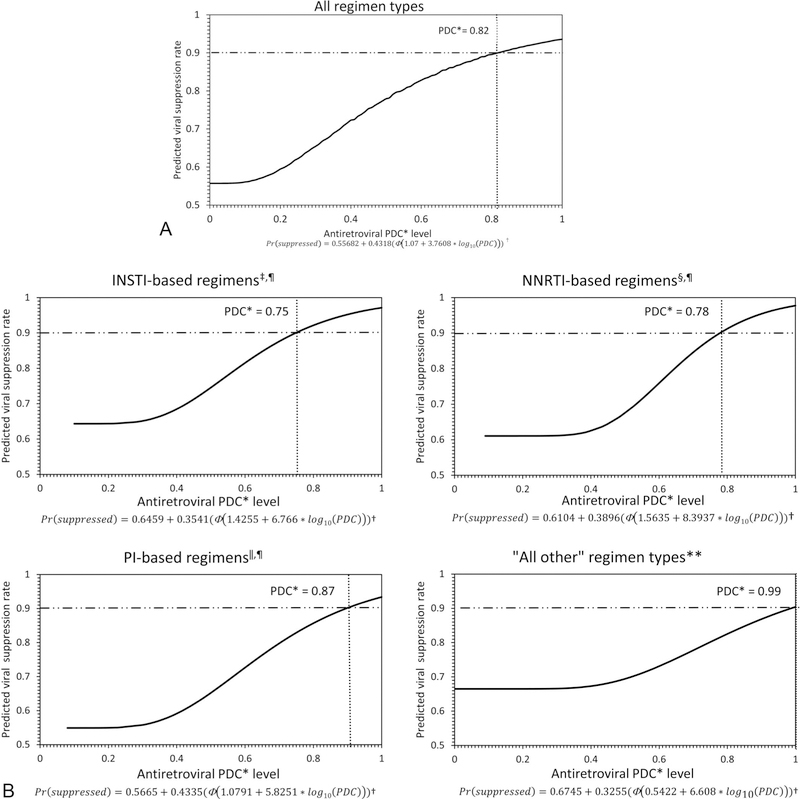
Results: The adjusted odds of viral suppression did not differ between persons with an adherence level of 80% to <85% or 85% to <90% and those with an adherence level of ≥90%. In addition, the overall estimated adherence level necessary to achieve viral suppression in 90% of viral load tests was 82% and varied by regimen type; integrase inhibitor- and nonnucleoside reverse transcriptase inhibitor-based regimens achieved 90% viral suppression with adherence levels of 75% and 78%, respectively.
Conclusions: The ART adherence level necessary to reach HIV viral suppression may be lower than previously thought and may be regimen-dependent.
Conflict of interest statement
J.G.H., R.H., H.K., and A.D. report that they were employees of Walgreen Co., during the conduct of this study. The remaining authors have no conflicts of interest to disclose.
Figures
References
-
- Panel on Antiretroviral Guidelines for Adults and Adolescents. Guide-lines for the Use of Antiretroviral Agents in Adults and Adolescents Living With HIV: Department of Health and Human Services. Available at: http://www.aidsinfo.nih.gov/contentfiles/adultandadolescentgl.pdf. Accessed June 5, 2018.
-
- Centers for Disease Control and Prevention. Evidence of HIV treatment and viral suppression in preventing the sexual transmission of HIV. Available at: https://www.cdc.gov/hiv/pdf/risk/art/cdc-hiv-art-viral-suppression.pdf. Accessed January 10, 2019.
MeSH terms
Substances
Grants and funding
LinkOut - more resources
Full Text Sources
Medical
