Review
. 2019 Sep:26:101270.
doi: 10.1016/j.redox.2019.101270. Epub 2019 Jul 6.

Mechanisms of SOD1 regulation by post-translational modifications

Affiliations
Review

Mechanisms of SOD1 regulation by post-translational modifications

C J Banks et al. Redox Biol. 2019 Sep.

Abstract

SOD1 is commonly known for its ROS scavenging activity, but recent work has uncovered additional roles in modulating metabolism, maintaining redox balance, and regulating transcription. This new paradigm of expanded SOD1 function raises questions regarding the regulation of SOD1 and the cellular partitioning of its biological roles. Despite decades of research on SOD1, much of which focuses on its pathogenic role in amyotrophic lateral sclerosis, relatively little is known about its regulation by post-translational modifications (PTMs). However, over the last decade, advancements in mass spectrometry have led to a boom in PTM discovery across the proteome, which has also revealed new mechanisms of SOD1 regulation by PTMs and an array of SOD1 PTMs with high likelihood of biological function. In this review, we address emerging mechanisms of SOD1 regulation by post-translational modifications, many of which begin to shed light on how the various functions of SOD1 are regulated within the cell.

Keywords: Acylation; Phosphorylation; Post-translational modification; SOD1; Ubiquitination.


Figures

Fig. 1
Fig. 1
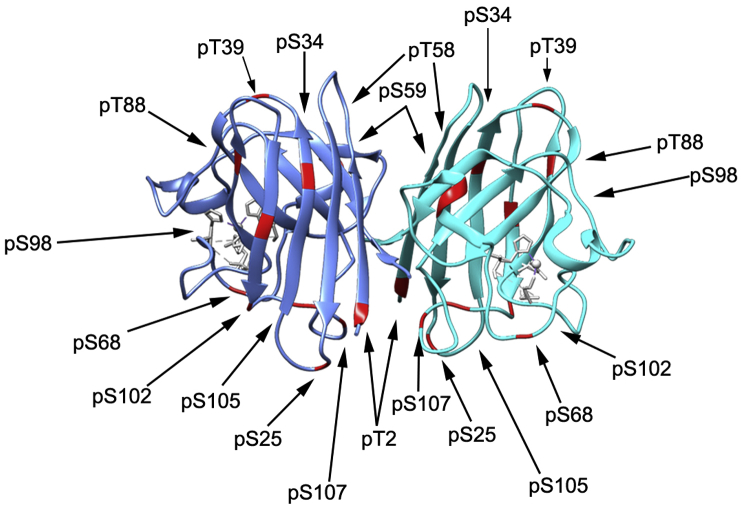
SOD1 sites of phosphorylation. Crystal structure of mouse SOD1 (PDB: 3GTV) with known human SOD1 sites of phosphorylation highlighted in red (sites compiled from papers discussed in this review and from www.phosphosite.org). (For interpretation of the references to colour in this figure legend, the reader is referred to the Web version of this article.)
Fig. 2
Fig. 2
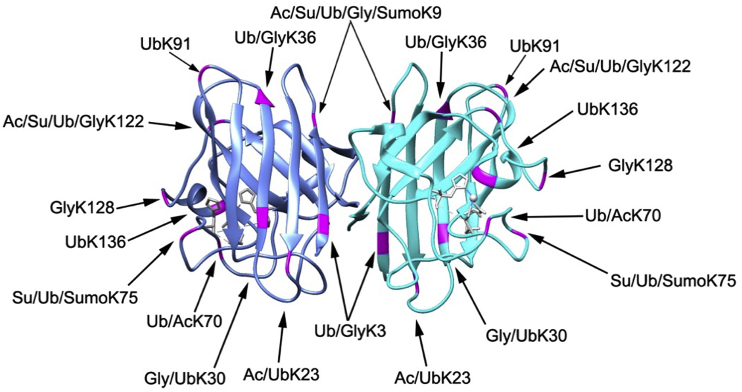
SOD1 sites of lysine modification. Crystal structure of mouse SOD1 (PDB: 3GTV) with known human SOD1 sites of lysine-modifications highlighted in magenta (sites compiled from papers discussed in this review and from www.phosphosite.org).
Fig. 3
Fig. 3
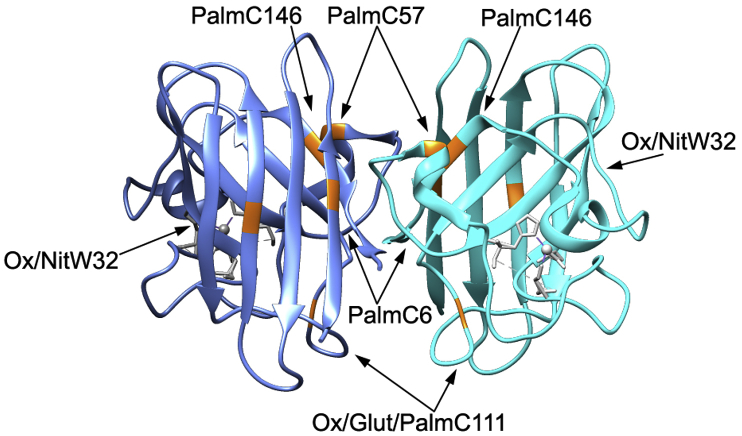
SOD1 sites of redox, palmitoylation, and nitration modifications. Crystal structure of mouse SOD1 (PDB: 3GTV) with known human SOD1 sites of redox, palmitoylation, and nitration modifications highlighted in orange (sites compiled from papers discussed in this review). (For interpretation of the references to colour in this figure legend, the reader is referred to the Web version of this article.)
Fig. 4
Fig. 4
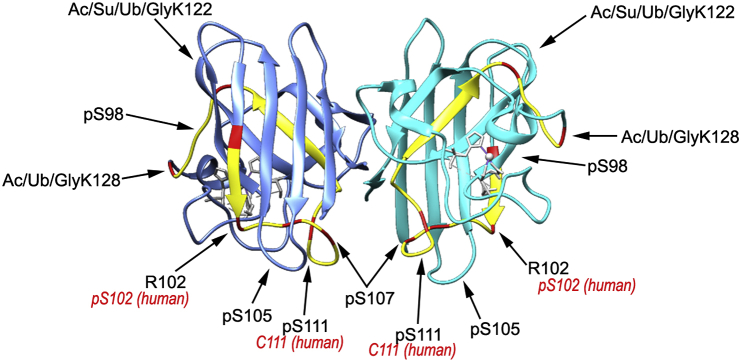
Highest ranked PTM ‘hotspots’ identified by SAPH-ire. Crystal structure of mouse SOD1 (PDB: 3GTV) with highest ranked PTM hotspots identified by SAPH-ire highlighted in red and the region between S98–K128 (which contains the seven highest ranked PTM hotspots) highlighted in yellow. Residues labeled in black are the mouse sites with the corresponding human site labeled in red. (For interpretation of the references to colour in this figure legend, the reader is referred to the Web version of this article.)
Fig. 5
Fig. 5
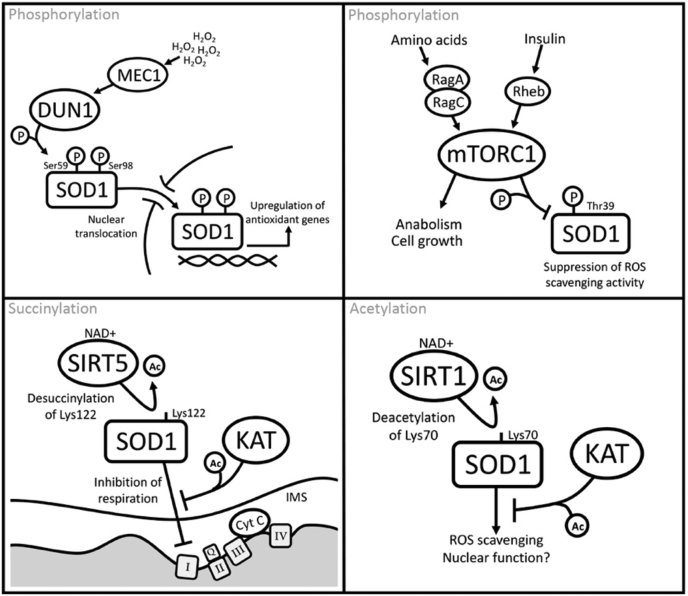
PTM-driven mechanisms of SOD1 regulation.

References

    1. McCord J.M., Fridovich I. Superoxide dismutase. An enzymic function for erythrocuprein (hemocuprein) J. Biol. Chem. 1969;244(22):6049–6055. - PubMed
    1. Kruman ALS-linked Cu/Zn-SOD mutation increases vulnerability of motor neurons to excitotoxicity by a mechanism involving increased oxidative stress and perturbed calcium homeostasis. Exp. Neurol. 1999;160(1):28–39. - PubMed
    1. Somwar R. Superoxide dismutase 1 (SOD1) is a target for a small molecule identified in a screen for inhibitors of the growth of lung adenocarcinoma cell lines. Proc. Natl. Acad. Sci. U. S. A. 2011;108(39):16375–16380. - PMC - PubMed
    1. Glasauer A. Targeting SOD1 reduces experimental non-small-cell lung cancer. J. Clin. Investig. 2014;124(1):117–128. - PMC - PubMed
    1. Papa L. SOD2 to SOD1 switch in breast cancer. J. Biol. Chem. 2014;289(9):5412–5416. - PMC - PubMed

Publication types