


Immunotherapies for the Treatment of Uveal Melanoma-History and Future
- PMID: 31344957
- PMCID: PMC6721437
- DOI: 10.3390/cancers11081048
Immunotherapies for the Treatment of Uveal Melanoma-History and Future
Abstract
Background: Uveal melanoma is the most common primary intraocular malignancy among adults. It is, nevertheless, a rare disease, with an incidence of approximately one case per 100,000 individuals per year in Europe. Approximately half of tumors will eventually metastasize, and the liver is the organ usually affected. No standard-of-care treatment exists for metastasized uveal melanoma. Chemotherapies or liver-directed treatments do not usually result in long-term tumor control. Immunotherapies are currently the most promising therapy option available.
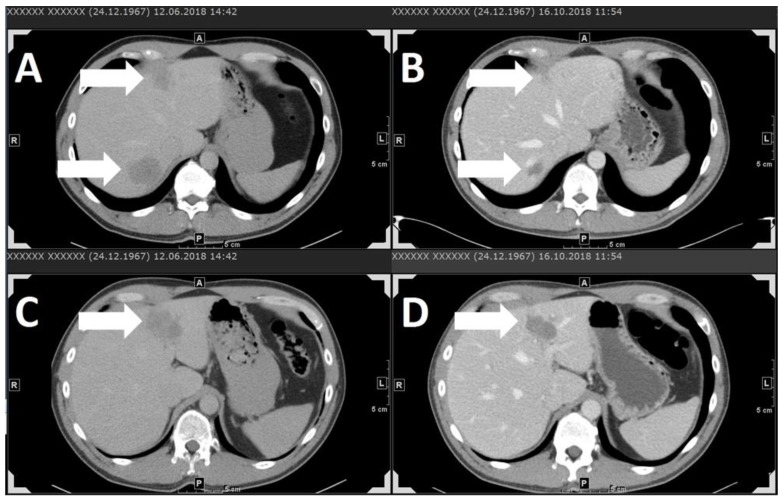
Methods: We reviewed both relevant recent literature on PubMed concerning the treatment of uveal melanoma with immunotherapies, and currently investigated drugs on ClinicalTrials.gov. Our own experiences with immune checkpoint blockers are included in a case series of 20 patients.
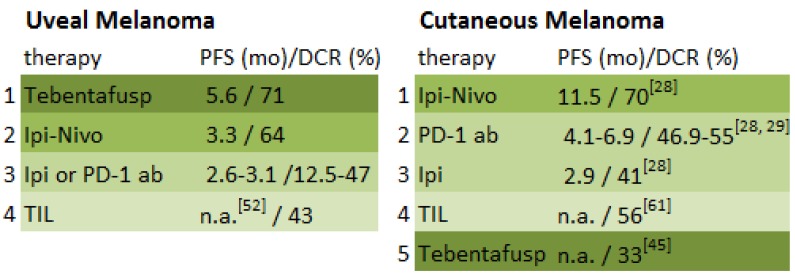
Results: Because few clinical trials have been conducted for metastasized uveal melanoma, no definitive treatment strategy exists for this rare disease. The outcomes of most immunotherapies are poor, especially compared with cutaneous melanoma. However, encouraging results have been found for some very recently investigated agents such as the bispecific tebentafusp, for which a remarkably increased one-year overall survival rate, and similarly increased disease control rate, were observed in early phase studies.
Conclusions: The treatment of metastatic uveal melanoma remains challenging, and almost all patients still die from the disease. Long-term responses might be achievable by means of new immunological strategies. Patients should therefore be referred to large medical centers where they can take part in controlled clinical studies.
Keywords: IMCgp100; adoptive T-cell therapy; checkpoint inhibitors; dendritic-cell vaccination; immunotherapy; tebentafusp; uveal melanoma.
Conflict of interest statement
JCH has had a paid consulting role with Merck and Amgen, has received honoraria from Bristol-Myers Squibb, Merck, Novartis, Roche and Pfizer and received research funding from BMS.
Figures
References
-
- McLaughlin C.C., Wu X.-C., Jemal A., Martin H.J., Roche L.M., Chen V.W. Incidence of noncutaneous melanomas in the U.S. Cancer. 2005;103:1000–1007. - PubMed
-
- Davies H., Bignell G.R., Cox C., Stephens P., Edkins S., Clegg S., Teague J., Woffendin H., Garnett M.J., Bottomley W., et al. Mutations of the BRAF gene in human cancer. Nature. 2002;417:949–954. - PubMed
Publication types
LinkOut - more resources
Full Text Sources
Other Literature Sources
