. 2019 Jun 14;9(13):7861-7874.
doi: 10.1002/ece3.5373. eCollection 2019 Jul.

Origin and evolution of the major histocompatibility complex class I region in eutherian mammals

Affiliations

Origin and evolution of the major histocompatibility complex class I region in eutherian mammals

Shamshidin Abduriyim et al. Ecol Evol. .

Abstract

Major histocompatibility complex (MHC) genes in vertebrates are vital in defending against pathogenic infections. To gain new insights into the evolution of MHC Class I (MHCI) genes and test competing hypotheses on the origin of the MHCI region in eutherian mammals, we studied available genome assemblies of nine species in Afrotheria, Xenarthra, and Laurasiatheria, and successfully characterized the MHCI region in six species. The following numbers of putatively functional genes were detected: in the elephant, four, one, and eight in the extended class I region, and κ and β duplication blocks, respectively; in the tenrec, one in the κ duplication block; and in the four bat species, one or two in the β duplication block. Our results indicate that MHCI genes in the κ and β duplication blocks may have originated in the common ancestor of eutherian mammals. In the elephant, tenrec, and all four bats, some MHCI genes occurred outside the MHCI region, suggesting that eutherians may have a more complex MHCI genomic organization than previously thought. Bat-specific three- or five-amino-acid insertions were detected in the MHCI α1 domain in all four bats studied, suggesting that pathogen defense in bats relies on MHCIs having a wider peptide-binding groove, as previously assayed by a bat MHCI gene with a three-amino-acid insertion showing a larger peptide repertoire than in other mammals. Our study adds to knowledge on the diversity of eutherian MHCI genes, which may have been shaped in a taxon-specific manner.

Keywords: MHC; bats; comparative genomics; evolution; mammals; origin.


Conflict of interest statement

The authors declare that they have no conflict of interest.

Figures
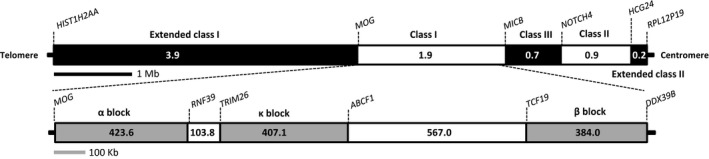
Figure 1
Figure 1
Simplified map of the human MHC (upper) and MHC class I (lower) regions. The MHC was drawn according to Horton et al. (2004). Both regions are drawn to scale. The α duplication lies between the MOG (myelin oligodendrocyte glycoprotein) and RNF39 (RING finger protein 39) genes, the κ duplication block between TRIM26 (tripartite motif containing 26) and ABCF1 (ATP‐binding cassette subfamily F member 1), and the β duplication block between TCF19 (transcription factor 19) and MICB/BAT1
Figure 2
Figure 2
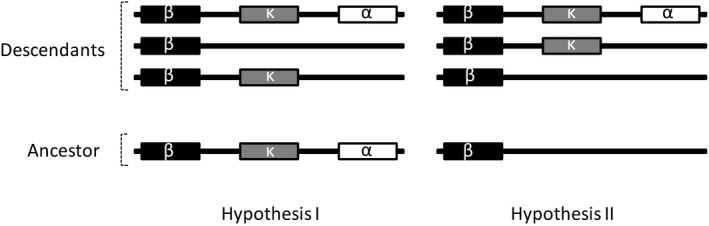
Two previous hypotheses for the evolution of canonical MHC class I region. Hypothesis I (Kumánovics et al., 2003) postulated that all of the three MHCI duplication blocks were present in the common ancestor of mammals, and were lost in taxon‐specific fashion, whereas hypothesis II (Ng et al., 2016) proposed that these duplication blocks arose in a stepwise manner, with the β duplication block originating first and the α block last
Figure 3
Figure 3
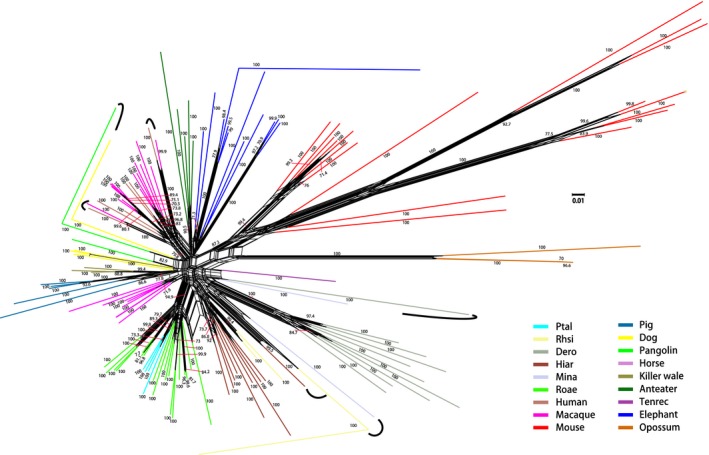
NeighborNet network showing inferred phylogenetic relationships among MHC class I sequences of eutherian mammals, based on a segment of MHCI exons 2–5. Numerals are bootstrap support values for each edge, with only values >70% shown. Edges with high support are thickened. Different colors indicate different species, as defined at lower right. Orthologous sequences are indicated by curved lines. Dero, D. rotundus (common vampire bat); Hiar, H. armiger (great roundleaf bat); Mina, M. natalensis (natal long‐fingered bat); Ptal, P. alecto (black flying fox); Rhsi, R. sinicus (Chinese horseshoe bat); Roae, R. aegyptiacus (Egyptian rousette bat). See Figure S1 for sequence names and accession numbers at the tips of branches
Figure 4
Figure 4
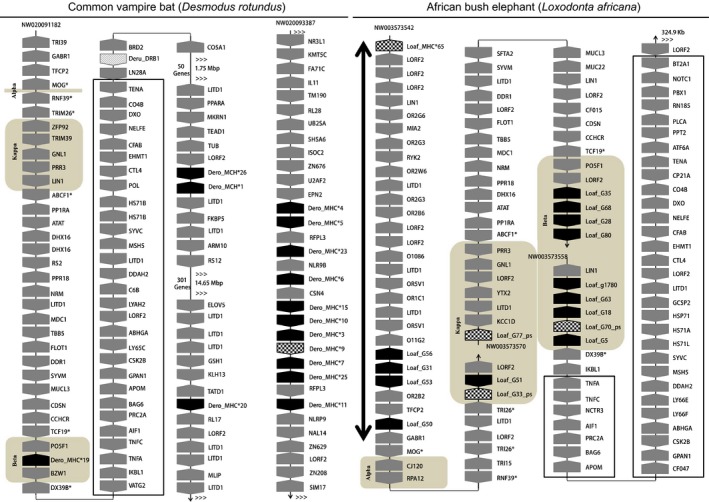
Genomic map of MHC class I (MHCI) genes for common vampire bat (left) and elephant (right). Black boxes indicate putatively functional MHCI genes; gray boxes, non‐MHC I genes; heavily stippled boxes, MHC I pseudogenes. The apex of each box indicates the transcriptional direction. The α, β, and κ blocks are shaded and labeled. An outline rectangle indicates the Class III region. The thick, double‐headed arrow indicates the extended class I region. The lightly stippled box indicates a class II gene. Accession numbers for scaffolds are at the top for each separate fragment. MHCI maps for other species are presented in Figure S2
Figure 5
Figure 5
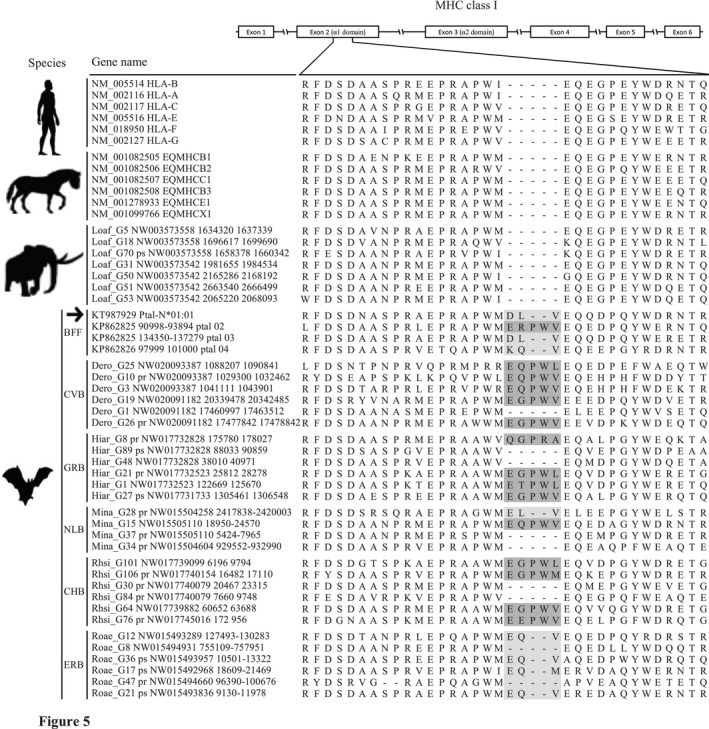
Alignment of deduced amino acid sequences, showing bat‐specific amino acid insertions in the α1 peptide‐binding domain (exon 2) of MHC class I genes. Three‐amino‐acid insertions are shaded in light gray, five‐amino‐acid insertions in dark gray. BFF, black flying fox; CHB, Chinese horseshoe bat; CVB, common vampire bat; ERB, Egyptian rousette bat; GRB, great roundleaf bat; NLB, Natal long‐fingered bat. The antigen presentation function of Ptal‐N*01:01 (arrow) was characterized by Wynne et al. (2016). See Figure S3 for the complete MHCI amino acid sequences
Figure 6
Figure 6
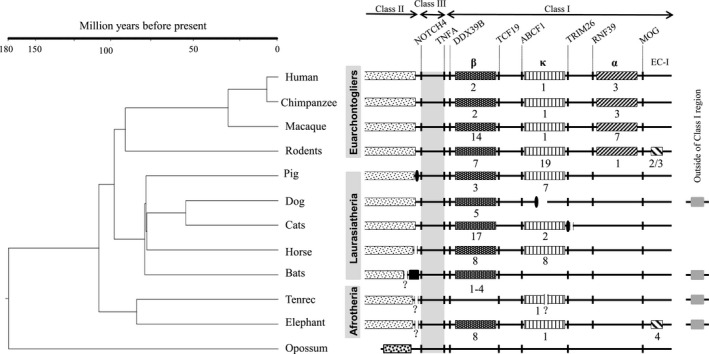
Diagram showing MHC organization in eutherian mammals. Vertical bars in each row indicate non‐MHC genes that are labeled near the top of the figure. Differently shaded boxes indicate the β, κ, and α duplication blocks, and the extended class I region (EC‐1), all labeled at the top of each column; the numbers below the boxes indicate the number of class I genes in that duplication block; finely stippled boxes, class II region; vertical black ellipses, centromeres; black box, bat‐specific MHCI gene region flanked by class III region; question marks, possible splits in the MHC region at the positions indicated; heavily stippled box in opossum, mixed class I and II region

References

    1. Abduriyim, S. , Nishita, Y. , Kosintsev, P. A. , Raichev, E. , Väinölä, R. , Kryukov, A. P. , … Masuda, R. (2017). Diversity and evolution of MHC class II DRB gene in the Eurasian badger genus Meles (Mammalia: Mustelidae). Biological Journal of the Linnean Society, 122(2), 258–273. 10.1093/biolinnean/blx077 - DOI
    1. Abduriyim, S. , Nishita, Y. , Kosintsev, P. A. , Raichev, E. , Väinölä, R. , Kryukov, A. P. , … Masuda, R. (2019). Evolution of MHC class I genes in Eurasian badgers, genus Meles (Carnivora, Mustelidae). Heredity, 122(2), 205–218. 10.1038/s41437-018-0100-3 - DOI - PMC - PubMed
    1. Altschul, S. F. , Madden, T. L. , Schaffer, A. A. , Zhang, J. , Zhang, Z. , … Lipman, D. J., (1997). Gapped BLAST and PSI‐BLAST: A new generation of protein database search programs. Nucleic Acids Research, 25, 3389–3402. 10.1093/nar/25.17.3389 - DOI - PMC - PubMed
    1. Amadou, C. (1999). Evolution of the Mhc class I region: The framework hypothesis. Immunogenetics, 49(4), 362–367. 10.1007/s002510050507 - DOI - PubMed
    1. Arenas, M. , & Posada, D. (2010). The effect of recombination on the reconstruction of ancestral sequences. Genetics, 184, 1133–1139. 10.1534/genetics.109.113423. - DOI - PMC - PubMed