Review
. 2019 Jul 25;7(Suppl 1):48.
doi: 10.1186/s40635-019-0259-9.

Ventilator-induced diaphragm dysfunction: translational mechanisms lead to therapeutical alternatives in the critically ill

Affiliations
Review

Ventilator-induced diaphragm dysfunction: translational mechanisms lead to therapeutical alternatives in the critically ill

Oscar Peñuelas et al. Intensive Care Med Exp. .

Abstract

Mechanical ventilation [MV] is a life-saving technique delivered to critically ill patients incapable of adequately ventilating and/or oxygenating due to respiratory or other disease processes. This necessarily invasive support however could potentially result in important iatrogenic complications. Even brief periods of MV may result in diaphragm weakness [i.e., ventilator-induced diaphragm dysfunction [VIDD]], which may be associated with difficulty weaning from the ventilator as well as mortality. This suggests that VIDD could potentially have a major impact on clinical practice through worse clinical outcomes and healthcare resource use. Recent translational investigations have identified that VIDD is mainly characterized by alterations resulting in a major decline of diaphragmatic contractile force together with atrophy of diaphragm muscle fibers. However, the signaling mechanisms responsible for VIDD have not been fully established. In this paper, we summarize the current understanding of the pathophysiological pathways underlying VIDD and highlight the diagnostic approach, as well as novel and experimental therapeutic options.

Keywords: Critically ill patient; Diaphragm dysfunction; Diaphragmatic fatigue; Mechanical ventilation; Respiratory muscles; Weaning failure.


Conflict of interest statement

The authors declare that they have no competing interests.

Figures
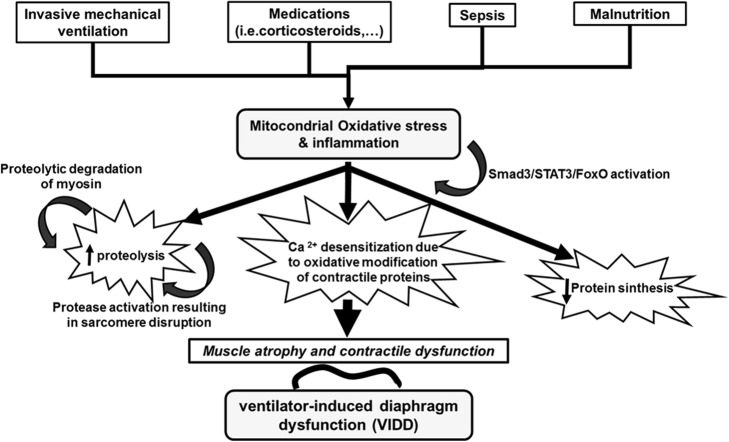
Fig. 1
Fig. 1
Summary of the current understanding of the molecular pathways contributing to ventilator-induced diaphragm dysfunction (VIDD) in critically ill patients. As shown, different conditions can lead to diaphragm atrophy via an imbalance between proteolysis and protein synthesis [11, 14], whereas remaining muscle proteins may be impaired by enhanced oxidation and dephosphorylation [–17]. Inflammation and oxidative stress are proposed to be the major drivers of these impairments [17]. In addition, certain drugs can impair neural drive and excitation-contraction coupling
Fig. 2
Fig. 2
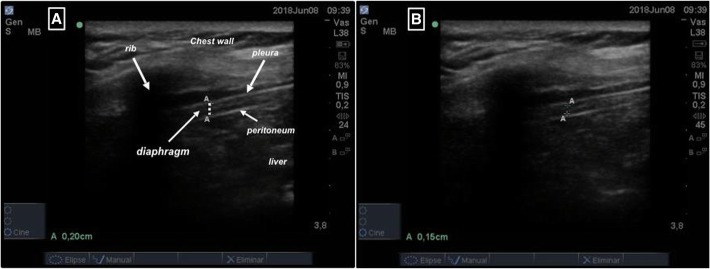
Representative ultrasound image at the zone of apposition in B-mode view of the diaphragm during inspiration (a) and expiration (b). The diaphragm is identified as a 3-layer comprising two hyperechoic lines representing the pleural and peritoneal membranes and a middle hypoechoic layer representing the diaphragmatic muscle itself (with permission of the Intensive Care Unit from the Hospital Universitario de Getafe)
Fig. 3
Fig. 3
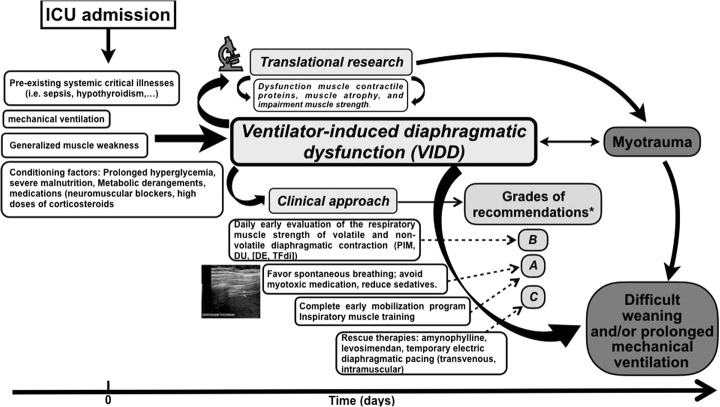
A practical approach for the management of diaphragm dysfunction in critically ill patients. Abbreviations: DU, diaphragmatic ultrasound; DE, diaphragmatic excursion; PIM maximum inspiratory pressure; TFdi, thickening fraction. Asterisk refers to reference [196]

References

    1. Esteban A, Frutos-Vivar F, Muriel A, Ferguson ND, Peñuelas O, Abraira V, et al. Evolution of mortality over time in patients receiving mechanical ventilation. Am J Respir Crit Care Med. 2013;188(2):220–230. doi: 10.1164/rccm.201212-2169OC. - DOI - PubMed
    1. Esteban A, Ferguson ND, Meade MO, Frutos-Vivar F, Apezteguia C, Brochard L, et al. Evolution of mechanical ventilation in response to clinical research. Am J Respir Crit Care Med. 2008;177(2):170–177. doi: 10.1164/rccm.200706-893OC. - DOI - PubMed
    1. Peñuelas O, Frutos-Vivar F, Fernández C, Anzueto A, Epstein SK, Apezteguía C, et al. Characteristics and outcomes of ventilated patients according to time to liberation from mechanical ventilation. Am J Respir Crit Care Med. 2011;184:430–437. doi: 10.1164/rccm.201011-1887OC. - DOI - PubMed
    1. Fan E, Needham DM, Stewart TE. Ventilatory management of acute lung injury and acute respiratory distress syndrome. JAMA. 2005;294:2889–2896. doi: 10.1001/jama.294.22.2889. - DOI - PubMed
    1. Slutsky AS, Ranieri VM. Ventilator-induced lung injury. N Engl J Med. 2013;369:2126–2136. doi: 10.1056/NEJMra1208707. - DOI - PubMed

LinkOut - more resources