


Continuity in Undergraduate Medical Education: Mission Not Accomplished
- PMID: 31346908
- PMCID: PMC6816620
- DOI: 10.1007/s11606-019-04949-0
Continuity in Undergraduate Medical Education: Mission Not Accomplished
Abstract
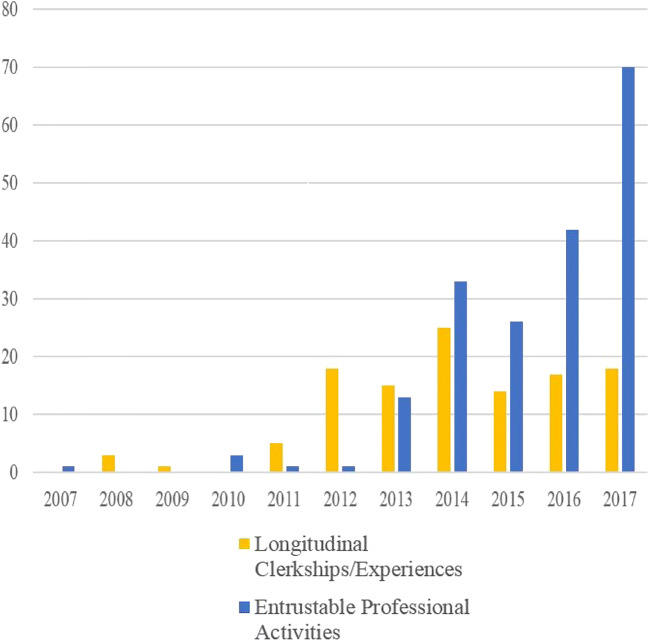
Evidence is mounting that longitudinal medical student clerkships provide better educational experiences than traditional block clerkship "silos." Education studies across institutions demonstrate positive effects of continuity on medical students, including creating patient-centered learning environments, improving fidelity of evaluations and feedback, improving medical student patient-centeredness, enabling more autonomous functioning in the clinical workplace, and increased recruitment and retention of students into primary care careers. Outcome studies show potential for longitudinal students to add value to patient care. This perspective piece summarizes the current evidence basis for longitudinal clerkships broken down by Kirkpatrick level (reactions, perceptions/attitudes, knowledge, behaviors, and patient benefits). Despite this evidence, expansion of longitudinal clerkships has been slow-i.e., fewer than half of current US medical schools offer one. While more recent curricular innovations center around Entrustable Professional Activities (EPAs), there are clear opportunities for medical schools to use longitudinal clerkships as a lens through which EPAs can be effectively evaluated. This perspective highlights the synergy between longitudinal clerkships and EPAs, showing that successful implementation of the former should empower the latter. While large, complex educational interventions are daunting tasks, change is needed. Regulatory organizations should mandate continuity-focused experiences for US medical graduates.
Keywords: Entrustable Professional Activities; Longitudinal Integrated Clerkship; continuity in medical education; undergraduate medical education; value-added medical education.
Conflict of interest statement
The authors declare that they do not have a conflict of interest.
Figures
References
-
- Commonwealth Fund. Envisioning the Future of Academic Health Centers. 2003. Available at: http://www.commonwealthfund.org/publications/fund-reports/2003/feb/envis.... Accessed October 23, 2018.
-
- Whitcomb ME. Redesigning clinical education: a major challenge for academic health centers. Acad Med. 2005;80(7):615–616. - PubMed
-
- Abelson J. The Disappearing Doctor: How Mega-mergers are changing the business of medical care. Available at: https://www.nytimes.com/2018/04/07/health/health-care-mergers-doctors.html. Accessed October 23, 2018.
-
- Gawande A. The Heroism of Incremental Care. 2017. Available at: https://www.newyorker.com/magazine/2017/01/23/the-heroism-of-incremental... . Accessed October 23, 2018.
-
- Hirsh DA, Ogur B, Thibault GE, Cox M. “Continuity” as an organizing principle for clinical education reform. N Engl J Med. 2007;356(8):858–866. - PubMed
