Impact of the 2015 Middle East Respiratory Syndrome Outbreak on Emergency Care Utilization and Mortality in South Korea
- PMID: 31347336
- PMCID: PMC6660446
- DOI: 10.3349/ymj.2019.60.8.796
Impact of the 2015 Middle East Respiratory Syndrome Outbreak on Emergency Care Utilization and Mortality in South Korea
Abstract
Purpose: In May 2015, South Korea experienced an epidemic of Middle East respiratory syndrome (MERS). This study investigated the impacts of MERS epidemic on emergency care utilization and mortality in South Korea.
Materials and methods: A natural experimental study was conducted using healthcare utilization and mortality data of the entire Korean population. The number of monthly emergency room (ER) visits was investigated to identify changes in emergency care utilization during the MERS epidemic; these trends were also examined according to patients' demographic factors, disease severity, and region. Deaths within 7 days after visiting an ER were analyzed to evaluate the impact of the reduction in ER visits on mortality.
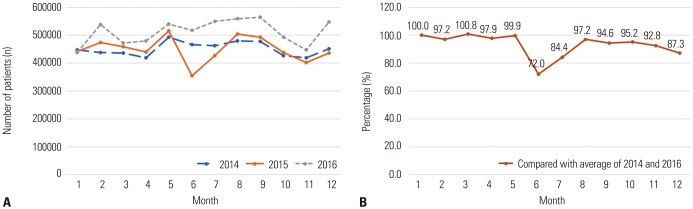
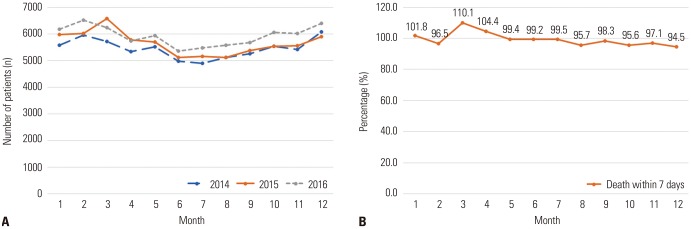
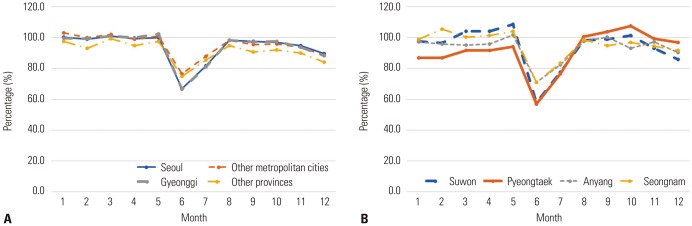
Results: The number of ER visits during the peak of the MERS epidemic (June 2015) decreased by 33.1% compared to the average figures from June 2014 and June 2016. The decrease was observed in all age, sex, and income groups, and was more pronounced for low-acuity diseases (acute otitis media: 53.0%; upper respiratory infections: 45.2%) than for high-acuity diseases (myocardial infarctions: 14.0%; ischemic stroke: 16.6%). No substantial changes were detected for the highest-acuity diseases, with increases of 3.5% for cardiac arrest and 2.4% for hemorrhagic stroke. The number of deaths within 7 days of an ER visit did not change significantly.
Conclusion: During the MERS epidemic, the number of ER visits decreased in all age, sex, and socioeconomic groups, and decreased most sharply for low-acuity diseases. Nonetheless, there was no significant change in deaths after emergency care.
Keywords: Middle East respiratory syndrome (MERS); communicable diseases, emerging; disaster planning; emergency service, hospital.
© Copyright: Yonsei University College of Medicine 2019.
Conflict of interest statement
The authors have no potential conflicts of interest to disclose.
Figures
References
-
- Fagbuyi DB, Brown KM, Mathison DJ, Kingsnorth J, Morrison S, Saidinejad M, et al. A rapid medical screening process improves emergency department patient flow during surge associated with novel H1N1 influenza virus. Ann Emerg Med. 2011;57:52–59. - PubMed
-
- Costello BE, Simon HK, Massey R, Hirsh DA. Pandemic H1N1 influenza in the pediatric emergency department: a comparison with previous seasonal influenza outbreaks. Ann Emerg Med. 2010;56:643–648. - PubMed
MeSH terms
LinkOut - more resources
Full Text Sources
Medical