


Unintentional error in formula preparation and its simulated impact on infant weight and adiposity
- PMID: 31347776
- PMCID: PMC6834868
- DOI: 10.1111/ijpo.12564
Unintentional error in formula preparation and its simulated impact on infant weight and adiposity
Erratum in
-
Correction to "Unintentional error in formula preparation and its simulated impact on infant weight and adiposity".Pediatr Obes. 2023 Nov;18(11):e13074. doi: 10.1111/ijpo.13074. Epub 2023 Aug 25. Pediatr Obes. 2023. PMID: 37622665 No abstract available.
Abstract
Background: Accelerated weight gain in infancy is a public health issue and is likely due to feeding behaviours.
Objectives: To test the accuracy of individuals to dispense infant formula as compared with recommended serving sizes and to estimate the effect of dispensing inaccuracy on infant growth.
Methods: Fifty-three adults dispensed infant formula powder for three servings of 2, 4, 6, and 8 fl oz bottles, in random order. The weight of dispensed infant formula powder was compared with the recommended serving size weight on the nutrition label. A novel mathematical model was used to estimate the impact of formula dispensing on infant weight and adiposity.
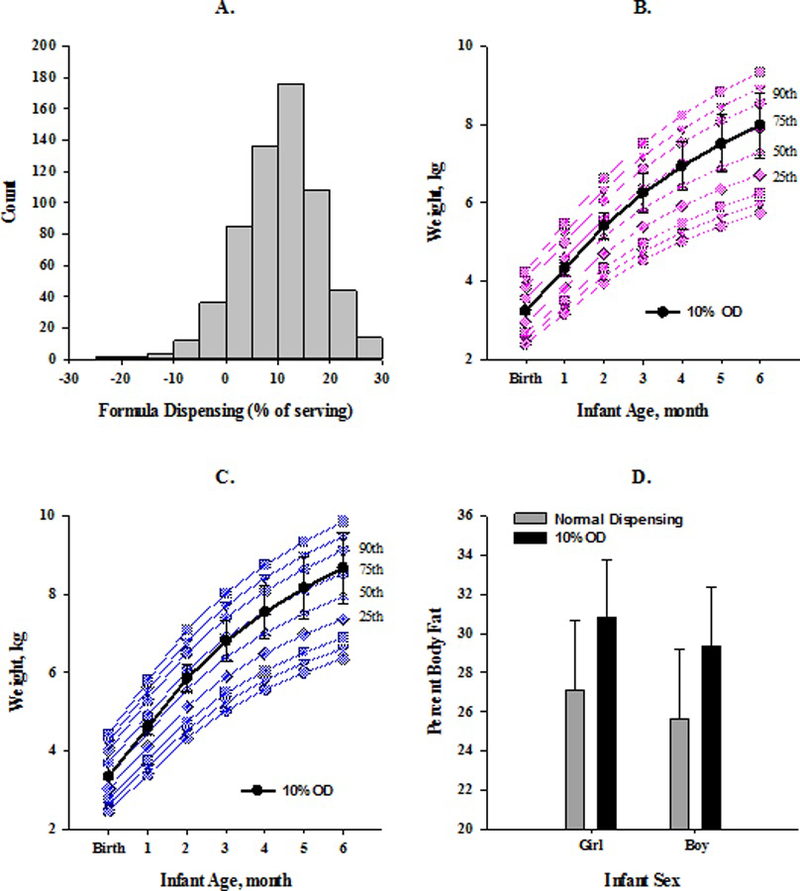
Results: Nineteen percent of bottles (20 of 636) prepared contained the recommended amount of infant formula powder. Three percent were underdispensed, and 78% of bottles were overdispensed, resulting in 11% additional infant formula powder. Mathematical modelling feeding 11% above energy requirements exclusively for 6 months for male and female infants suggested infants at the 50th percentile for weight at birth would reach the 75th percentile with increased adiposity by 6 months.
Conclusions: Inaccurate measurement of infant formula powder and overdispensing, which is highly prevalent, specifically, may contribute to rapid weight gain and increased adiposity in formula-fed infants.
Keywords: feeding; infant formula; infant growth; mathematical modelling.
© 2019 World Obesity Federation.
Conflict of interest statement
Figures
References
-
- Plagemann A, Harder T, Schellong K, Schulz S, Stupin JH. Early postnatal life as a critical time window for determination of long-term metabolic health. Best Pract Res Clin Endocrinol Metab 2012;26(5):641–653. - PubMed
-
- CDC. National Immunization Surveys 2012 and 2013 2014. http://www.cdc.gov/breastfeeding/data/reportcard.htm.
-
- Li R, Magadia J, Fein SB, Grummer-Strawn LM. Risk of bottle-feeding for rapid weight gain during the first year of life. Archives of pediatrics & adolescent medicine 2012;166(5):431–436. - PubMed
Publication types
MeSH terms
Grants and funding
LinkOut - more resources
Full Text Sources
Medical
