


Association of metabolic syndrome with the incidence of hearing loss: A national population-based study
- PMID: 31348810
- PMCID: PMC6660075
- DOI: 10.1371/journal.pone.0220370
Association of metabolic syndrome with the incidence of hearing loss: A national population-based study
Abstract
Background & aims: Sensorineural hearing loss (HL) is one of the most common public health problems, and its prevalence increases with increasing life expectancy. An association between HL and metabolic syndrome (MetS) is suspected. Although previous epidemiological studies have investigated the association between the two variables, there have been conflicting conclusions. Therefore, we aimed to evaluate the association between the presence of MetS-and individual components of MetS-and HL, using a longitudinal design and a large-scale population.
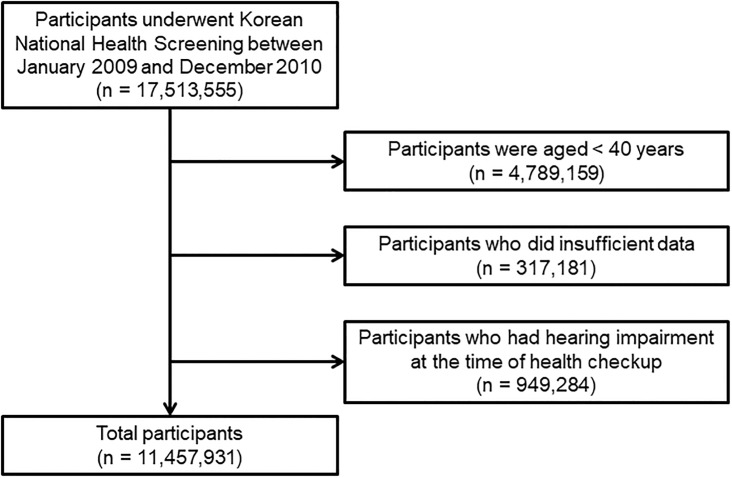
Methods: A total of 17,513,555 individuals who underwent national health screening between January 2009 and December 2010 were identified. Subject data from the Korean Health Insurance Review and Assessment Service were reviewed. A total of 11,457,931 subjects were ultimately included in the analysis. Baseline comorbidities were defined according to the ICD-10 code from the Korean Health Insurance Review and Assessment Service data. If the participants had an ICD-10 code for HL during the follow-up, they were defined as having incident HL. Criteria for MetS adhered to the revised National Cholesterol Education Program Adult Treatment Panel III.
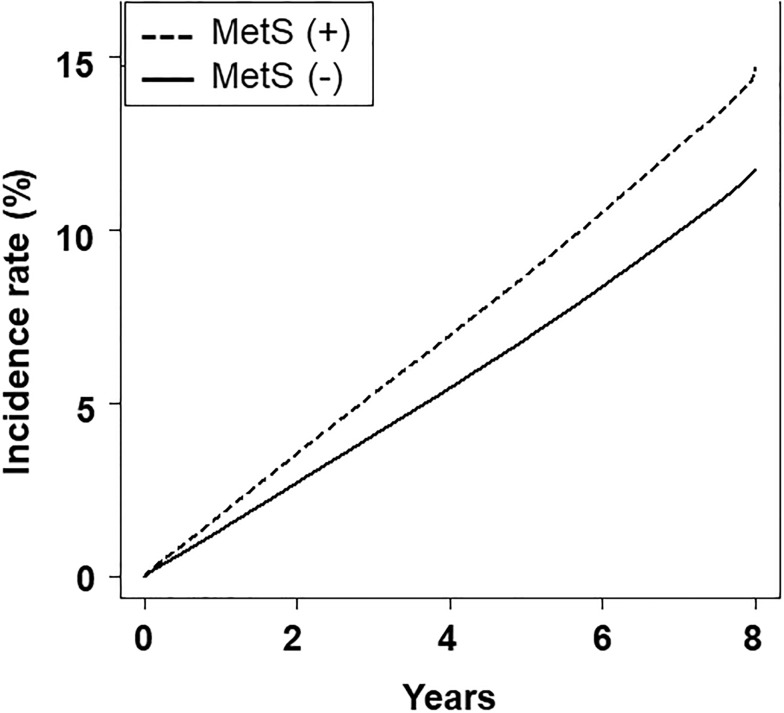
Results: There were 7,574,432 subjects without MetS and 3,883,499 with MetS. The incidence of HL in subjects without MetS and with MetS was 1.3% and 1.8% at 1 year, 4.1% and 5.2% at 3 years, and 6.8% and 8.6% at 5 years, respectively (P < 0.001). However, multivariate analyses revealed a negative association. Analyses according to the components of MetS demonstrated a positive association for those associated with dyslipidemia; however, the others exhibited an inverse association with HL. We also performed analyses using 4 groups according to the presence of MetS and the components of dyslipidemia. Univariate analysis revealed a positive association between the presence of MetS and HL; however, multivariate analysis revealed a positive association between the presence of dyslipidemia components and HL, regardless of the presence of MetS.
Conclusion: Among the components of MetS, the association between low HDL or high TG levels and HL was most apparent. It is useful to evaluate each MetS component in isolation, such as the presence of low HDL or high TG levels, rather than the presence of MetS as a cluster of components.
Conflict of interest statement
The authors have declared that no competing interests exist.
Figures
References
-
- Global Burden of Disease Study 2013 Collaborators. Global, regional, and national incidence, prevalence, and years lived with disability for 301 acute and chronic diseases and injuries in 188 countries, 1990–2013: a systematic analysis for the Global Burden of Disease Study 2013. Lancet. 2015;386:743–800. 10.1016/S0140-6736(15)60692-4 - DOI - PMC - PubMed
-
- World Health Organization. Deafness prevention. Geneva: World Health Organization; 2013; 30, September, 2018 http://www.who.int/pbd/deafness/news/Millionslivewithhearingloss.pdf?ua=1
-
- Grundy SM, Cleeman JI, Daniels SR, Donato KA, Eckel RH, Franklin BA, et al. Diagnostic and management of the metabolic syndrome: an American Heart Association/National Heart, Lung, and Blood Institute Scientific Statement. Circulation. 2005;112:2735–2752. 10.1161/CIRCULATIONAHA.105.169404 - DOI - PubMed
Publication types
MeSH terms
LinkOut - more resources
Full Text Sources
Medical
Miscellaneous
