


Decreased Quality of Life in Individuals with Type 2 Diabetes Mellitus Is Associated with Emotional Distress
- PMID: 31349552
- PMCID: PMC6695823
- DOI: 10.3390/ijerph16152652
Decreased Quality of Life in Individuals with Type 2 Diabetes Mellitus Is Associated with Emotional Distress
Abstract
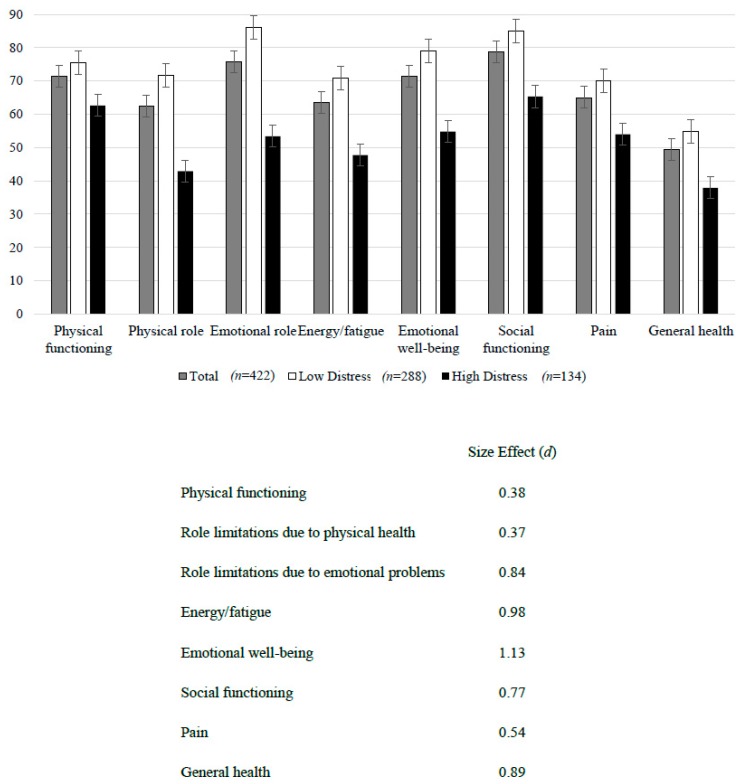
Background: individuals with type 2 diabetes show emotional distress as they learn how to cope with the disease. The emotional distress increases the possibility of complications in these patients. The aims of the present study were to evaluate the impact of the emotional distress in the quality of life of individuals with diabetes, and to investigate the demographic and clinical characteristics associated with the emotional distress of living with diabetes in a Mexican population. Methods: a total of 422 Mexican individuals with type 2 diabetes were recruited from the outpatient Diabetes Clinic of the Hospital Regional de Alta Especialidad Dr. Gustavo A. Rovirosa of Villahermosa, Tabasco. Demographic and clinical characteristics along with quality of life (SF-36) were assessed in these individuals. The emotional distress of living with diabetes was measured using the 5-item Problem Areas in Diabetes. Patients were divided according to the presence of high or low distress. Results: we identified that 31.8% (n = 134) of patients presented high diabetes-related emotional distress. We observed that hepatic diseases as comorbidities (p = 0.008) and diagnosis of major depression (p = 0.04) are factors associated with the emotional distress of living with diabetes. These patients showed a reduced quality of life in all dimensions (p < 0.001); the most affected dimensions were physical role (d = 0.37) and general health (d = 0.89) showing lower scores in comparison with patients with low emotional distress. Conclusions: our results suggest that Mexican individuals with type 2 diabetes mellitus show high emotional distress living with the disease and have a decreased quality of life. Therefore, it is necessary to decrease factors associated with the high emotional distress of living with diabetes in patients with type 2 diabetes.
Keywords: Mexican population; diabetes; distress; quality of life.
Conflict of interest statement
The authors declare no conflict of interest.
Figures
References
-
- Federation I.D. IDF Diabetes Atlas. International Diabetes Federation; Brussels, Belgium: 2015.
-
- DeFronzo R.A., Ferrannini E., Alberti K.G.M.M., Zimmet P., Alberti G. International Textbook of Diabetes Mellitus, 2 Volume Set. Volume 1 John Wiley Sons; Hoboken, NJ, USA: 2015.
-
- Molina Iriarte A., Acevedo Giles O., Yáñez Sandoval M.E., Dávila Mendoza R., González Pedraza Avilés A. Comparación de las prevalencias de duelo, depresión y calidad de vida asociados con la enfermedad entre pacientes con diabetes mellitus tipo 2 descontrolados y controlados. Rev. Espec. Médico-Quirúrgicas. 2013;18:13–18.
MeSH terms
LinkOut - more resources
Full Text Sources
Medical
