Review
. 2019 Jul 25;11(8):681.
doi: 10.3390/v11080681.

Current Findings on Gut Microbiota Mediated Immune Modulation against Viral Diseases in Chicken

Affiliations
Review

Current Findings on Gut Microbiota Mediated Immune Modulation against Viral Diseases in Chicken

Muhammad Abaidullah et al. Viruses. .

Abstract

Chicken gastrointestinal tract is an important site of immune cell development that not only regulates gut microbiota but also maintains extra-intestinal immunity. Recent studies have emphasized the important roles of gut microbiota in shaping immunity against viral diseases in chicken. Microbial diversity and its integrity are the key elements for deriving immunity against invading viral pathogens. Commensal bacteria provide protection against pathogens through direct competition and by the production of antibodies and activation of different cytokines to modulate innate and adaptive immune responses. There are few economically important viral diseases of chicken that perturb the intestinal microbiota diversity. Disruption of microbial homeostasis (dysbiosis) associates with a variety of pathological states, which facilitate the establishment of acute viral infections in chickens. In this review, we summarize the calibrated interactions among the microbiota mediated immune modulation through the production of different interferons (IFNs) ILs, and virus-specific IgA and IgG, and their impact on the severity of viral infections in chickens. Here, it also shows that acute viral infection diminishes commensal bacteria such as Lactobacillus, Bifidobacterium, Firmicutes, and Blautia spp. populations and enhances the colonization of pathobionts, including E. coli, Shigella, and Clostridial spp., in infected chickens.

Keywords: Bifidobacterium; E. coli; Lactobacillus; Shigella; chicken; commensal; gut-microbiota; pathobionts.


Conflict of interest statement

All authors declared have no conflict of interest.

Figures
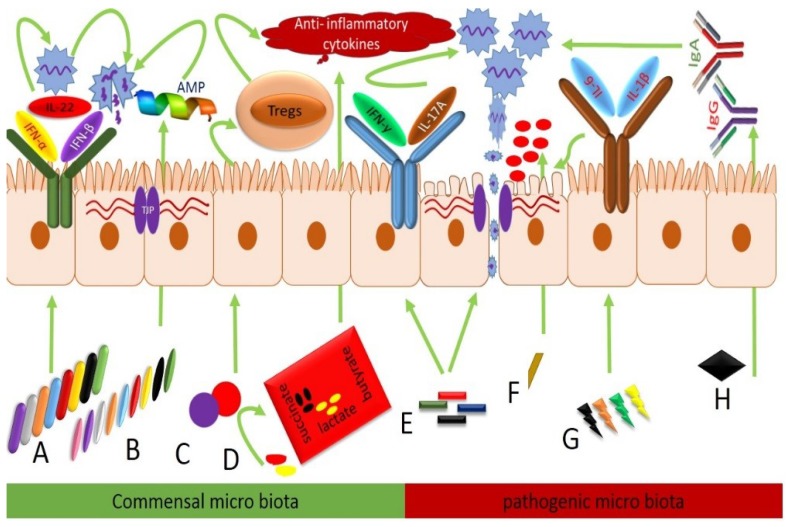
Figure 1
Figure 1
Regulation of different immune mechanisms by intestinal microbiota in AIV, IBDV, MDV, and NDV virus infected broiler chickens. (A) Collinsella, Faecalibacterium, Oscillibacter, Holdemanella, Pseudoflavonifractor, Anaerotruncus, Butyricoccus, and Bifidobacterium enhance the IFN-α, IFN-β, and IL-22 secretions, which control the virus replication by degrading the virus nucleus, as well as virus replication genes, and repair mucosal tissue damage. (B) Bacteroides, Candidatus, SMB53, Parabacteroides, Lactobacillus, Paenibacillus, Enterococcus, and Streptococcus spp. promote the antimicrobial peptides such as MUC, TFF, ZO, and tight junction proteins comprised of claudins, occludin, and zona occludens mRNA expressions and inhibit pathobiont colonization and translocation and suppress inflammation. (C) Clostridium XlVa and Firmicutes induce the T regulatory cells, which produce anti-inflammatory cytokines and suppress inflammation. (D) Faecalibacterium and Blautia spp. enhance butyrate succinate and lactate production, which provide energy and reduce inflammation. (E) Cluster XI, Salmonella, Escherichia, and Shigella are pathobionts. These pathogens decrease IFN-α, IFN-β, and IL-22 antimicrobial peptides such as MUC, TFF, ZO, and tight junction proteins comprised of claudins, occludin, and zona occludens mRNA expressions, increase the IFN- γ, IL-17A secretions that cause the mucosal inflammation, tissue damage Increased virus replication and fecal shedding. (F) Desulfovibrionaceae produce hydrogen sulfides and produce inflammation of mucosa. (G) Vampirovibrio, Clostridium cluster XIVb, and genus Ruminococcus induce the proinflammatory cytokines IL-6 and IL-1B, which produce GIT inflammation and leads to increased viral replication. (H) Salmonella typhimurium, Campylobacter jejuni decrease viral specific IgG and IgA production, which results in more viral shedding.

References

    1. Ley R.E., Peterson D.A., Gordon J.I. Ecological and Evolutionary Forces Shaping Microbial Diversity in the Human Intestine. Cell. 2006;124:837–848. doi: 10.1016/j.cell.2006.02.017. - DOI - PubMed
    1. Dethlefsen L., McFall-Ngai M., Relman D.A. An ecological and evolutionary perspective on human–microbe mutualism and disease. Nature. 2007;449:811. doi: 10.1038/nature06245. - DOI - PMC - PubMed
    1. Round J.L., Mazmanian S.K. The gut microbiota shapes intestinal immune responses during health and disease. Nat. Rev. Immunol. 2009;9:313. doi: 10.1038/nri2515. - DOI - PMC - PubMed
    1. Flint H.J., Scott K.P., Louis P., Duncan S.H. The role of the gut microbiota in nutrition and health. Nat. Rev. Gastroenterol. Hepatol. 2012;9:577. doi: 10.1038/nrgastro.2012.156. - DOI - PubMed
    1. Zhu G., Jiang Y., Yao Y., Wu N., Luo J., Hu M., Tu Y., Xu M. Ovotransferrin ameliorates the dysbiosis of immunomodulatory function and intestinal microbiota induced by cyclophosphamide. Food Funct. 2019;10:1109–1122. doi: 10.1039/C8FO02312C. - DOI - PubMed

Publication types

MeSH terms
