. 2019 Jul 25;8(3):103.
doi: 10.3390/antibiotics8030103.

Synergistic Action of Phage and Antibiotics: Parameters to Enhance the Killing Efficacy Against Mono and Dual-Species Biofilms

Affiliations

Synergistic Action of Phage and Antibiotics: Parameters to Enhance the Killing Efficacy Against Mono and Dual-Species Biofilms

Ergun Akturk et al. Antibiotics (Basel). .

Abstract

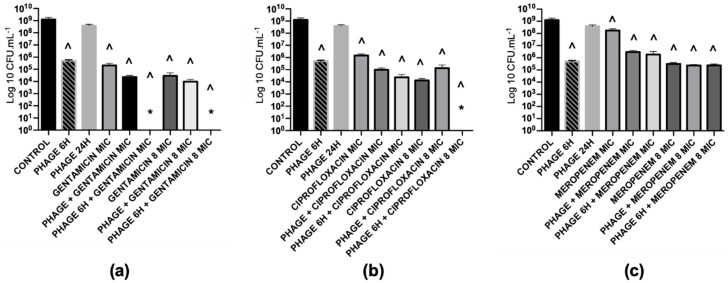
Pseudomonas aeruginosa and Staphylococcus aureus are opportunistic pathogens and are commonly found in polymicrobial biofilm-associated diseases, namely chronic wounds. Their co-existence in a biofilm contributes to an increased tolerance of the biofilm to antibiotics. Combined treatments of bacteriophages and antibiotics have shown a promising antibiofilm activity, due to the profound differences in their mechanisms of action. In this study, 48 h old mono and dual-species biofilms were treated with a newly isolated P. aeruginosa infecting phage (EPA1) and seven different antibiotics (gentamicin, kanamycin, tetracycline, chloramphenicol, erythromycin, ciprofloxacin, and meropenem), alone and in simultaneous or sequential combinations. The therapeutic efficacy of the tested antimicrobials was determined. Phage or antibiotics alone had a modest effect in reducing biofilm bacteria. However, when applied simultaneously, a profound improvement in the killing effect was observed. Moreover, an impressive biofilm reduction (below the detection limit) was observed when gentamicin or ciprofloxacin were added sequentially after 6 h of phage treatment. The effect observed does not depend on the type of antibiotic but is influenced by its concentration. Moreover, in dual-species biofilms it was necessary to increase gentamicin concentration to obtain a similar killing effect as occurs in mono-species. Overall, combining phages with antibiotics can be synergistic in reducing the bacterial density in biofilms. However, the concentration of antibiotic and the time of antibiotic application are essential factors that need to be considered in the combined treatments.

Keywords: Pseudomonas aeruginosa; Staphylococcus aureus; antibiotic; bacteriophage; biofilms; dual-species; sequential; simultaneous; synergy.


Conflict of interest statement

The authors declare no conflict of interest.

Figures
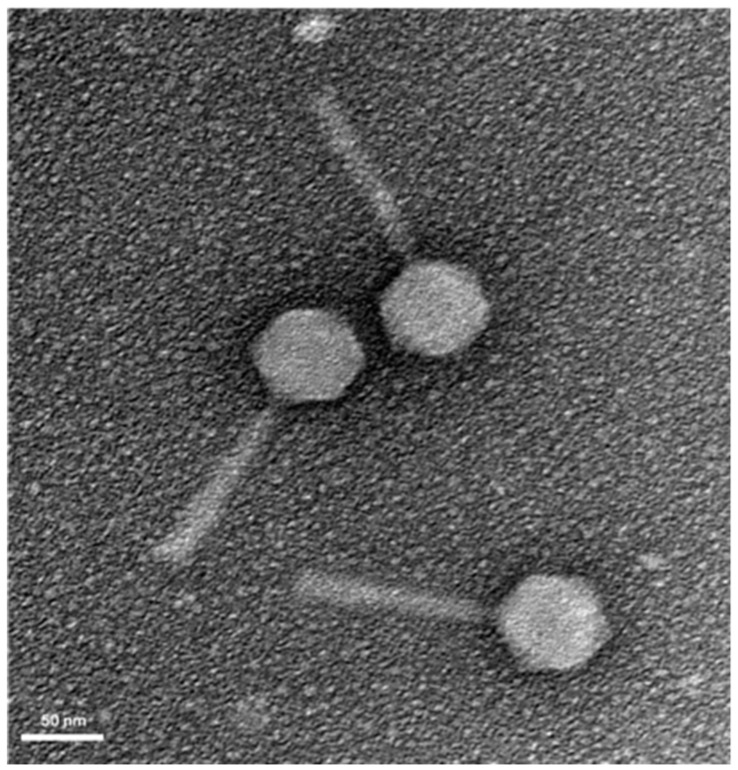
Figure 1
Figure 1
TEM image of P. aeruginosa specific phage EPA1 obtained by negative staining with 2% (w/v) uranyl acetate. Scale bar represents 50 nm.
Figure 2
Figure 2
Treatment of P. aeruginosa PAO1 48 h biofilms with different antimicrobial agents individually or in combinations; phage EPA1 and (a) gentamicin; (b) ciprofloxacin; and (c) meropenem for 24 h. A prefix PHAGE indicates EPA1 in MOI 1, 6 H and 24 Hindicates treatment time period for 6 and 24 h, MIC indicates the dose of antibiotics with 1-time MIC value of P. aeruginosa 8× MIC indicates the dose of antibiotics with 8-times MIC value of P. aeruginosa, PHAGE + antibiotic indicates simultaneous treatment, and PHAGE 6 H+ antibiotics indicates phage was added first then antibiotic was added with 6 h delay. * Under detection limit (<102). (^) Statistical differences between the control and treated biofilms were determined by two-way repeated-measures analysis of variance (ANOVA) with a Tukey’s multiple comparison test.
Figure 3
Figure 3
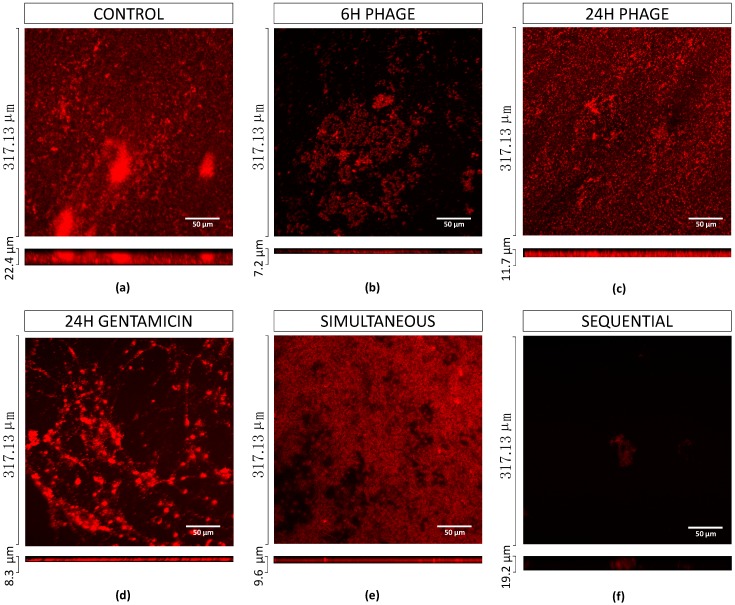
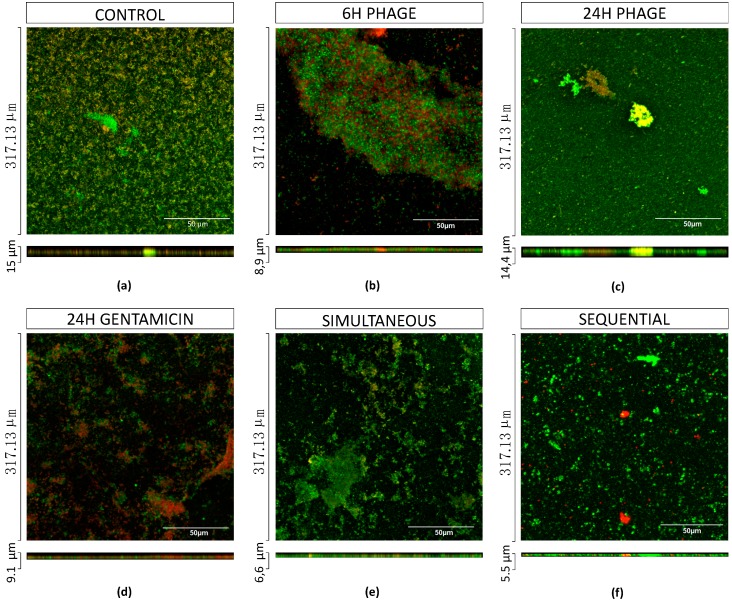
3D reconstructions of confocal stacks of images of mono-species P. aeruginosa biofilms. (a) Control, (b) 6 h phage treatment, (c) 24 h phage treatment, (d) 24 h Gentamicin treatment, (e) 24 h simultaneous treatment, (f) 24 h sequential treatment. All biofilms were stained with EPA1_TFP (with mCherry) recombinant protein. Scale bar represents 50 μm.
Figure 4
Figure 4
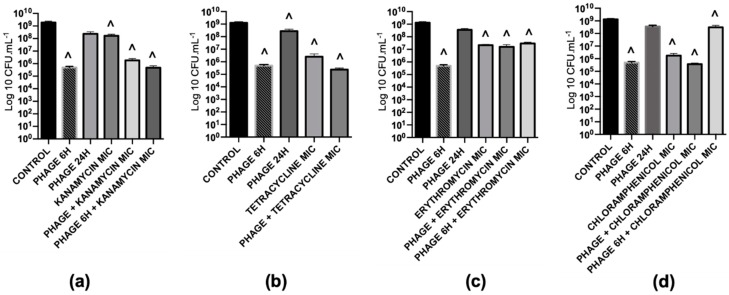
Treatment of P. aeruginosa PAO1 48 h biofilms with protein synthesis inhibitor antimicrobial agents individually or in combinations for 24 h. (a) Kanamycin is a 30S protein synthesis inhibitor; (b) Tetracycline is a 30S protein synthesis inhibitor; (c) Erythromycin is a 50S protein synthesis inhibitor; (d) Chloramphenicol is a 50Ss protein synthesis inhibitor. A prefix PHAGE indicates EPA1 in MOI 1, 6 H and 24 H indicates treatment time period for 6 and 24 h, MIC indicates the dose of antibiotics with 1-time MIC value of P. aeruginosa, PHAGE + antibiotic indicates simultaneous treatment and PHAGE 6 H + antibiotics indicates that phage was added first, then antibiotic was added with 6 h delay. (^) Statistical differences between the control and treated biofilms were determined by two-way repeated-measures analysis of variance (ANOVA) with a Tukey’s multiple comparison test.
Figure 5
Figure 5
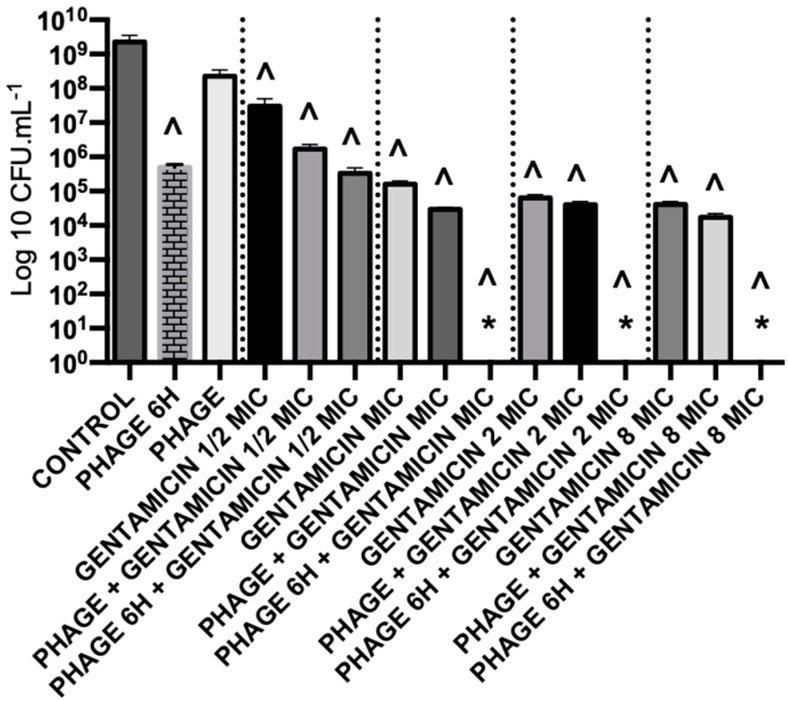
Treatment of P. aeruginosa PAO1 48 h biofilms with gentamicin at different concentrations. A prefix PHAGE indicates EPA1 in MOI 1, 1/2 MIC indicates the dose of antibiotics with 1/2× MIC value, MIC indicates the dose of antibiotics with 1× MIC value of P. aeruginosa, 2 MIC indicates the dose of antibiotics with 2× MIC value of P. aeruginosa, 8 MIC indicates the dose of antibiotics with 8× MIC value of P. aeruginosa, PHAGE + antibiotic indicates simultaneous treatment and PHAGE 6 H + antibiotics indicates phage was added first then antibiotic was added with 6 h delay. * Under detection limit (<102). (^) Statistical differences between the control and treated biofilms were determined by two-way repeated-measures analysis of variance (ANOVA) with a Tukey’s multiple comparison test.
Figure 6
Figure 6
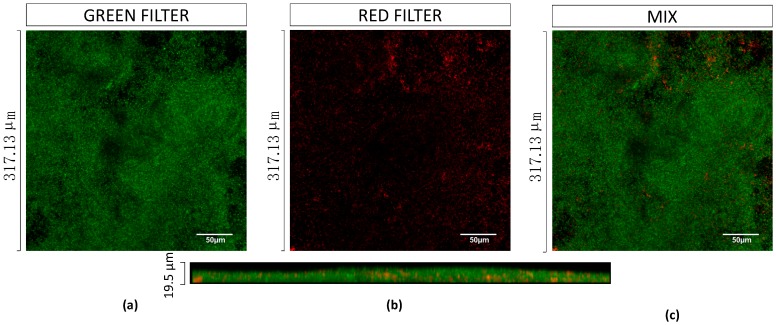
3D reconstructions of confocal stacks of images of dual-species of P. aeruginosa and S. aureus biofilms. (a) 48 h old intact biofilms were stained by using recombinant proteins, LM12_AMI-SH3 (with GFP) specific for S. aureus and (b)EPA1_TFP (with mCherry) specific for P. aeruginosa. (c) 48 h old intact biofilms were stained by using both recombinant proteins. Scale bar represents 50 μm.
Figure 7
Figure 7
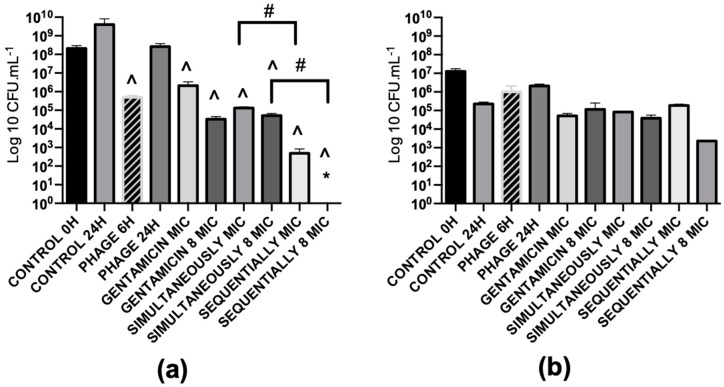
Treatment of 48 h dual-species biofilm. (a) P. aeruginosa number of viable cells. (b) S. aureus number of viable cells. A prefix PHAGE indicates EPA1 in MOI 1, 6 H and 24 H indicates treatment time period for 6 and 24 h, MIC indicates the dose of antibiotics with 1× MIC value of P. aeruginosa, 8 MIC indicates the dose of antibiotics with 8× MIC value of P. aeruginosa, PHAGE + antibiotic indicates simultaneous treatment and PHAGE 6 H + antibiotics indicates phage was added first then antibiotic was added with 6 h delay. * Under detection limit (<102). (^) Statistical differences between the control and treated biofilms. (#) Statistical differences between the simultaneously and sequentially treated biofilms. Statistical differences were determined by two-way repeated-measures analysis of variance (ANOVA) with a Tukey’s multiple comparison test.
Figure 8
Figure 8
3D reconstructions of confocal stacks of images of dual-species of P. aeruginosa and S. aureus biofilms. (a) Control, (b) 6 h phage treatment, (c) 24 h phage treatment, (d) 24 h Gentamicin with MIC treatment, (e) 24 h simultaneous treatment, (f) 24 h sequential treatment. 48 h old intact biofilms were stained by using LM12_AMI-SH3 (with GFP) and EPA1_TFP (with mCherry) recombinant proteins. Scale bar represents 50 μm.

References

    1. Røder H.L., Sørensen S.J., Burmølle M. Studying Bacterial Multispecies Biofilms: Where to Start? Trends Microbiol. 2016;24:503–513. doi: 10.1016/j.tim.2016.02.019. - DOI - PubMed
    1. Wolcott R.D., Rhoads D.D., Bennett M.E., Wolcott B.M., Gogokhia L., Costerton J.W., Dowd S.E. Chronic wounds and the medical biofilm paradigm. J. Wound Care. 2014;19:45–53. doi: 10.12968/jowc.2010.19.2.46966. - DOI - PubMed
    1. Römling U., Balsalobre C. Biofilm infections, their resilience to therapy and innovative treatment strategies. J. Intern. Med. 2012;272:541–561. doi: 10.1111/joim.12004. - DOI - PubMed
    1. Hall C.W., Mah T.-F. Molecular mechanisms of biofilm-based antibiotic resistance and tolerance in pathogenic bacteria. FEMS Microbiol. Rev. 2017;41:276–301. doi: 10.1093/femsre/fux010. - DOI - PubMed
    1. Lopes S.P., Ceri H., Azevedo N.F., Pereira M.O. Antibiotic resistance of mixed biofilms in cystic fibrosis: Impact of emerging microorganisms on treatment of infection. Int. J. Antimicrob. Agents. 2012;40:260–263. doi: 10.1016/j.ijantimicag.2012.04.020. - DOI - PubMed

LinkOut - more resources